Capacity in an escape room is the number of games you can actually run, not the number the clock allows. Every sellable slot has to hold the briefing, the game, the reset and a buffer, and the slot only earns money once it is booked, paid and staffed. Work that out per room, then connect it to the calendar, payments, waivers and reporting that decide whether the slot fills. That is how a booking and venue-management platform like Riddlio earns its place: the plan lives in one system, not in a spreadsheet that drifts away from the live schedule.
TL;DR
- Slots per room per day = open minutes ÷ (briefing + game + reset + buffer), rounded down. Never round up.
- Set slot length per room, not per venue. A 60-minute room and a 90-minute room do not share a grid.
- Your ceiling is fixed by room count and slot length. Most of the gain comes from filling the slots you already have, especially off-peak ones.
- Holds, deposits, waivers and no-show rules protect capacity. A slot that sits empty because of a lapsed hold is lost revenue.
- Track fill rate by day part and by room, not one blended utilisation number.
Table of Contents
- Start with the hard ceiling for one room
- Match slot length to each room
- Player limits and group sizes
- Turn the ceiling into a realistic plan
- Staff to the bookings, not to the hours
- Protect capacity with holds, deposits and waivers
- What to measure
- Where Riddlio fits
- A monthly capacity routine
- FAQ
- Sources
Start with the hard ceiling for one room
A room can only run as many games as fit inside your opening hours. The formula is simple:
Slots per day = open minutes ÷ minutes per slot, rounded down
Minutes per slot is the briefing, the game, the reset and any turnover buffer you add. Rounding down matters. If you open for 720 minutes and each slot takes 75, you get 9.6. You can sell 9 games. Calling it 10 schedules a slot that has only 60 of the 75 minutes it needs.
A worked example (illustrative, not a benchmark)
Take one room open 10 hours, so 600 minutes:
| Setup | Minutes per slot | Slots per day |
|---|---|---|
| 60-minute game, 15-minute reset | 75 | 8 |
| Same room, plus a 10-minute briefing | 85 | 7 |
| Same room, briefing, and a 20-minute reset because props need rebuilding | 90 | 6 |
The last game of the day needs no reset, which can sometimes squeeze in one more slot, so check the arithmetic against your real closing time. The point is that ten minutes of hidden time per game costs you a full slot per room per day. Over a week, that is seven slots on a single room.
Be honest about what goes into the clock. The briefing, hints, the photo at the end and the walk out all come out of the same minutes as the game. Escape Game Owners puts it as capacity being what you can run, not what you could run, and that is the right test for every number below.
Reset time is your most valuable input
In a 2018 to 2019 owner survey of 206 escape room businesses, most respondents reported resets of 10 to 15 minutes, with a mean of 12. If your own reset runs well beyond that, the first fix is not more marketing. Time a handful of real resets per room, with a different staff member each time, and set the slot length to what actually happens. Then review planned against actual monthly.
Match slot length to each room
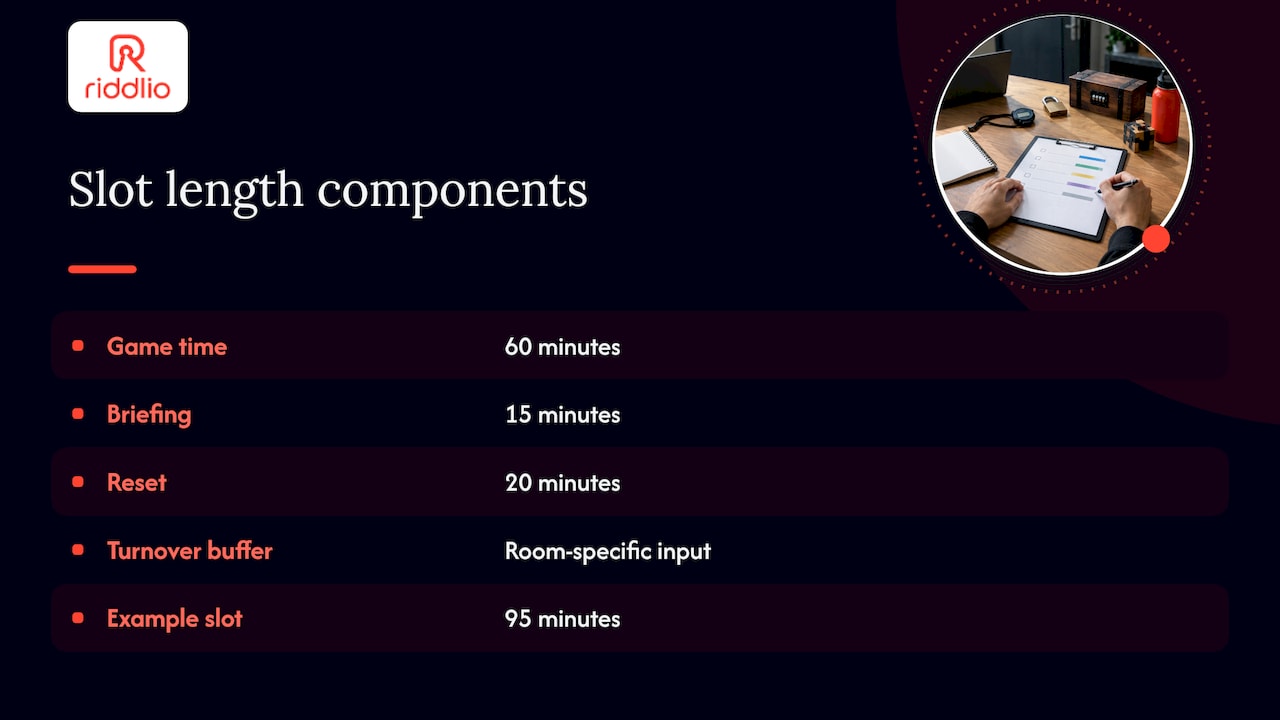
Do not copy one grid across the venue. A room with a 60-minute game, a 15-minute briefing and a 20-minute reset needs a 95-minute slot. A room with a 90-minute game and a heavy reset needs far more. Build each room’s schedule from four inputs: game length, briefing, reset and turnover buffer.
On the staffing side, a room with an easy reset can run back-to-back with one game master. Two rooms starting at the same time cannot, because the briefing and the reset for each one happen in the same few minutes. Stagger start times across rooms by 15 to 30 minutes where you can, so one person can brief, start and reset without collisions. Our 90-day multi-room scheduling plan walks through how to do this across several rooms.
Player limits and group sizes
Your maximum group size is a design and safety decision first, and a revenue decision second. It also differs sharply from the group size you really get.
The same owner survey found that 84.95% of venues allowed maximum teams of 7 to 12 players, while 63.05% reported actual average teams of 2 to 5. Plan revenue around the average, not the maximum. If you price per player and your average group is four, a room you advertise for eight is not a room you fill with eight.
Scott Nicholson’s State of Escape research found that about 60% of facilities give each group a private room, and that in North America about 60% still place small groups of strangers together, compared with roughly 20% in Asia and Europe. Public games raise fill rates for slots that would otherwise run with two or three players. They also change what guests expect, so label them clearly at booking.
Practical rules for setting limits:
- Set a minimum and a maximum for every room, based on the puzzle flow and the physical space.
- Set a price or price tier for each group size band, so a small group still covers the slot.
- Decide whether a room can ever take a second party, and state it before checkout.
- Keep a separate rule for large groups and events, because they take more than one room at once.
With Riddlio you set room schedules and player limits in the online booking calendar, so guests can only book within the limits you set.
Turn the ceiling into a realistic plan
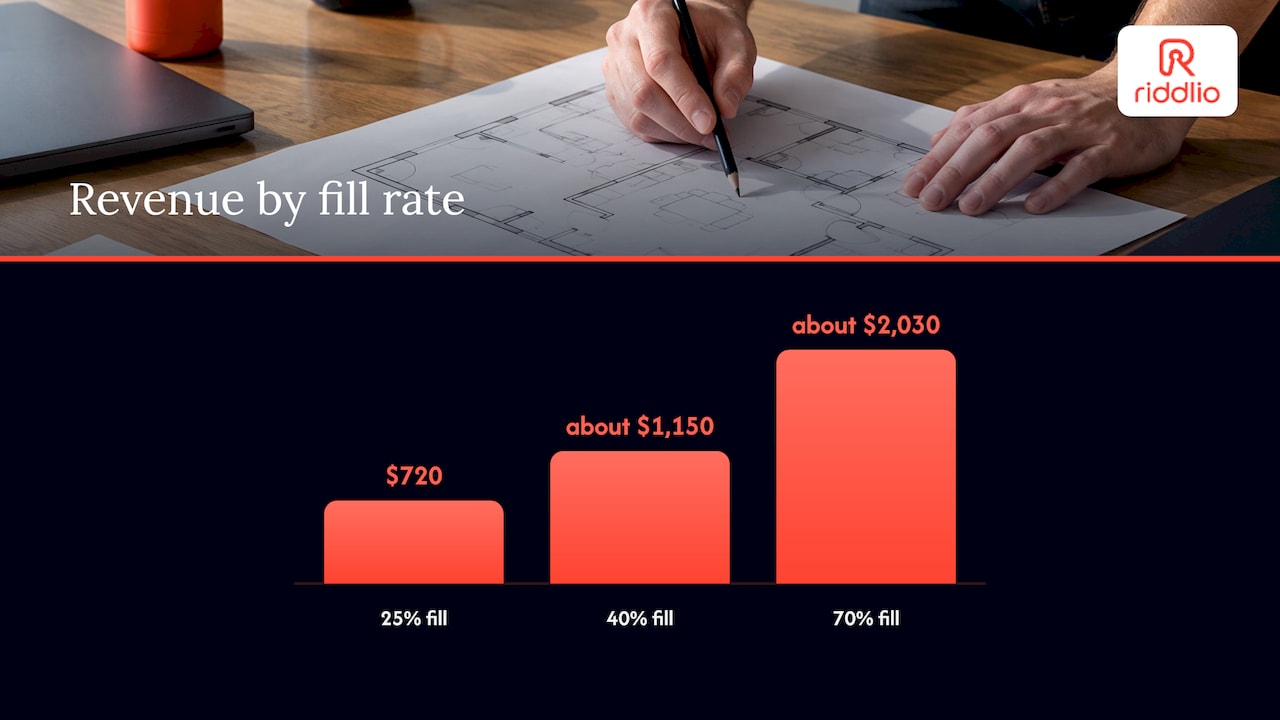
The ceiling is the maximum. Demand is the real constraint. Take an illustrative three-room venue with 8 slots per room, which is 24 slots on a Saturday. If the average booking is four players at $30, each slot is $120.
| Fill rate | Slots sold | Revenue (illustrative) |
|---|---|---|
| 25% | 6 | $720 |
| 40% | about 10 | about $1,150 |
| 70% | about 17 | about $2,030 |
Those numbers are an example of the arithmetic, not a forecast. What they show is that fill rate moves revenue, and a fill rate target must be set per day part. Weekday afternoons and Saturday evenings are different businesses.
Operators describe this the same way. In a September 2026 interview with the owner of a seven-room venue, he said not all capacity is created equal and that a weekday 9am slot is unlikely ever to sell. He also noted that most reservations land after 5pm. So block or close the hours that will not sell, and put your effort into the slots that can.
One published case study found The Epic Escape Room running at about 70% capacity utilisation while closed on Mondays and Tuesdays. Closing the weakest days can be part of a capacity plan, not a retreat from one.
Use price to shape demand
When peak slots are full and weekday slots are empty, the lever is price, not another room. Dynamic pricing lets you set peak, off-peak and group pricing so that a quiet slot costs less and a busy one costs more. For a deeper look at filling the nights that are currently half empty, read our slot utilisation playbook, and for the numbers that tell you whether each room pays its way, revenue per room.
Staff to the bookings, not to the hours
Staffing does not raise your ceiling. A room with 8 slots has 8 slots however many people stand in the lobby. Staffing decides whether you can run the slots you sell.
A workable rule of thumb: one game master can run back-to-back games in one room, two rooms usually need two people, and venues with three or more rooms often need more per shift. Weekends concentrate demand, so roster from your booked games per day of week, not from an even spread.
Riddlio includes staff scheduling in its operational tools, so the roster can sit next to the room calendar. Check the plan you are considering on the pricing page for what each tier includes.
Protect capacity with holds, deposits and waivers
A slot can be lost long before game day. Three leaks cost operators the most.
Holds that never expire. If a guest can reserve a slot and walk away, you have a full-looking calendar and an empty room. Set holds on a clock. As a starting point, Escape Game Owners suggests 24 hours for weekend slots and 48 for weekday slots.
Unpaid bookings. A payment up front confirms the slot. Whether you charge a deposit or the full amount is a business choice with a real effect on no-shows, and we cover the trade-off in our deposit versus full payment test. Whatever you pick, label it honestly: an upfront booking payment and a security deposit are different things, and your terms should say which one you take.
No-shows and late arrivals. Publish the reschedule window, the late-arrival rule and what happens to the payment before checkout, so guests agree to it at the point of booking. Our guides on cancellation policy and booking form design cover the wording and the form checks that cut no-shows.
Then the arrival. Send the waiver 24 to 48 hours ahead so check-in does not eat into the briefing, and send a reminder. Riddlio handles digital waivers and SMS reminders. SMS usage is charged separately from the subscription, so budget for it by volume.
What to measure
A single utilisation figure hides the problem. Track these instead, by room and by day part:
- Sellable slots available, after closures and blocked hours.
- Fill rate: slots booked ÷ sellable slots.
- Average group size against your maximum.
- Revenue per slot and per room.
- Planned versus actual slot length, and the share of games that start on time.
- No-show and late-cancellation rate.
- Lead time: how many days ahead peak slots sell.
Targets vary, so avoid chasing a number from another venue. Instead, compare each of your rooms and day parts against your own history. Change one thing a month, either the schedule or the roster, so you can tell what worked.
If you run several venues, put them on the same definitions: same slot length rule, same fill rate calculation, same day parts. Only then can you see which location has a capacity problem and which has a demand problem. A site that is full on Saturdays and empty on Tuesdays needs different help from one that is half empty all week.
Where Riddlio fits
Capacity planning only works if the plan and the live calendar are the same thing. Riddlio is built by escape room operators and connects room availability, bookings, payments, waivers, guest communications and reporting. Plans are billed as a flat monthly subscription with no booking commission: Starter is $29 per month, Pro is $79, Unlimited is $199, and Enterprise has no published price. Payment provider fees and SMS usage are separate. See the pricing page for what each plan includes, or read about the escape room booking system and management software.
If you are comparing tools first, the guide to choosing booking software lists the questions to ask.
A monthly capacity routine
- Time five resets per room and update slot lengths.
- Recalculate slots per room per day, rounding down.
- List your day parts and mark the ones you will not sell. Close or discount them.
- Check hold expiry, deposit rules and the no-show policy.
- Review fill rate, average group size and on-time starts.
- Change the schedule or the roster, not both.
FAQ
How many games can one escape room run per day?
Divide your open minutes by the full slot length (briefing, game, reset and buffer) and round down. A room open 600 minutes with a 75-minute slot runs 8 games. Add a 10-minute briefing and it drops to 7.
What is a good fill rate for an escape room?
It depends heavily on the day and hour. Peak weekend evenings fill far more readily than weekday daytime, so set targets by day part and compare against your own history. A blended average tells you very little.
Does adding staff increase capacity?
No. Slot length and room count set the ceiling. Staff make sure you can run the slots you sell on time. To raise the ceiling you shorten resets, change opening hours or add a room.
Should I let strangers share a room to fill slots?
It can fill small-group slots, and about 60% of North American facilities do it, according to Scott Nicholson’s research. Whether it suits your guests depends on your audience. If you do it, state it clearly at booking.
Sources
- State Of Escape Room Industry Survey 2019 (Owner’s Survey)
- The State of Escape: Escape Room Design and Facilities
- Starting an escape room right: access, capacity and cash
- Scheduling escape room work so nothing slips
- Buy a Business with Your Tax Bill (Acquiring Minds)
- The Epic Escape Room: Choosing the Best Option for Growth