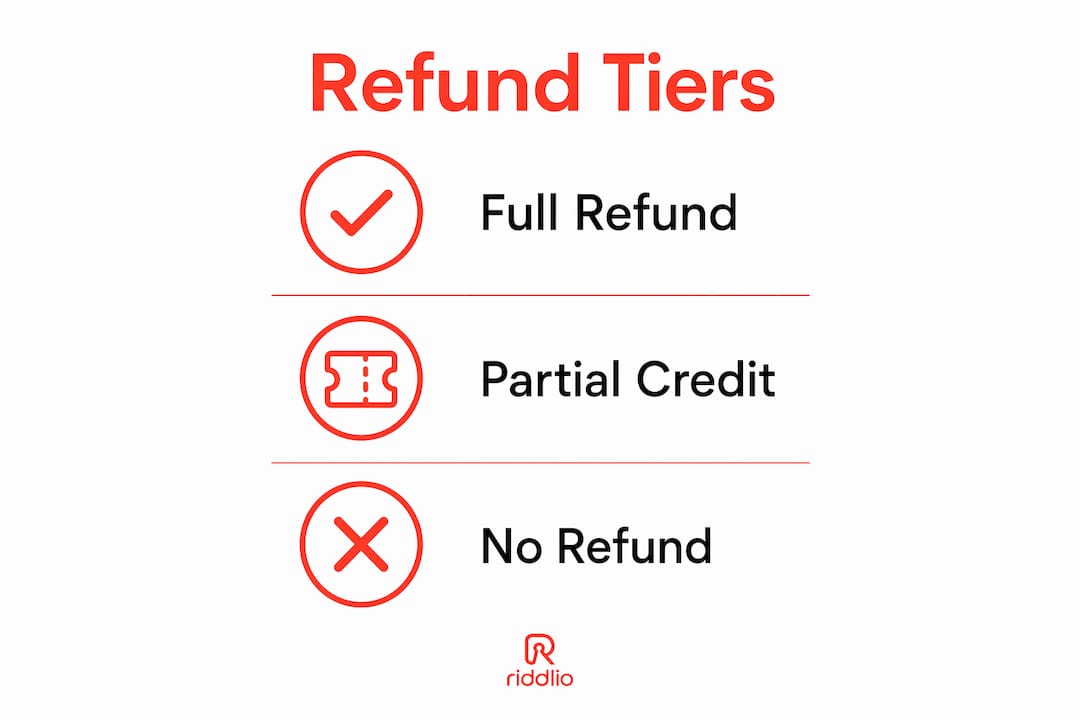
Most Australian escape rooms follow a tiered cancellation structure that gives you a full refund with 48 or more hours’ notice, a booking credit for cancellations in the 24–48 hour window, and nothing back if you cancel within 24 hours. That’s the short version. Here’s what the full picture looks like:
- 48+ hours before your session: Full refund to your original payment method
- 24–48 hours before: Booking credit only, no cash refund
- Under 24 hours: No refund, no credit in most cases
- No-show: Full forfeiture of your payment, no exceptions
- Rescheduling: Usually permitted once, with at least 24–48 hours’ notice
- Late arrival: Sessions may be shortened or cancelled after a 10–15 minute grace period
- Policy agreement: Most venues require you to acknowledge terms at booking, which makes those terms enforceable
These are the norms across the industry. Individual venues vary, so always read the specific terms before you pay.
What standard cancellation windows and refund conditions look like
Australian escape rooms generally apply a three-tier refund structure: full refund for cancellations 48 or more hours out, credit only in the 24–48 hour window, and no refund inside 24 hours. Some venues extend the full-refund window to one week, applying a 50% cancellation fee for anything less than seven days’ notice and no refund at all within 24 hours.

Refunds, when they apply, go back to your original payment method. Credits are typically valid for a set period, often 30 days, though this varies by venue. For multi-room bookings, partial cancellation fees may apply per room if your group shrinks below the minimum player count required to fill each room.
Australian consumer law requires that refund and cancellation terms be disclosed clearly before payment. Venues that bury their policy in fine print face a harder time enforcing fees if a dispute reaches Consumer Affairs.
No-show and late arrival penalties
A no-show is exactly what it sounds like: your party doesn’t arrive, or arrives too late to play. Most venues designate a booking as a no-show if no member of your group has arrived within 15 minutes of the scheduled start time. At that point, the full booking fee is forfeited with no refund offered.
Late arrivals that fall inside the grace period may still face a shortened session. The venue won’t hold up the next group’s booking to give you extra time, so a 10-minute delay can cost you 10 minutes of gameplay. Some operators will turn a late group away entirely if the delay would make the session unworkable.
- No-show threshold: typically 15 minutes after start time
- Full payment forfeited on no-show, regardless of deposit or full-payment structure
- Late arrivals may receive a shortened session or be declined entry
- Deposits do not protect you from no-show penalties
Pro Tip: Set a calendar reminder for 90 minutes before your session. If something comes up, you still have time to contact the venue and potentially reschedule rather than forfeit your payment.
How rescheduling works and what to expect
Operators generally prefer offering a one-time reschedule over issuing a refund. It keeps revenue intact and gives you a second chance at the experience. The catch is that rescheduling windows are usually tighter than cancellation windows: many venues require at least 24 hours’ notice to reschedule, and some ask for 48.
- One-time reschedule is the norm; a second request is rarely granted
- Rescheduling within the late-cancellation window may still incur a fee
- Once a booking has been rescheduled, it typically becomes ineligible for any refund
- Group size conditions may apply: if your group shrinks significantly, the reschedule may not be honoured at the original price
- Self-service cancellation links in confirmation emails let you reschedule without calling the venue
The distinction between a cancellation and a reschedule matters. Venues treat them differently, and choosing the wrong option can cost you your credit.
Best practices for managing cancellation policies at escape rooms
Clear, published policies reduce disputes before they start. Requiring explicit acknowledgment via a checkbox at booking, not just a link buried in the footer, makes your terms far easier to enforce if a customer later claims they weren’t aware.
- Display cancellation terms on the booking page, in confirmation emails, and in SMS reminders
- Require a checkbox or active agreement before payment is processed
- Define emergency grace periods separately from standard cancellation rules so staff aren’t making ad hoc decisions
- Use deposits combined with automated reminders: deposits paired with SMS reminders reduce no-shows by up to 60%
- Offer one-time rescheduling as a goodwill gesture rather than a blanket policy
- Align all terms with Australian Consumer Law, particularly around disclosure before payment
Pro Tip: Automated SMS reminders sent 48 hours and again 24 hours before a session prompt customers to cancel or confirm in time. That window is exactly when most last-minute no-shows can still be avoided.
Private vs public sessions: how cancellation terms differ
Private bookings carry stricter cancellation terms than public sessions, and for good reason. When you book a private room, the venue blocks that slot entirely for your group. A late cancellation leaves them with an unsellable timeslot and no way to fill it. Expect full forfeiture of your deposit or payment for cancellations inside 24 hours on private bookings.
Public sessions, where your group joins others to fill a room, give venues more flexibility. A cancellation from one party doesn’t necessarily kill the session. Some operators apply a lighter fee structure for public bookings, or allow cancellations up to the session start time if the room still has enough players. Always check which session type you’ve booked before assuming the same rules apply.
Exceptional circumstances and COVID-era policy changes
COVID-19 pushed most Australian escape rooms to adopt more flexible cancellation terms, and many venues kept those changes. Force majeure clauses now appear more commonly in booking terms, covering government-mandated closures, severe weather, and public health orders. Under these conditions, venues typically offer a full credit or reschedule rather than a cash refund.
For personal emergencies, documented medical situations, or severe weather affecting your travel, most operators will waive standard fees at their discretion. The key word is documented: a phone call explaining the situation is a start, but a medical certificate or similar evidence strengthens your case considerably. Contact the venue as early as possible rather than waiting until after the session time has passed.
How to contact a venue and what timelines to expect
Cancellation methods vary by venue, but the most common options are a self-service link in your confirmation email, a direct phone call during business hours, or an email to the bookings address. Most venues do not accept cancellations via social media.
Confirmation of your cancellation should come back to you in writing, either by email or via a portal notification. If you don’t receive confirmation within a few hours, follow up. A cancellation is only effective once the venue has acknowledged it, not when you sent the request.
Refunds, where applicable, typically process within 5–7 business days depending on your bank and the payment method used.
Common disputes and how to resolve them
The most frequent dispute is a customer claiming they weren’t aware of the cancellation terms. Venues with a checkbox at booking have a clear record of agreement; venues without one face a harder argument. If you believe a fee was applied unfairly, start by contacting the venue directly with your booking confirmation and a clear explanation.
If the venue won’t budge and you believe Australian Consumer Law was breached, Consumer Affairs in your state is the next step. Victoria, NSW, and Queensland each have their own consumer protection bodies, but the underlying rights are consistent nationally under the Australian Consumer Law framework. Credit card chargebacks are a last resort and should only be used when a genuine breach has occurred, not simply because you changed your mind.
Riddlio gives escape room operators full control over cancellation management
Running a venue means setting policies that protect your revenue without alienating your customers. Riddlio is built specifically for escape room operators who want that balance without the manual overhead. You set your own cancellation and refund rules, including tiered windows, deposit requirements, and credit versus cash refund conditions. Customers can log in and manage their own bookings, cancellations, and reschedules within the rules you define, which cuts admin time and reduces disputes.
Automated SMS and email reminders go out at the intervals you choose, prompting customers to act before the cancellation window closes. Payment processing and refunds are handled inside the same platform, so there’s no jumping between systems when a cancellation comes through. The online booking calendar gives you a real-time view of every slot, every change, and every no-show, all in one place.
Key takeaways
Most Australian escape rooms apply a tiered cancellation structure: full refund with 48 or more hours’ notice, credit only in the 24–48 hour window, and no refund inside 24 hours.
| Point | Details |
|---|---|
| Standard cancellation window | Full refund requires 48+ hours’ notice; credits apply in the 24–48 hour window; no refund inside 24 hours. |
| No-show threshold | Bookings are treated as no-shows 15 minutes after start time, with full payment forfeited. |
| Rescheduling limit | Most venues allow one reschedule with sufficient notice; a rescheduled booking is rarely eligible for a refund. |
| Deposits reduce no-shows | Deposits combined with SMS reminders help reduce no-shows significantly. |
| Riddlio for operators | Riddlio lets venues set custom cancellation rules and gives customers self-service control within those rules. |