A corporate booking is not a bigger birthday party. It has a buyer who is not the player, a headcount that moves, a quote, a deposit, often an invoice, and a group too large for one room. Venues that win this work treat it as its own pipeline, with a written trigger for every stage, and run it in one system that ties together the calendar, payments, waivers and guest messages. That is what Riddlio is built for, and this playbook shows the routine, stage by stage, with real examples from US venues.
TL;DR
- Run corporate enquiries on a separate track from public bookings: own form, own quote, own deposit rule, own reminders.
- Match group size to a format before you quote. Venues commonly split groups of 40 or more into two waves or run several rooms at once.
- Count a group as booked only when the deposit has cleared, and give every quote an expiry date.
- Send the waiver link and arrival details with the confirmation, then remind again close to the date.
- Review corporate revenue, lead time and repeat rate every month, per location if you run more than one.
Table of Contents
- Why corporate groups need their own booking path
- Step 1: Capture the enquiry with the right fields
- Step 2: Match group size to rooms and sessions
- Step 3: Quote, deposit and invoice
- Step 4: Confirm, collect waivers and remind
- Step 5: Run arrival and check-in for a big group
- Step 6: Follow up and win the repeat booking
- Step 7: Report on corporate work every month
- What the Riddlio plans cost
- A one-page corporate booking checklist
- FAQ
- Sources
Why corporate groups need their own booking path
A public booking is a self-serve purchase: pick a slot, pay, play. A corporate booking is a small sales process. The person enquiring is an office manager or HR coordinator who needs a price they can take to a budget holder, a date their team can attend, and sometimes an invoice rather than a card receipt.
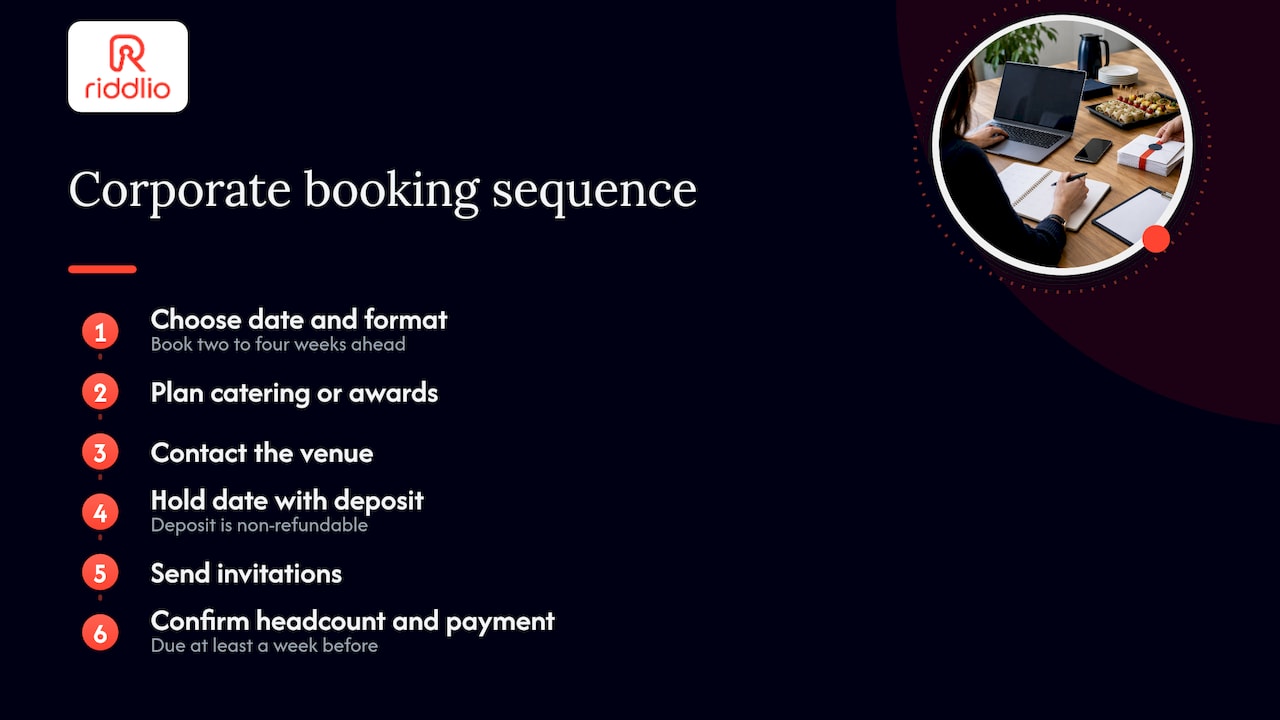
That changes what the venue must collect and promise. Quest Room’s FAQ shows the typical shape: a weekday date and format are chosen, catering or awards are planned, the venue is contacted, and the date is held with a non-refundable deposit. Invitations go out, then final headcount and final payment are due at least a week before the event. It recommends booking two to four weeks ahead, depending on the season.
Notice what is missing: an instant online checkout. Quest Room says corporate packages are arranged personally by staff and that it provides an invoice for all corporate events. Your online calendar still matters, because it shows which rooms and times are free before you promise anything, but the sale happens through a short conversation. Your software should support that conversation, not replace it.
Step 1: Capture the enquiry with the right fields
A generic contact form produces a dozen emails of back and forth. A corporate enquiry form should ask for what you need to quote in one pass.
Escape Room Madness in New York says that to quote a corporate event it needs the preferred date and time, headcount, rooms of interest and any billing requirements such as invoices or purchase orders. Add the fields that protect your calendar:
- Company name and the contact’s role (the person enquiring may not be the one who approves the spend).
- Headcount as a range, plus a backup date.
- Event type: team building, client entertainment, end-of-year party, onboarding.
- Whether they want food, drinks or lobby time before and after.
- Billing needs: card, invoice or purchase order, and any tax-exempt status.
- How they found you, so you know which channel produces corporate leads.
An agency that writes about corporate inquiry tracking suggests a control sheet with company, contact role, headcount range, target date, rooms required, quote amount, deposit percentage, cancellation terms, marketing source and pipeline stage (AdvisorPPC). Whatever tool you use, the point is that every enquiry has a stage and nothing lives only in someone’s inbox. If you are planning the packages and extras you will offer, a corporate event design guide is a useful companion for thinking about what planners expect around the activity itself.
Online booking with Riddlio’s online booking calendar keeps live availability in one place, so when an enquiry arrives you can see at a glance which rooms and times are open for the dates the client asked about.
Step 2: Match group size to rooms and sessions
Most escape rooms hold roughly 4 to 12 players. A 30-person team outing therefore means several rooms at once or several waves. Decide your formats in advance so you can quote in minutes.
Two real US examples show the range:
| Venue | Group size | How it runs |
|---|---|---|
| Quest Room | 10 to 20 (Sprint) | All teams in rooms at once, about 2 hours |
| Quest Room | 21 to 35 (Tournament) | Parallel rooms with live scoring, about 3 hours |
| Quest Room | 36 to 50 (Championship) | Exclusive venue buyout, all five rooms at once for 36 to 41 people, two waves for 42 to 50, up to 5 hours |
| Mastermind Escape Games | 16 to 23, 24 to 31, 32 to 39, 40+ | Two, three, four or five-plus rooms, roughly 10 to 12 players per room, rooms held back to back, discounts up to 25% |
The lesson is not to copy these numbers. It is to publish a small set of tiers so the buyer sees their group size mapped to a room count, a duration and a price.
Check the schedule before you quote
Before quoting a multi-room event, confirm three things on your calendar:
- Every room you need is free for the whole block, including reset time between teams.
- The staff you need are on shift. A buyout needs more game masters than a normal Tuesday evening.
- You are not blocking a peak public slot that would earn more than the corporate package.
That third point is where pricing rules matter. Riddlio supports dynamic pricing for peak, off-peak and groups, so you can steer corporate groups toward quieter weekday times, which is also what buyers usually prefer. Quest Room’s own Sprint package shows the idea, with a lower private-venue price off-peak ($200) than peak ($250). For the mechanics of running several rooms without clashes, see our multi-room scheduling plan.
Step 3: Quote, deposit and invoice
This is where corporate bookings go wrong most often, because money arrives in stages and someone has to decide when a group is really booked.
Write the quote with an expiry
An open-ended quote holds your rooms hostage. AdvisorPPC’s worked example is a hypothetical 40-person package at $3,200 plus tax, valid for 10 days, with a 50% deposit that holds the rooms. The group counts as booked only when that deposit clears. Treat that as an illustration of the method, not a price to copy.
Set a deposit rule and publish it
Real venues differ, which is useful: you choose the rule that fits your volume.
- Zone 28 (Pittsburgh) asks for a minimum of 10 guests, booking at least three days ahead, a non-refundable 50% deposit, and a final headcount three business days before the event. Billing is on the final count or actual attendance, whichever is higher, and it does not invoice companies or take purchase orders.
- Exit 4 (Glassboro, NJ) takes a $100 deposit up front, with the balance paid on arrival plus sales tax. Tax-exempt groups bring a copy of their form, and extra participants pay on arrival.
- Quest Room takes a non-refundable deposit, requires final headcount and payment at least a week ahead, and provides an invoice for every corporate event.
Three different models, all workable. What matters is that the rule is written on your page, repeated in the quote and shown again in the confirmation. Sales tax and tax-exempt status vary by state, so confirm your own obligations with your accountant or state tax authority; no software setting replaces that.
Track cash and contract value separately
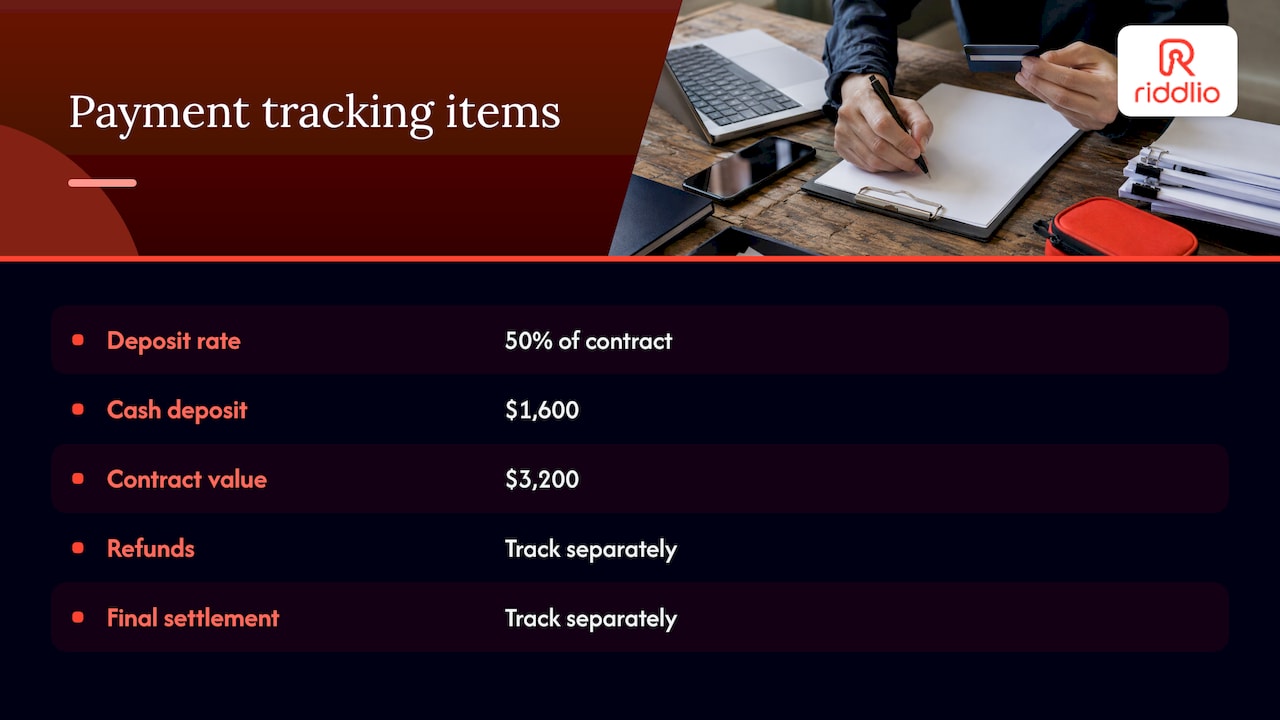
A 50% deposit on a $3,200 contract is $1,600 of cash and $3,200 of contract value. Reporting them as one number inflates your month. Keep both, plus refunds and the final settlement, visible.
Riddlio handles payment management and connects to payment providers, so card payments and deposits sit alongside the booking rather than in a separate spreadsheet. Pricing is a flat monthly subscription with no booking commission; the payment provider’s processing fees are separate. Read more on escape room payment processing, and for the invoice side of corporate work, our practical guide to corporate booking invoices walks through what a buyer’s accounts team expects to see.
Step 4: Confirm, collect waivers and remind
The confirmation is the document the office coordinator forwards to 30 colleagues. It should work as an instruction sheet:
- Date, arrival time and how early to come.
- Parking and entrance details.
- The waiver link, with a clear request that every participant sign before the day.
- Final headcount deadline and what happens if numbers change.
- Your contact number for the day.
Putting the waiver link in the confirmation matters more for corporate groups than for families. The person who booked rarely knows every attendee, so the link has to be shareable. Riddlio’s digital waiver management lets guests complete waivers digitally, which means you are not handing clipboards to 30 people in the lobby. What a waiver says and whether it is enforceable in your state is a question for your own lawyer; we make no promise on that.
Reminders protect your revenue. Riddlio sends email and SMS reminders, and SMS usage is billed separately from the subscription, so check the current figures on the pricing page before you plan a messaging routine. A sensible corporate pattern is a reminder a couple of days before with the waiver link again, and a short message on the morning with parking and entrance details. See SMS reminders for escape rooms for how it works.
Step 5: Run arrival and check-in for a big group
Thirty people arriving within ten minutes can swamp a front desk built for six. Plan it like a small event:
- Know the list. Have the attendee count from the final headcount and the waiver status in front of you before the group arrives.
- Chase waivers early. Send a final reminder the day before to the organiser with the names still outstanding, rather than collecting signatures at the door.
- Stagger arrivals. Ask the organiser to have teams arrive in blocks, matched to the start times of each room.
- Brief once. For a group in several rooms, give one rules briefing together and then split into teams.
- Staff for the moment. Put an extra person on the door for the first fifteen minutes.
If you use Riddlio’s self check-in kiosk, guests can check themselves in on arrival, which takes pressure off the desk during a busy arrival window. Corporate events also make use of the space around the game: Quest Room points out that groups can use the lobby and party space before and after play, so build that time into the schedule.
Step 6: Follow up and win the repeat booking
A corporate group is a team of potential repeat buyers, and the person who organised the event is the one who rebooks. A good follow-up sequence is short:
- A thank-you the next day to the organiser, with a photo if you take them.
- A simple offer for the next team event a week or so later.
- A reminder at the same time next year, when budgets and year-end events are being planned.
- A review request to the organiser and, where it fits, the players.
The sequence is a sensible practice rather than a proven formula, so tune it to your own numbers. For the marketing side of attracting these buyers in the first place, read our three-step team building marketing playbook.
Step 7: Report on corporate work every month
You cannot improve corporate sales if you cannot see them. Tag every corporate booking with its source and type, then review monthly:
- Corporate enquiries, quotes sent, deposits cleared and groups played (the pipeline).
- Average group size and average booking value.
- Lead time between deposit and event, to see how far ahead buyers plan.
- Share of corporate revenue taken in off-peak slots.
- Repeat corporate customers.
- Cancellations and no-shows by group type.
Riddlio includes analytics and AI-assisted analytics for venues, so you can look at revenue and booking patterns across rooms, and for multi-location operators the same view helps compare which site converts corporate enquiries best. Operators with several venues can read more on escape room management software.
What the Riddlio plans cost
If you are choosing software for this routine, Riddlio’s published plans (USD per month) are Starter at $29, Pro at $79 and Unlimited at $199, with Enterprise available without a published price. Subscription pricing is flat with no booking commission, while payment provider fees and SMS usage are billed separately. Plan limits and which features sit on which tier are on the pricing page, and that is the page to check before you decide, since not every feature is on every plan.
If corporate groups are a growing share of your calendar, our escape room booking system connects availability, bookings, payments, waivers, guest communications and reporting in one place, so the routine above runs from a single screen rather than five tools.
A one-page corporate booking checklist
- Separate enquiry form with date options, headcount range, event type and billing needs.
- Published group tiers mapped to room counts and durations.
- Calendar check for rooms, staff and reset time before quoting.
- Written quote with an expiry date.
- Deposit rule stated on your site, in the quote and in the confirmation.
- Group counted as booked only when the deposit clears.
- Confirmation with waiver link, arrival details and headcount deadline.
- Reminders before the date, and a morning-of message.
- Extra staff and a staggered arrival plan for large groups.
- Next-day thank-you, repeat offer and next-year reminder.
- Monthly review of corporate pipeline, lead time and repeat rate.
FAQ
How far in advance should corporate groups book?
Venues typically ask for two to four weeks. Quest Room recommends two to four weeks for big corporate events, and some venues set a minimum, such as three days at Zone 28 or seven days for off-hours groups of nine or more at Exit 4. Publish your own minimum and mention that peak season fills earlier.
Should I require a deposit for corporate bookings?
Yes, a deposit is how you turn a quote into a held date. Examples range from a flat $100 to a 50% non-refundable deposit. Choose a rule, state the refund terms at the point of payment, and count the group as booked only once the deposit has cleared.
What should a corporate escape room quote include?
Include the date and time, group size, number of rooms, duration, price and whether tax is added, the deposit amount and due date, the final headcount deadline, cancellation terms, and the date the quote expires. If the buyer needs an invoice or purchase order, say how that works.
Do I need separate software for corporate bookings?
Not necessarily. What you need is a clear process: a separate enquiry path, a quote and deposit routine, waivers and reminders, and reporting that tags corporate work. Riddlio covers the booking, payment, waiver, messaging and reporting parts in one platform, and the pricing page shows which plan includes which features.
Sources
- Quest Room: Escape Room FAQ
- Quest Room: Corporate Team Building and Events
- Escape Room Madness: Corporate Events and Team Building NYC
- Mastermind Escape Games: Team Building
- Zone 28: Corporate Team Building in Pittsburgh
- Exit 4: Team Building Glassboro, NJ
- AdvisorPPC: Corporate Escape Room Inquiries, Count Cleared Deposits
- Corporate event design guide