Selling escape rooms to companies means selling a measurable outcome, not an hour of fun. The highest-impact approach: build a dedicated corporate landing page speaking directly to HR and office managers, back it with direct outreach, and close every session with a 20 to 30 minute facilitated debrief. Some venues report that this three-part structure converts better than pushing corporate leads through a consumer booking widget.
TL;DR:
- Corporate bookings are driven by measurable outcomes, such as team engagement and skills development, rather than entertainment value alone.
- A dedicated corporate landing page with clear pricing, session details, facilitation options, and a contact form significantly improves conversion.
- Direct outreach, including personalized emails and FAM tours, is more effective for securing corporate clients than organic search alone.
- Providing a structured debrief that links in-game behaviors to workplace skills encourages repeat business and justifies higher pricing.
- Using management tools like Riddlio streamlines admin tasks, automates follow-ups, and offers analytics to identify weekday capacity gaps and improve outreach.
Table of Contents
- What “team building marketing” actually means for escape room venues
- [Build a dedicated corporate landing page](#build-a-dedicated-corporate-landing-pagehttpstheslatespacecombook)
- Direct outreach and the corporate sales motion
- Pricing, packages and proving value to corporate buyers
- Turning the session into a measurable team outcome
- Getting your admin ready for corporate accounts
- Which marketing channels actually generate corporate enquiries
- Tracking whether your marketing is actually working
- How Riddlio supports the corporate booking workflow
- Strategies to engage diverse teams
- Benefits of team building marketing for businesses
- Customisation and personalisation options for team building marketing
- Challenges and solutions in marketing team building programs
- Types of team building marketing activities and examples
- The gap between what most venues advertise and what actually books
- Let Riddlio handle the admin your corporate clients expect
- Sources
- FAQ
What “team building marketing” actually means for escape room venues
Team building marketing is the set of strategies, channels and messaging escape room venues use to convert corporate and group bookings, distinct from consumer marketing aimed at friends and families. The distinction matters because the buyer is different. An HR manager or office manager isn’t purchasing entertainment. They’re purchasing a solution to a problem: a disengaged team, a new hire cohort that hasn’t gelled, or a leadership offsite that needs a memorable centerpiece. Corporate team building marketing treats that buyer as a business decision-maker, not a thrill-seeker.
This shift changes everything downstream, from the words on your website to the paperwork you keep on file. A venue that markets corporate bookings well is running two businesses under one roof: a consumer experience and a B2B service. Confusing the two is where most operators lose the sale before the phone even rings.
Build a dedicated corporate landing page
A generic booking page built for date nights and birthday parties tells a corporate buyer nothing about capacity, facilitation or invoicing, and they will bounce. Landing page best practices research confirms that pages speaking directly to a specific buyer, with clear packages and a dedicated contact form, convert markedly better than a one-size-fits-all page.
Your corporate page needs:
- Per-person pricing and group minimums stated upfront
- Session duration, capacity limits, and available room combinations
- A sample agenda showing arrival, briefing, play, and debrief
- Facilitation options (light-touch vs. fully guided)
- Invoice and payment terms, plus a note on COI and vendor registration availability
- A corporate contact form, not the consumer booking widget
| Page element | Why it matters to a buyer |
|---|---|
| Per-person pricing + minimums | Lets a manager budget without calling |
| Sample agenda | Shows the event has structure, not just gameplay |
| Facilitation outline | Signals a training outcome, not just entertainment |
| Invoice/COI/vendor info | Clears procurement without back-and-forth |
| Downloadable venue deck (PDF) | Gives the buyer something to forward internally |
A downloadable venue deck matters because most HR bookings need internal sign-off. A PDF a manager can forward to their director does more selling for you than any web page, since it travels through the approval chain without you in the room.
Direct outreach and the corporate sales motion
Corporate bookings rarely arrive through search alone. Someone has to reach the buyer, and that buyer is usually HR, People Operations, or an office manager juggling five other vendors. Basecamp Advertising’s guide to escape room marketing points out that direct outreach and familiarisation (FAM) tours convert far better than generic consumer campaigns, precisely because they target the person signing off on the spend.
Multi-threading the outreach, reaching both HR and the office manager at the same company, raises your odds. If one contact goes quiet, the other keeps the deal alive.
A workable outreach sequence:
- Identify 10 to 15 local companies with 20+ staff within a short commute of your venue
- Send a short, personalised email offering a complimentary FAM tour for two decision-makers
- Run the FAM tour as a compressed version of the real experience, with a live debrief demo
- Follow up within 48 hours with a written proposal: agenda, facilitation outline, pricing, payment terms
- Set a follow-up cadence (day 3, day 10, day 21) rather than a single “just checking in” email
Pro Tip: Treat the FAM tour like a product demo, not a freebie. Walk your guests through exactly what their team will experience, including the debrief, so they leave with a story to tell their boss.
Pricing, packages and proving value to corporate buyers
Corporate buyers weigh reliability and time saved more heavily than novelty, so lead your pricing conversation with outcomes, not fun. Per-person pricing with a stated minimum (say, 10 to 12 players) keeps quoting fast, while a flat facilitation fee for guided debriefs justifies charging above your standard consumer rate.
Package ideas that convert repeat business:
- Quarterly team packages at a discounted per-person rate for HR teams booking recurring sessions
- A “new hire onboarding” package bundling two room sessions across a quarter
- A leadership offsite package combining a private buyout with an extended debrief
Transparent invoice terms matter as much as the price itself. State net 15 or net 30 payment terms plainly, and offer a deposit-and-invoice structure rather than requiring full upfront card payment, which many procurement departments simply cannot process on short notice.
Turning the session into a measurable team outcome
The gameplay is the easy part. What separates a one-off booking from a recurring corporate client is what happens in the last half hour. Breakout Games’ research on corporate team building found that a structured 20 to 30 minute debrief helps HR connect in-game behaviours directly to workplace skills, turning an entertainment purchase into a justified training expense.
A workable debrief structure:
- Open with the session’s stated objective (communication, problem-solving under pressure, delegation)
- Walk through two or three specific moments the facilitator observed, naming who stepped up and how
- Ask the group two reflection prompts: “What worked?” and “What would you do differently next time?”
- Close with three action takeaways the team can apply back at their desks
Pro Tip: Give the facilitator a one-page observation template to fill in during play. It turns loose notes into a clean, professional-looking summary you can hand the client on the way out.
A simple one-page report, even just bullet points on team strengths observed and suggested follow-ups, gives HR something concrete to show their own management. That single page is often what gets you rebooked next quarter.
Getting your admin ready for corporate accounts
Companies with even modest procurement processes will ask for paperwork you don’t need for a birthday party. Research on escape rooms pivoting toward corporate contracts shows that venues without invoicing infrastructure, certificates of insurance and vendor registration on hand get disqualified before pricing is even discussed.
Have these ready before you pitch your first corporate client:
- A certificate of insurance (COI) you can email within the hour
- A completed W-9 (or your local equivalent) on file
- A standard invoice template with clear net payment terms
- A vendor registration process if larger clients require one
- A written deposit, cancellation and refund policy for group bookings
Pro Tip: Keep a folder of your COI, W-9 and invoice template ready to send as a single attachment. Procurement teams move faster when they don’t have to chase three separate documents.
If your sales cycle stretches across weeks with multiple touchpoints, per client, it’s worth appointing one team member as the dedicated corporate contact. Relationship-led selling works best when the buyer always reaches the same person.
Which marketing channels actually generate corporate enquiries
Not every channel deserves equal budget. EscapeRoomPPC’s guide on escape room marketing recommends treating corporate bookings as a distinct funnel with its own landing page and conversion tracking, separate from consumer campaigns, because the corporate buyer takes far longer to decide.
Channels worth prioritising:
- Google Ads pointed directly at your corporate landing page, not your homepage
- LinkedIn outreach to HR and office manager job titles within your service radius
- Curated corporate event marketplaces, which Events In Minutes notes can shorten the time to visibility while your own SEO is still building
- Local business partnerships (coworking spaces, chambers of commerce, corporate wellness vendors)
- FAM tours, as covered earlier, for your highest-value target accounts
For email, CUFinder’s research on escape room lead generation recommends capturing contact details at the waiver stage and running automated follow-up within 24 hours of the event, then a re-engagement sequence three months later for repeat business.
Your creative assets matter as much as the channel. A professional venue deck, real photos (not stock images), a capacity diagram, and short client testimonials do more to close a corporate deal than any ad copy.
Tracking whether your marketing is actually working
A handful of numbers tell you whether your corporate marketing is paying off or quietly leaking leads.
| Metric | What it tells you |
|---|---|
| Share of revenue from corporate bookings | Whether corporate is a real business line or a side hustle |
| Weekday utilisation rate | Whether you’re filling the slots corporate clients actually want |
| Booking abandonment rate | Whether your enquiry-to-booking process has friction |
| Lead-to-book conversion rate | Whether your proposal and follow-up cadence is working |
| Repeat-client rate | Whether debriefs and reporting are landing with HR |
Track form submissions on your corporate landing page as a distinct conversion event, separate from consumer bookings, and pull a monthly report from your booking software. If reply times are slow, that alone can sink a deal with a corporate buyer used to same-day vendor responses. If weekday utilisation stays low, revisit your outreach targeting before assuming the pricing is wrong.
How Riddlio supports the corporate booking workflow
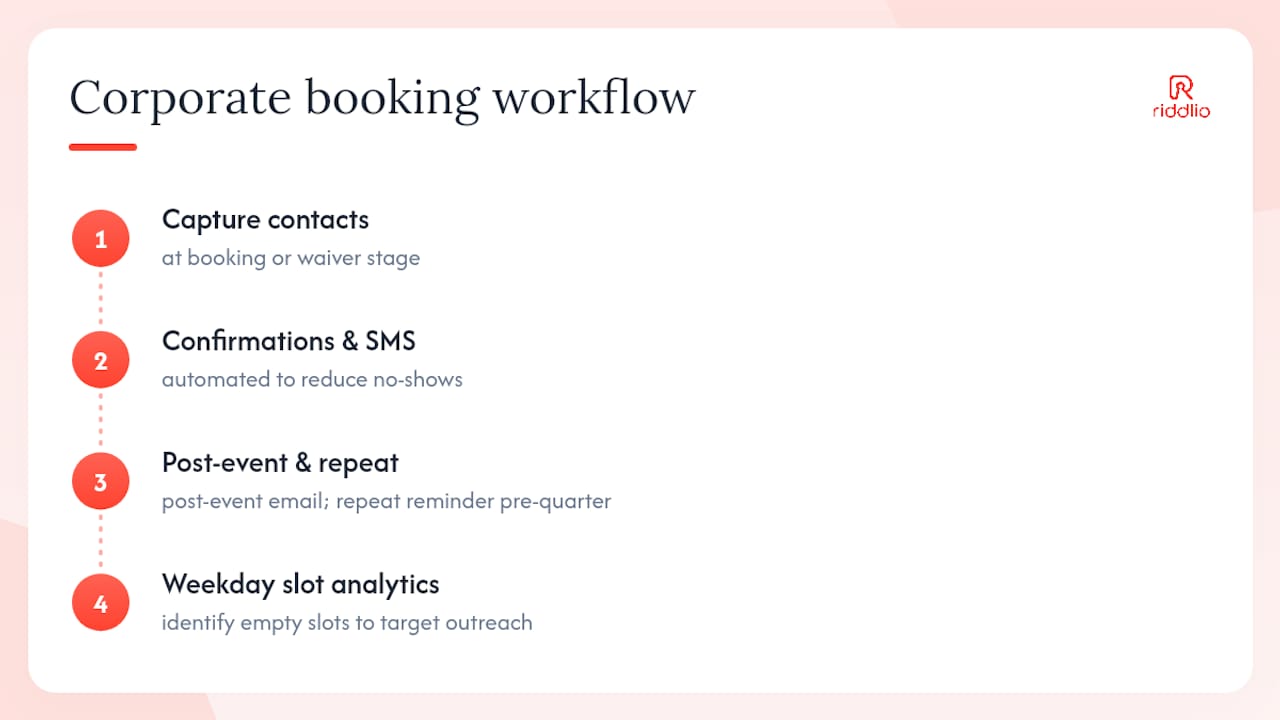
A booking platform built for escape rooms removes a lot of the friction described above. Riddlio lets venues capture corporate enquiries through a dedicated contact flow, send automated confirmations and SMS reminders that cut no-shows, and generate the analytics needed to spot a weekday gap before it becomes a quiet month.
A typical workflow: capture contact details at the online booking or waiver stage, trigger an automated post-event follow-up email, then let a repeat-booking reminder fire automatically ahead of the next quarter. Analytics surface which weekday slots sit empty, so outreach can target exactly those gaps instead of guessing. None of this replaces the sales work covered above. It just means the admin doesn’t eat the hours you’d rather spend on the phone with your next HR contact.
Strategies to engage diverse teams
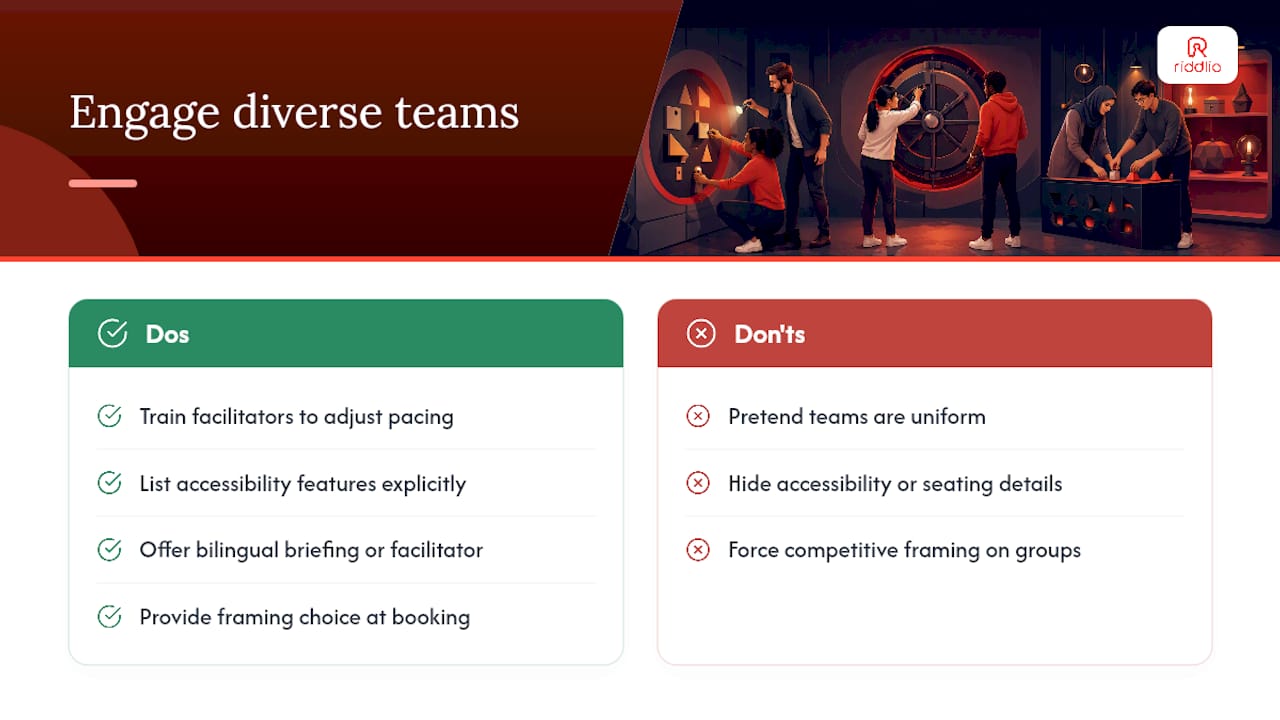
Corporate groups rarely arrive as a uniform crowd. A booking might include a mix of seniority levels, first languages, physical abilities, and personalities that range from competitive to reluctant. Marketing to this reality, rather than pretending every team looks the same, widens your addressable market.
Offer facilitators trained to adjust pacing and puzzle hints on the fly, so a team with mixed experience levels doesn’t leave one person carrying the whole session. Mention accessibility features explicitly on your corporate page, seating options, room accessibility, and adjustable difficulty, since many office managers are booking on behalf of a team they don’t know well and need reassurance before they commit.
Language matters too. If your local market includes a large non-native English speaking workforce, offering a bilingual briefing sheet or facilitator removes a real barrier to booking. Some venues offer a “low-pressure” room variant explicitly marketed for teams with mixed comfort levels around puzzles, framed not as an easier option but as a differently structured one.
Multi-generational teams respond differently to competitive framing. A younger team might enjoy a leaderboard tied to their session; a more senior group might prefer a collaborative framing with no scoreboard at all. Give office managers the option to choose the framing when they book, and note it as a checkbox on your corporate contact form rather than a conversation they have to initiate themselves.
Benefits of team building marketing for businesses
Selling into the corporate segment does more than add another revenue line. It fills weekday hours that would otherwise sit empty, since most public bookings cluster around evenings and weekends while corporate sessions happily fill a Tuesday morning.
Corporate clients also tend to book in bulk. A single HR contact booking a quarterly team session across departments can generate more predictable revenue than a dozen scattered consumer bookings, and that predictability makes staff scheduling far easier.
There’s a reputational upside too. A local business that becomes known as “the escape room companies actually book” earns word-of-mouth referrals through HR networks, chambers of commerce, and corporate wellness circles, channels that rarely respond to consumer-facing social ads.
Finally, corporate clients who see genuine value from the debrief tend to become repeat accounts rather than one-off customers. That repeat relationship compounds over a year in a way single consumer bookings simply don’t.
Customisation and personalisation options for team building marketing
Generic corporate packages leave money on the table. Offering tiered customisation, from a light-touch drop-in session to a fully facilitated leadership workshop, lets you price for the level of service each client actually wants rather than a single flat rate.
Personalisation can be as simple as branding the debrief report with the client’s company name and logo, or as involved as tailoring puzzle themes to reference internal jargon or a company milestone. Some venues offer a custom “welcome message” recorded for the group as they enter the room, using the company name, which costs almost nothing to produce but reads as a considered touch to the buyer.
Session length is another lever. Not every company wants a 60 minute room plus a 30 minute debrief. Offering a compressed 45-minute format for lunch-hour team sessions, or an extended half-day format combining two rooms with a longer workshop-style debrief, lets your corporate page serve very different budgets and time constraints without you building separate products from scratch.
Where you can, let the buyer select facilitation intensity on the contact form itself, light guidance, full facilitation, or a custom workshop add-on, so the quote they receive already matches what they actually want rather than a rate you then have to talk them up from.
Challenges and solutions in marketing team building programs
The most common failure point isn’t the room itself, it’s the sales cycle length. Corporate buyers often need two or three weeks to get internal sign-off, and venues used to instant consumer bookings can lose patience and stop following up. The fix is a scheduled follow-up cadence, set at the first contact, rather than leaving momentum to chance.
A second challenge is pricing objections from buyers comparing your quote to a cheap consumer booking rate. Address this directly by leading with the facilitation and debrief, not the room, since that’s the part a spreadsheet-driven comparison misses entirely.
Procurement friction trips up more venues than poor puzzle design ever will. Missing a COI or invoice template at the moment a corporate client asks for one can quietly kill a deal that was otherwise ready to close. Keep that documentation on hand before you need it.
Finally, many venues struggle with weekday capacity planning once corporate demand actually arrives. Staggered starts and buyout options solve this, but only if your booking system can handle the scheduling complexity without a staff member manually juggling a spreadsheet.
Types of team building marketing activities and examples
Not every corporate booking looks the same, and your marketing should reflect the range on offer. A standard single-room booking for a team of six to eight works well for smaller departments wanting a quick, low-commitment session.
Full-venue buyouts suit larger companies running an all-staff event, letting multiple teams compete across different rooms simultaneously with a shared leaderboard tying the day together. Multi-room progressive events, where one large team rotates through several rooms in sequence, work well for company-wide offsites needing a full afternoon programme.
Leadership-specific sessions, marketed separately from general staff bookings, position the debrief around decision-making under pressure and delegation rather than general communication, and can command a premium rate. New-hire onboarding sessions, booked as a recurring quarterly package, help HR teams standardise how new cohorts get introduced to each other.
Hybrid formats combining a room session with a catered lunch or a short workshop afterward turn a one-hour booking into a half-day package, which suits companies wanting a fuller offsite experience without booking multiple vendors. Each of these deserves its own line on your corporate landing page, since a buyer scanning quickly needs to see their exact use case named, not inferred.
The gap between what most venues advertise and what actually books
Most escape room marketing still leads with the puzzles: the theme, the props, the immersive set design. None of that is wrong, but none of it is what gets a corporate booking signed either. The research is consistent on this point: corporate buyers are purchasing a training outcome dressed up as entertainment, and venues that keep selling the costume instead of the outcome leave money on the table.
The conventional advice, “just add a corporate page and wait”, undersells how much of this is a sales motion, not a marketing campaign. A landing page without direct outreach behind it is a brochure nobody reads. The venues doing this well treat their first ten target companies the way a software company treats its first ten enterprise accounts: named, researched, and followed up on a schedule.
If there’s one thing to prioritise above the rest, it’s the debrief. It’s the cheapest change to make, it costs nothing beyond fifteen extra minutes and a facilitator willing to take notes, and it’s the single element separating a one-off party booking from a client who rebooks every quarter for the next two years.
— Iosif Beraru
Let Riddlio handle the admin your corporate clients expect
Riddlio is the alternative to running corporate bookings off a shared inbox and a spreadsheet. Instead of manually chasing invoices, sending reminder texts, and guessing which weekday slots are sitting empty, you get one dashboard showing bookings, payments and analytics side by side, with automated SMS reminders and confirmations built in to cut no-shows before they cost you a corporate rebooking.

For a venue running both consumer and corporate bookings, that operational view matters more than any single feature. You can see weekday utilisation drop before it becomes a quiet month, trigger outreach off that data, and let automated communications handle the confirmation emails a corporate client expects without a staff member typing them out by hand. Plans start at $29 a month on the Starter tier, with Pro and Unlimited tiers adding the analytics and white-label widget features corporate accounts tend to need most. Check the Riddlio pricing page and book a demo to see the corporate workflow in action.
Sources
FAQ
What Is Team Building Marketing for Escape Rooms?
It’s the set of strategies venues use to attract corporate and group bookings rather than casual consumer visits, built around a dedicated corporate landing page, direct outreach and facilitated debriefs. It treats HR and office managers as business buyers solving a workplace problem, not thrill-seekers booking for fun.
How Do I Price Corporate Escape Room Sessions?
Most venues use per-person pricing with a stated group minimum, then add a facilitation fee for a guided debrief. Presenting clear invoice and payment terms alongside the price, rather than requiring upfront card payment, removes a common procurement objection.
Why Does a Facilitated Debrief Matter for Corporate Bookings?
A structured 20 to 30 minute debrief helps HR connect in-game behaviours to real workplace skills, which is what turns the session into a justified training expense rather than a one-off treat. Venues that skip the debrief tend to see far fewer repeat corporate bookings.
What Documents Do Corporate Clients Usually Ask For?
Most procurement processes expect a certificate of insurance, a completed W-9 or local tax equivalent, and a standard invoice with clear payment terms. Having these ready before your first corporate pitch prevents early disqualification.
Can Riddlio Help Manage Corporate Bookings and Follow-Up?
Riddlio combines booking management, automated SMS reminders, invoicing support and analytics in one dashboard, which reduces the manual admin corporate accounts typically create. Pricing starts at $29 a month, with higher tiers adding the analytics and white-label features larger corporate programs tend to need.