TikTok ads can fill escape room slots, but only if you judge them by completed bookings rather than views. Point the campaign at your booking page, install tracking on the confirmation step, test spoiler-free creative that shows what a game feels like, and keep the budget small until you know what a booked room costs you. Everything below is built around that order of operations, for owners and venue managers who need the ad to end in a paid booking.
TL;DR
- Start with a Traffic or Sales campaign aimed at your booking page, and set up tracking before you spend anything.
- Creative that works for escape rooms is short, captioned, spoiler-free and shows real, consenting players or your game masters.
- Target your metro area first, keep audience layers light, and treat the first budget as a test.
- Measure cost per completed booking, not views or clicks, and cross-check Ads Manager against a TikTok-specific link or promo code.
- A fast, clear mobile booking flow decides whether the click turns into a booked room.
Table of Contents
- Why TikTok suits escape rooms, and what it can’t do alone
- How a TikTok campaign is built
- Creative that fills rooms without spoiling them
- Local targeting and a sensible first budget
- Measuring bookings, not views
- What visitors see after the click
- Where the booking software fits
- A first month, week by week
- Common mistakes
- FAQ
- Sources
Why TikTok suits escape rooms, and what it can’t do alone
An escape room is hard to explain in a photo. People want to know what it feels like, whether they will look silly, and whether a group of friends or coworkers will enjoy it. Short vertical video answers those questions better than a text ad does.
That is the logic behind Escapology’s approach. Its social media case study says it prioritised short-form video, trending audio, “come with me” formats and staff or creator point-of-view content to show what a session is like and reduce first-timer hesitation. Breakout Games, as reported by Escape Room Daily, leans on riddles, memes, relatable questions and short clips of real player reactions, and keeps the focus on the fun whether or not a team escapes.
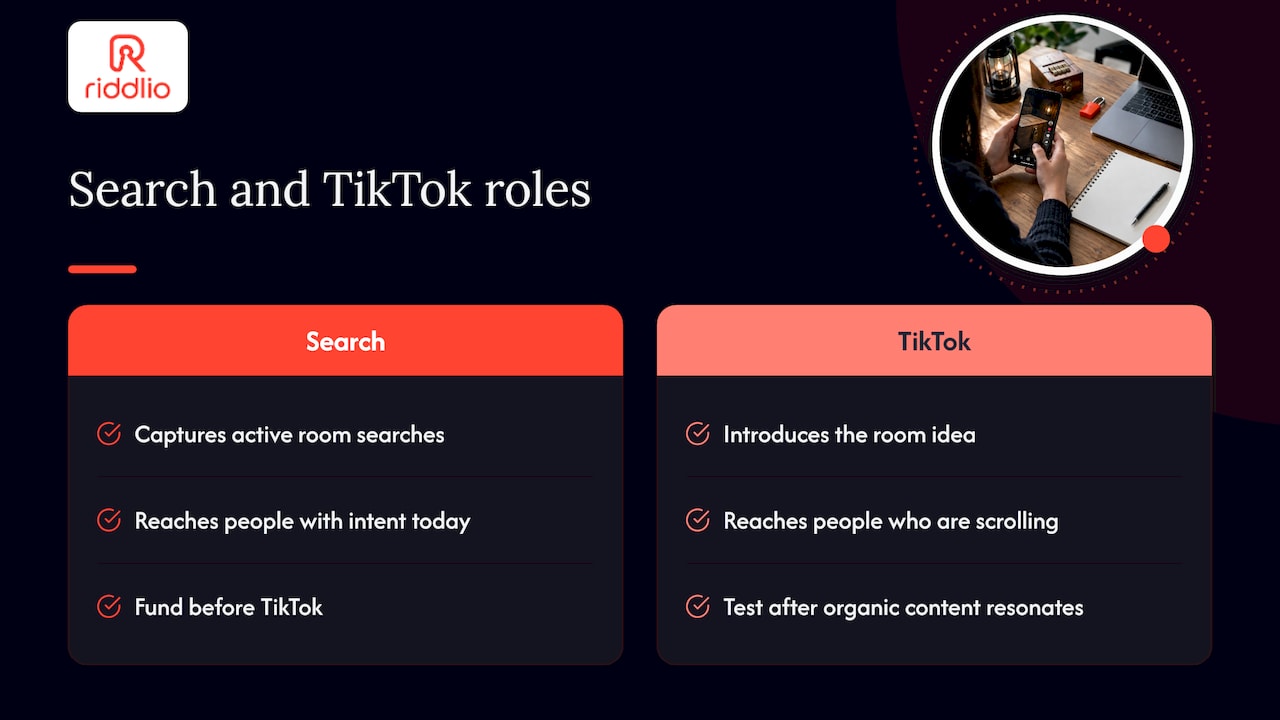
What TikTok does not do is capture people who are already searching for a room. Someone typing a search for escape rooms in your city has intent today. Someone scrolling TikTok is being introduced to the idea. The Escape Room PPC playbook suggests funding search-intent capture first, then giving TikTok a modest test once your organic content shows what resonates. If you have not set that up yet, our guide to Google Ads for escape rooms covers it.
How a TikTok campaign is built
TikTok’s own Ads Manager User Guide (March 2026) describes three levels: Campaign, Ad Group and Ad. Each has its own settings.
Campaign level: the objective
The campaign is where you choose an objective, such as Traffic or Sales. For most escape rooms the practical choice is Traffic or conversions pointed at the booking page, with the TikTok Pixel or events installed so you can see whether bookings actually happen, as the Escape Room PPC playbook advises.
Traffic sends people to your page. A conversion-style objective asks TikTok to find people likely to complete an action you define. The second only works if the platform can see bookings, which is why tracking comes before spend. According to the same TikTok guide, the website optimisation goals you can pick, such as Purchases, Initiate Checkout, Conversions and Clicks, depend on the campaign objective you chose.
Ad group level: audience, budget and schedule
The Ad Group is where you set audience, placements, budget, schedule, optimisation and bids. This is where local escape rooms most often waste money, usually by going too broad on geography or too narrow on interests. More on that below.
Ad level: the creative
The Ad is the video itself plus the text and the button. Run several creatives inside one ad group so the platform and you can see which hook earns the click. If you have an organic post that clearly outperforms your others, the Escape Room PPC playbook recommends boosting it with Spark Ads, which preserves the native engagement on the post such as likes and comments.
Creative that fills rooms without spoiling them
Your ad has about a second to stop the scroll, so lead with the hook: a reaction, a question, a reveal. Keep clips short, add captions because many people watch muted, and name your city in the caption or on screen.
Ideas worth testing, drawn from the Escape Room PPC playbook, the Escapology case study and VidFarm’s escape room ideas list:
- Player reactions. Real groups, with their consent, at the moment a clue lands or the lock opens.
- Spoiler-free room teases. A door, a prop, a soundscape, with no exact solutions. VidFarm specifically cautions against revealing them.
- Game master point of view. Walking a team in, watching from the control desk, or the “what to expect” briefing.
- Room resets and time-lapses. Satisfying to watch and a quiet signal that the venue is well run.
- Secret-door reveals and clue-object spotlights. Visual hooks that need no explanation.
- Short answers to common questions. How many people fit, whether it is scary, what happens if you get stuck.
- Local hooks. Date-night, birthday, coworker outing or a rainy-day option in your city.
Escapology’s case study also identifies six repeatable content pillars: planning an outing, what to expect, memorable team moments, clues and challenges, game worlds, and community proof such as user-generated content, giveaways and reactions. Used as a checklist, those pillars stop you posting the same type of clip ten times.
A simple test plan for creative
- Pick three different hooks, for example a player reaction, a room tease and a game master Q&A.
- Run them in one ad group with identical audience and budget.
- Let each gather enough activity to compare, then keep the one that produces bookings, not just the one with the most views.
- Replace the weakest and test another hook.
Local targeting and a sensible first budget
The TikTok guide lists targeting controls for location, gender, age, language, interests and behaviours, plus custom and lookalike audiences. An escape room only needs a few of these.
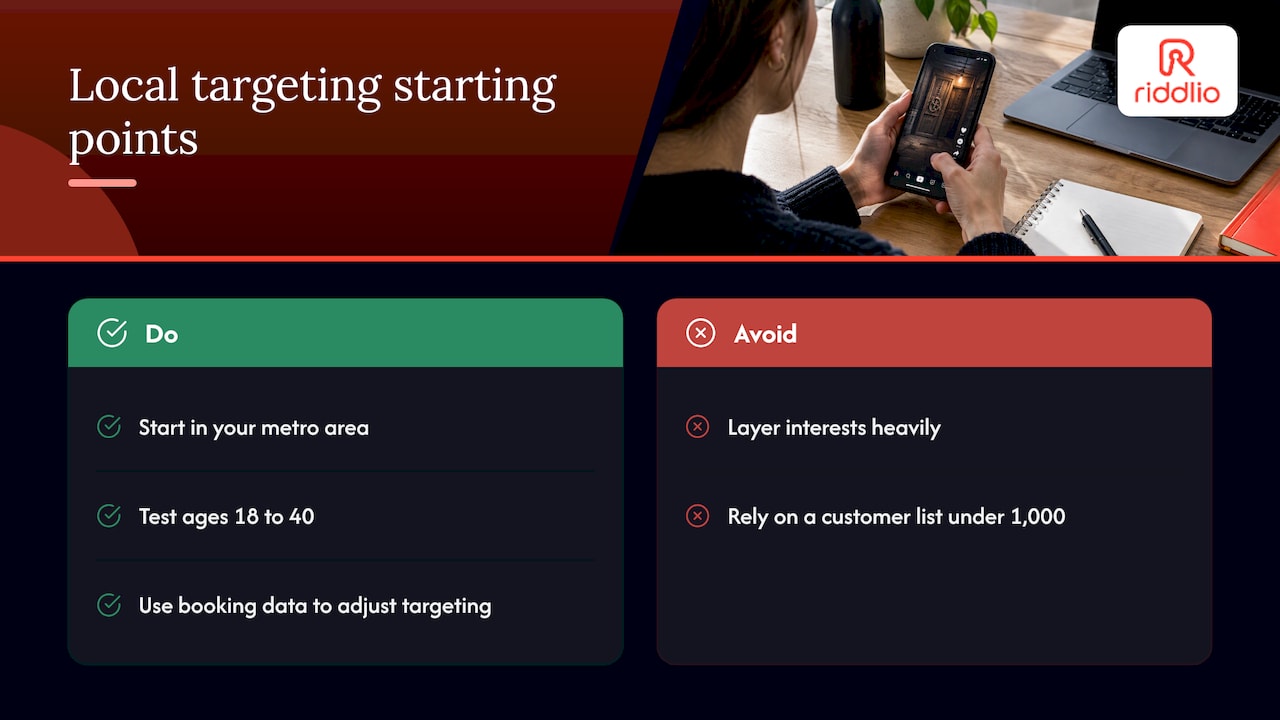
The Escape Room PPC playbook suggests starting with your metro area, roughly ages 18 to 40, testing entertainment and things-to-do interests without heavy layering. Treat that as a starting point from one practitioner, not a benchmark. Your own data should overrule it: if your bookings skew to corporate team building or family birthdays, your ages and messages will differ. Our team building marketing playbook helps if the corporate side matters to you.
A note on custom audiences: TikTok’s guide states a custom audience must contain at least 1,000 people to be targetable in an ad group. A single venue’s customer list is often smaller than that, so do not plan your first campaign around uploading it.
Budget logic for a single venue
Set the budget as a test, not a commitment. A useful way to think about it is in booking terms:
- Work out what a booking is worth to you: average group size times your average ticket price, minus the costs of running the game.
- Decide what share of that you can spend to win a new booking.
- Set a test budget that could plausibly produce several bookings at that cost, and run it for long enough to see results.
This is an illustrative method, not a guarantee of results. A group of five at a ticket price you set yourself gives a clear booking value to work from. If the cost per booking lands inside your limit, increase gradually. If not, change the creative or the landing page before you change the budget.
Measuring bookings, not views
Impressions and clicks are diagnostics. The business outcome is a completed booking, and the cost of getting one. That is also the position of event-marketing guidance from the ticketing industry, which treats clicks as supporting information only.
Set up tracking before the first ad
The Escape Room PPC playbook recommends installing the TikTok Pixel on the booking confirmation step, so the platform sees a completed booking rather than a visit. Our conversion tracking guide for bookings walks through the setup for escape rooms, and the server-side tracking guide covers the case where browser-based tracking misses sales. The same logic applies to ads on other networks, as in our Facebook Pixel guide.
Add a second, independent check
Platform numbers and your own numbers will not match perfectly, because attribution differs between them. Run a cross-check:
- Give TikTok traffic its own booking link or a TikTok-specific promo code.
- Ask new guests how they heard about you, at booking or on arrival.
- Watch branded searches and direct traffic for assisted effects. Someone may see your video, then search your name later.
- Compare orders from your tracking link with the conversions Ads Manager reports, and expect a gap.
Trust the pattern across all of them. If bookings from your link rise when the campaign runs and fall when it stops, the ads are working even if one dashboard disagrees.
The numbers to keep in one sheet
| Metric | What it tells you |
|---|---|
| Spend | What you put in during the period |
| Completed bookings from the TikTok link or code | What you got out |
| Cost per completed booking | The number that decides whether to scale |
| Click-to-booking rate | Whether the booking page is losing people |
| Booking value | Whether the right groups are booking |
What visitors see after the click
A good ad sends people to a page that fails them, and the money is gone. TikTok visitors are on phones, impatient and often unsure. Before launch, go through your full booking flow on a phone from the first tap to the confirmation. Make sure of the following:
- The room you advertised is the room they land on, with the date picker visible quickly.
- Price, group size and any fees are easy to understand before they enter details.
- Available time slots are clear, and sold-out ones are not a dead end.
- The booking and payment steps are short, with no surprise at the last screen.
- Guests know what comes next: confirmation, waiver, arrival instructions.
Our 30 day audit to improve booking conversion rate gives a longer checklist if your click-to-booking rate is weak. The point to remember is that TikTok ads cost the same whether the page converts well or badly. Fixing the page lowers your cost per booking more reliably than rewriting the ad.
Where the booking software fits
TikTok creates demand; your booking system turns it into a confirmed, paid game. That is the part Riddlio is built for. Riddlio is booking and venue-management software for escape room businesses, and it connects room availability, bookings, payments, waivers, guest communications and reporting in one place.
A few things matter for ad traffic specifically:
- A live booking calendar on your own site, so a guest who taps an ad can pick a real slot. See the online booking calendar for escape rooms.
- Dynamic pricing, which lets you set peak, off-peak and group pricing, useful when you want ads to push demand into quieter slots. See dynamic pricing for escape rooms.
- Email and SMS reminders to cut the gap between booking and arrival. SMS usage is charged separately from the subscription, so check the details on the SMS reminders page.
- No booking commission. Riddlio charges a flat monthly subscription, so a booking that your ad paid for is not subject to a further cut by the software. Payment provider fees are separate.
Plans are Starter at $29 per month, Pro at $79 per month and Unlimited at $199 per month, with Enterprise available without a published price. Provider processing fees and SMS usage are separate, and not every feature is part of every plan, so compare the tiers on the pricing page against what your venue needs. If you run several locations or are still comparing systems, how to choose escape room booking software sets out the criteria.
Ad tracking itself happens in TikTok Ads Manager and on your website. The step-by-step tracking setup above is an external workflow that sits alongside your booking system, so follow the conversion tracking guide for where to place it.
A first month, week by week
Here is an illustrative plan for a single venue. Adjust it to your seasonality and capacity.
- Week 1: foundations. Test the booking flow on two phones. Install tracking on the confirmation step. Create a TikTok-specific link or code. Film three to five short clips.
- Week 2: launch small. One campaign, one ad group, your metro area, three creatives. Check that test bookings register before you leave it running.
- Week 3: read the bookings. Compare Ads Manager conversions with your link or code and with what guests tell you. Pause the weakest creative.
- Week 4: decide. Work out cost per completed booking. If it sits within your limit, add a new creative and raise spend gradually. Consider boosting your best organic post with Spark Ads. If not, change the page or the hook before adding budget.
Once the basics work, retargeting site visitors can be added, but only when there are enough visitors to make it worthwhile. Do not start there.
Common mistakes
- Chasing views. A viral clip that books nobody is entertainment, not marketing.
- Spoiling the puzzle. Showing exact solutions removes the reason to book.
- Filming guests without consent. Get permission from players before you use their reactions in an ad.
- Sending traffic to the home page. Link straight to the room or booking page the ad promises.
- Layering every interest. Heavy targeting stacks shrink your audience for little gain.
- Ignoring phone checkout. Most TikTok traffic is mobile, so test there first.
FAQ
Are TikTok ads worth it for a single escape room?
They can be, as a measured test. Start with a small budget, a local audience and tracking on the booking confirmation, then judge the result by cost per completed booking. If you have not yet captured people already searching for rooms in your area, do that first.
What objective should I choose?
For most rooms, begin with Traffic or conversions aimed at your booking page, with the Pixel or events installed so you can see whether bookings happen. TikTok’s guide says the optimisation goals you can select depend on the objective, so choose the objective before the goal.
How do I know TikTok ads led to bookings?
Combine the Pixel on your confirmation step with a TikTok-specific link or promo code and a quick question about how guests heard of you. Expect Ads Manager and your own count to differ, and judge the overall pattern. Branded searches and direct visits can also rise after people see your videos.
Can I show my rooms in the ads without giving away puzzles?
Yes. Show reactions, atmosphere, props, the briefing and the reset, and leave out solutions. Spoiler-free clips let viewers sample the experience and still want to play.
Sources
- TikTok Ads Manager User Guide, March 2026
- TikTok Marketing for Escape Rooms: A Practical Playbook
- Gaming the System, Escape Room Daily
- Escapology Social Media Case Study
- Escape Room TikTok Ideas, VidFarm