
Google Ads can fill your calendar, but only if every campaign decision is tied to a confirmed booking. The order that works is simple: build a Search campaign around people ready to book, send them to a page where booking takes a few taps, and report on reservations and revenue rather than clicks. This guide walks through each step for US escape room operators, and shows where a booking platform built for escape rooms makes the job easier.
TL;DR
- Start with a Search campaign aimed at high-intent queries such as booking an escape room in your city, and keep it separate from occasion and team-building campaigns.
- Set location targeting to people in or regularly in your area, and review where your real bookings come from before widening it.
- Install conversion tracking on the booking confirmation before you spend, so Google optimises for reservations and not traffic.
- Send each campaign to a page that matches its intent, with live availability and a visible booking button.
- Use ad scheduling and weekday offers to fill slow slots, and use reminders and clear policies to cut no-shows, which ads cannot do on their own.
Table of Contents
- Why escape rooms suit Google Ads
- Step 1: Set up the campaign
- Step 2: Choose keywords and match types
- Step 3: Get location targeting right
- Step 4: Structure campaigns by intent
- Step 5: Write ads and build the booking page
- Step 6: Track bookings, not clicks
- Step 7: Budget and bidding
- Step 8: Fill the slots that stay empty
- What ads can and cannot do about no-shows
- Our perspective
- Put the booking side in order first
- FAQ
- Sources
Why escape rooms suit Google Ads
An escape room is bought in one session. Someone searches, picks a room, chooses a time for a group and pays. That is exactly the behaviour Search ads are built to capture: the person is already looking for what you sell, in your area, right now.
The flip side is that each click costs money whether or not the visitor books. A venue with a thin local market can burn a budget on people who would never drive to the door. Escape Room PPC’s Eastern Escape case study describes a small-market venue that lost money on broad match and a wide radius, and recovered by cutting the radius to the real catchment and tightening match types. The lesson applies in any US town: tight targeting and honest measurement matter more than a big budget.
Step 1: Set up the campaign
Google’s own help page for a Search campaign gives the sequence: choose a goal (Sales, Leads or Website traffic), select Search as the campaign type, and add at least one conversion goal. Then you set bidding and targeting, build ad groups and ads, and choose a budget.
Google’s first-campaign walkthrough for US businesses lays out the same flow in five steps: add business information, pick a goal, create the ad, choose audience and budget, then finalise and launch. It also tells advertisers who optimise for online conversions to set up conversion tracking before going live. Treat that as a rule, not a tip. A campaign without it is guessing.
For an escape room the practical choices are:
- Goal: Sales if guests pay online at booking, Leads if you take enquiries (for corporate groups, for example).
- Campaign type: Search first. Add other types only once Search is converting.
- Conversion action: the booking confirmation, counted with its value.
- Budget: a daily figure you can sustain for several weeks, so the system has time to learn.
Step 2: Choose keywords and match types
Google’s small-business checklist recommends using the free Keyword Planner to generate candidate keywords and estimate bids, and advises new advertisers to begin with low-to-medium-cost terms so a few expensive clicks do not swallow the budget.
For escape rooms, think in three layers:
- Ready to book: phrases with an action and a place, such as “book escape room [city]” or “escape room near me”. Graphed’s campaign structure guide recommends action-led terms like these.
- Occasion: birthday, date night, friends’ night out, team building.
- Brand: your own venue name, which is cheap and protects you from rivals bidding on it.
Match types control how closely a search must resemble your keyword. As SpyFu’s beginner tutorial explains, exact match can include close variants, phrase match keeps your phrase in order while allowing other words around it, and broad match can reach semantically similar searches. KeywordMe’s local targeting guide suggests starting with phrase match for place-modified keywords, adding proven converters as exact match for tighter bid control, and treating broad match as risky unless you have smart bidding, conversion tracking and tight location settings in place.
Add negative keywords from day one, so you stop paying for people who want to build a room rather than visit one. Graphed lists terms such as DIY, how to build, printable and free. Review your search terms report weekly and add new negatives as irrelevant queries appear.
Choosing words that match how nearby customers actually search is the same discipline as winning nearby local searches in any hospitality business: the place in the query is the signal, so build around it.
Step 3: Get location targeting right
Location is where escape room budgets leak. KeywordMe advises choosing the option for people in or regularly in your targeted locations rather than the default that also includes people merely interested in the location. Someone in another state researching your city is not going to turn up on Saturday at 7 pm.
Two cautions keep you honest:
- “Near me” is a theme, not proof. AdvisorPPC’s near-me article points out that wording alone does not show where the searcher is, and recommends reviewing matched-location reports alongside search terms and booking origins before changing geographic exclusions.
- Your radius should come from your customers. Look at where past guests travelled from, then set the radius to cover most of them. Graphed suggests a range of 15 to 25 miles based on customer travel distance, but a downtown venue in a dense city may need far less and a rural one more.
If you hold your guests’ postcodes in your booking system, you already have the data to draw the map. Riddlio’s escape room booking system keeps bookings, payments and customer details together, which makes that kind of review easier than piecing it together from separate tools.
Step 4: Structure campaigns by intent
The common mistake is one campaign for everyone. Basecamp Advertising’s escape room marketing guide recommends separate campaigns for high-intent local search, occasions, corporate team building (with a form submission as the conversion) and retargeting, each with its own landing page, bid strategy and conversion tracking. Its strategy page describes a simpler three-tier version: brand, core service, and event or occasion.
Social Blaze’s PPC guide gives the same logic at ad-group level: separate brand, general escape-room-plus-city, individual room themes and occasions, so the keyword, the ad and the destination all speak to one intent.
A workable starting layout for a single venue:
| Campaign | Typical searches | Conversion | Destination |
|---|---|---|---|
| Brand | your venue name | Online booking | Home or booking page |
| Core local | book escape room in your city | Online booking | Room list with live availability |
| Occasions | birthday party ideas, date night | Online booking | Occasion page with group options |
| Team building | team building activities near me | Enquiry form or deposit booking | Corporate page |
The occasion and team-building campaigns deserve attention. Basecamp’s author argues that occasion keywords have broader volume and cheaper clicks because you compete with bowling alleys and axe-throwing venues rather than every other escape room, and that group bookings carry higher value. Riddlio’s team building marketing playbook goes deeper on that audience.
Step 5: Write ads and build the booking page
The ad earns the click. The page earns the booking.
Ad copy. Graphed recommends leading the first headline with a unique hook such as theme, difficulty or group size, and adding friction reducers: same-day availability, no deposit, free parking, wheelchair access. Only claim what is true for your venue, and make sure the page repeats it.
Destination. Send traffic to room-specific pages with photos, difficulty ratings and an availability calendar, with a booking button above the fold. Never drop a paying click on a generic home page.
Booking flow. The designER conversion guide recommends four steps or fewer (room, date and time, details, payment), upfront pricing, guest checkout and an instant confirmation with email receipt and calendar invite. It also advises sending waivers after booking or at arrival rather than inside checkout, and it flags forced account creation, hidden pricing and third-party redirects as problems that lose bookings. Each of those is within your control, and none costs anything in ad spend to fix.

Riddlio’s online booking calendar shows live room availability to guests, and white-label booking widgets let the flow sit on your own site. Waivers are part of the platform, so they can be handled around the booking instead of crowding the checkout.
Step 6: Track bookings, not clicks
This is the step that decides whether Google Ads pays for itself. Basecamp advises placing conversion tracking on the booking confirmation so Google’s algorithm optimises for real bookings instead of traffic. Escape Room PPC’s Mind Trap Escape case study frames it as the prerequisite for everything else: the owner was close to cancelling ads because he could not tell which ones produced bookings.
What to record:
- A conversion for each completed booking, with the booking value.
- A separate conversion for phone calls, if guests ring to book. Riddlio’s call tracking guide covers the setup.
- A separate conversion for corporate enquiries.
Browsers and consent settings can hide some bookings from tag-based tracking, which is why operators look at server-side tracking. Riddlio’s conversion tracking setup guide walks through the basics for escape rooms.
Once tracking is live, judge campaigns on cost per booking and revenue per ad dollar, and compare them against what a booking is worth to you after staffing and room costs. Check that the total bookings Google claims roughly match the reservations in your booking system. If the two are far apart, fix the tracking before you change bids.
Step 7: Budget and bidding
There is no universal number. Start from what you can spend while keeping the campaign running long enough to learn, and from what a booking is worth. A venue whose average group pays a given amount can work backwards: how many bookings per month does the budget need to produce to be worthwhile?
Guidance from Graphed is that Search campaigns should take most of an escape room’s budget because they capture bottom-of-funnel queries, and that Performance Max can send lower-quality traffic for local businesses where the decision happens in one visit. Google’s checklist adds that new advertisers should avoid high-competition keywords at first.
A sensible bidding path:
- Begin with a manual or capped approach for the first few weeks while conversion data builds.
- Move to automated bidding aimed at conversions once you have a steady flow of recorded bookings.
- Later, tie bidding to conversion value so larger group bookings count for more.
When the tracking is clean, raising or cutting budget becomes a calculation rather than a feeling.
Step 8: Fill the slots that stay empty
Packed Saturdays do not need ads. Tuesday evenings do. Basecamp recommends ad scheduling that raises bids on weekday evenings and mornings to catch last-minute searchers, plus weekday-only promotions, while leaving weekend prices alone.
To make that work in practice:
- Find the slots that regularly go unsold in your booking data.
- Build a weekday offer for those slots only, and advertise it in its own ad group.
- Use team-building campaigns to aim at weekday daytime, since corporate groups can come when families cannot.
- Keep discounts from colliding. Riddlio’s guide to coupon stacking rules shows how to stage offers so a promotion does not undercut your own pricing.
Riddlio includes dynamic pricing, which fits this approach: price movement can follow demand across the week while the ad points to the lowest-demand slots.
What ads can and cannot do about no-shows
Google Ads brings in bookings; it does not stop people missing them. No-shows are handled after the sale: clear payment at booking, confirmation messages, reminders and an easy way to reschedule. Ads can help indirectly, because campaigns that require payment or a deposit at booking attract people who intend to come, and a wasted slot is the most expensive kind of lost click.
The designER guide also recommends emails that bring back people who started a booking and did not finish, with a direct link back to the booking. That recovers lost sales; reminders by email and SMS protect the ones you already have. Riddlio sends both email and SMS reminders and handles online payments through its payments feature, so the same system that takes the booking also looks after the follow-up.
Our perspective
Most escape room owners we talk about ads with ask the wrong first question. They ask which keywords to buy. The better first question is how they will know a booking came from an ad.
An ad account is only as good as the booking data behind it. If reservations, payments and customer details sit in separate places, you end up trusting click reports that cannot tell a booked group of eight from a bounce. A platform built around escape room workflows, with room availability, player numbers, group bookings, payments and reporting in one place, gives you a clean record to measure ads against.
That is why we think of Google Ads as one part of a connected system: the ad finds the guest, the booking page converts them, the reminders bring them through the door, and the reports show which of those steps is working. Fix the system and the ad budget starts to make sense.
Iosif Beraru
Put the booking side in order first
Ads multiply whatever your booking process already does. If checkout is slow or availability is out of date, you pay more for each lost guest.
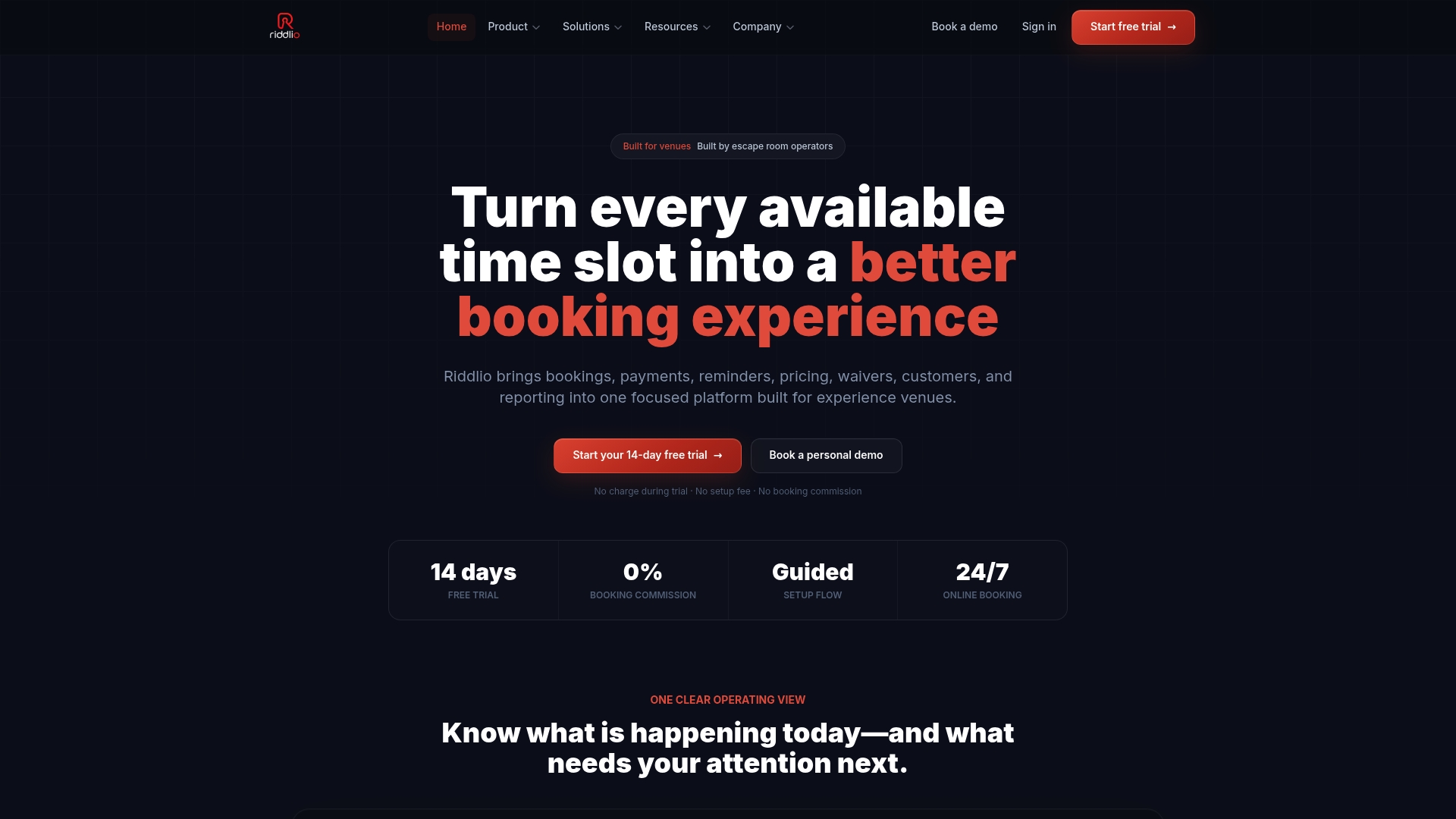
Riddlio is an online booking and management platform made for escape rooms. It brings bookings, availability, payments, customer communications and reporting together, with plans from Starter at $29 per month, Pro at $79 per month and Unlimited at $199 per month, plus Enterprise on request. See the plans and pricing or the escape room booking software overview.
If you also want to show up in Google’s local listings alongside your ads, our guides to the Google Things to Do listing and a 90-day SEO sprint cover the organic side.
FAQ
How much should I spend on Google Ads for my escape room?
Spend what you can keep running for several weeks, because the system needs conversion data to learn. Work backwards from what a booking is worth to you and how many bookings the budget must produce. Starting with lower-cost keywords, as Google’s checklist advises, stretches a small budget further.
Which keywords should I start with?
Begin with high-intent phrases that combine booking with your city, plus your own venue name. Add occasion terms such as birthdays and team building in their own campaign. Use Keyword Planner to check volume and costs, and add negative keywords for DIY and free searches.
Should I use Performance Max or Search?
Start with Search, since it captures people actively looking to book. Graphed advises that Search should hold most of the budget and warns that Performance Max can bring lower-quality traffic for local venues. Consider other campaign types only once Search converts steadily and your tracking is reliable.
Can Google Ads reduce no-shows?
Not by itself. Ads bring in bookings; no-shows are reduced by payment at booking, confirmations and email or SMS reminders. A booking platform that sends these automatically does that job after the ad has done its.
How do I know if my ads are working?
Record each completed booking as a conversion with its value, then compare cost per booking and revenue per ad dollar. Check that Google’s counted bookings roughly match the reservations in your booking system before you act on the numbers.
Sources
- Create a Search campaign - Google Ads Help
- How To Set Up Your First Google Ads Campaign
- How To Set Up Google Ads: A Checklist
- Google Ads for Escape Rooms: Campaign Structure, Budgets
- Escape Room Marketing: The Complete Guide
- Maximize Bookings: Google Ads for Escape Rooms Strategy
- Google Ads Local Keyword Targeting: Complete Guide
- Escape Room Near-Me Ads: Review Your Booking Area
- A Google Ads Tutorial for Beginners
- PPC Advertising for Escape Rooms
- Escape Room Conversion: Visitors to Bookings
- Eastern Escape Case Study
- Mind Trap Escape Case Study
- Hotel Local SEO: How Independent Hotels Win Nearby Searches