Most escape rooms need 10 to 20 minutes between the end of one game and the start of the next, and the right number for your room is the one you measure, then build into the booking calendar as a fixed buffer. A 60-minute game rarely occupies 60 minutes of room time. Add the briefing, the exit, the reset and a margin, and the real slot is closer to 90 to 95 minutes. In Riddlio you can set a buffer between bookings so the calendar never sells time you need for the reset.
This guide is for owners and venue managers who schedule rooms. It covers what turnover includes, typical reset times, how to turn them into slot lengths, and how to track the numbers.
TL;DR
- Turnover is everything between one group finishing and the next group being able to start: exit, photo, belongings sweep, reset, cleaning, final check and the briefing.
- A 2019 owner survey put the average reset at 12 minutes, with most owners at 10 to 15. Lock-heavy or consumable-heavy rooms can run much longer.
- Build slot length from four inputs: game length, brief, reset and buffer. A 60-minute game with a 15-minute brief and a 20-minute reset is a 95-minute slot.
- Time ten real resets per room with a stopwatch, use the average, and review actual against planned slot length every month.
- Put the buffer in the booking calendar, not in your head, so online bookings cannot collide with a reset.
Table of Contents
- What turnover time actually includes
- How long resets take in practice
- Turn reset time into a slot length
- How to measure your own turnover
- Why compressing the reset backfires
- Reduce reset time without rushing
- Put the buffer into the booking calendar
- What this costs with Riddlio
- Your turnover checklist
- FAQ
- Sources
What turnover time actually includes
Turnover is the staff time between one booking ending and the next starting: re-hiding clues, re-locking boxes, resetting puzzles, wiping down and fixing what the last group moved, according to a bookkeeping firm that works with escape room operators. That is the part staff see. The part the calendar has to cover is wider.
Think of the full cycle for one group:
- Check-in and waivers. One US venue tells guests to arrive 10 minutes early and plan about 15 minutes before a 60-minute game for waivers and briefing.
- The game. Your published length.
- Exit and photo. Staff escort the group out, take the photo and sweep for belongings.
- Reset and cleaning. The room goes back to its starting state, and high-touch props and surfaces are wiped.
- Final check. A walk-through before the next group enters.
A reset that overlaps with the next group’s check-in is the usual way a schedule slips. If your calendar only knows the 60 minutes of play, it will sell the rest of the cycle twice.
One measurement point matters for tracking. A common definition of reset time is minutes from the last player leaving to the room being ready for the next team. Pick that definition, write it into your shift sheet, and use it for every room so the numbers can be compared.
How long resets take in practice
Published figures vary because rooms vary. Use them as a starting range, not a target.
| Source | Reset time reported |
|---|---|
| 2019 owner survey, 206 owners, 156 in the US | Mean 12 minutes, most owners 10 to 15 |
| University of Central Florida thesis, 2025 | 5 to 15 minutes for mixed physical and technology rooms; upwards of 30 minutes for lock-heavy rooms |
| Bookkeeping firm for escape rooms, 2026 | About 8 minutes for a simple room, about 25 for a complex multi-room build |
The survey is from 2019, so treat it as a rough anchor and not a current industry average. What it shows well is the spread: the same game length can carry very different reset costs.
The same thesis names what pushes resets higher: lock-heavy designs, lengthy replacement of consumables such as refilling water systems, pieces that guests take home, and broken items. Staff speed is rarely the main cause. If one room consistently overruns, look at its puzzle list before you look at your game masters.
Turn reset time into a slot length
Build each room’s slot from four inputs: game length, brief length, reset length and a turnover buffer. One scheduling guide for owners gives an illustrative slot of 95 minutes for a 60-minute game with a 15-minute brief and a 20-minute reset, and 105 minutes when the reset takes 30.
Here is the same arithmetic as a labelled illustration. These are example numbers, not Riddlio defaults:
| Room A (light reset) | Room B (lock-heavy) | |
|---|---|---|
| Game | 60 min | 60 min |
| Check-in and brief | 15 min | 15 min |
| Reset | 15 min | 30 min |
| Slot length | 90 min | 105 min |
| Slots in a 10-hour day (600 min) | 6 | 5 |
The daily count is open minutes divided by slot length, rounded down. A spreadsheet formula published for operators makes the rounding point explicitly: 720 open minutes with a 60-minute session and a 15-minute reset gives 9 sellable slots, not 9.6. You cannot sell 0.6 of a game, so the leftover minutes are where you decide whether to open earlier, close later or shave the reset by changing the room.
The lesson from the table: five extra minutes of reset on a room can cost a whole sale per day. That is why reset time deserves its own number and not a rounded guess.
What it costs in labour
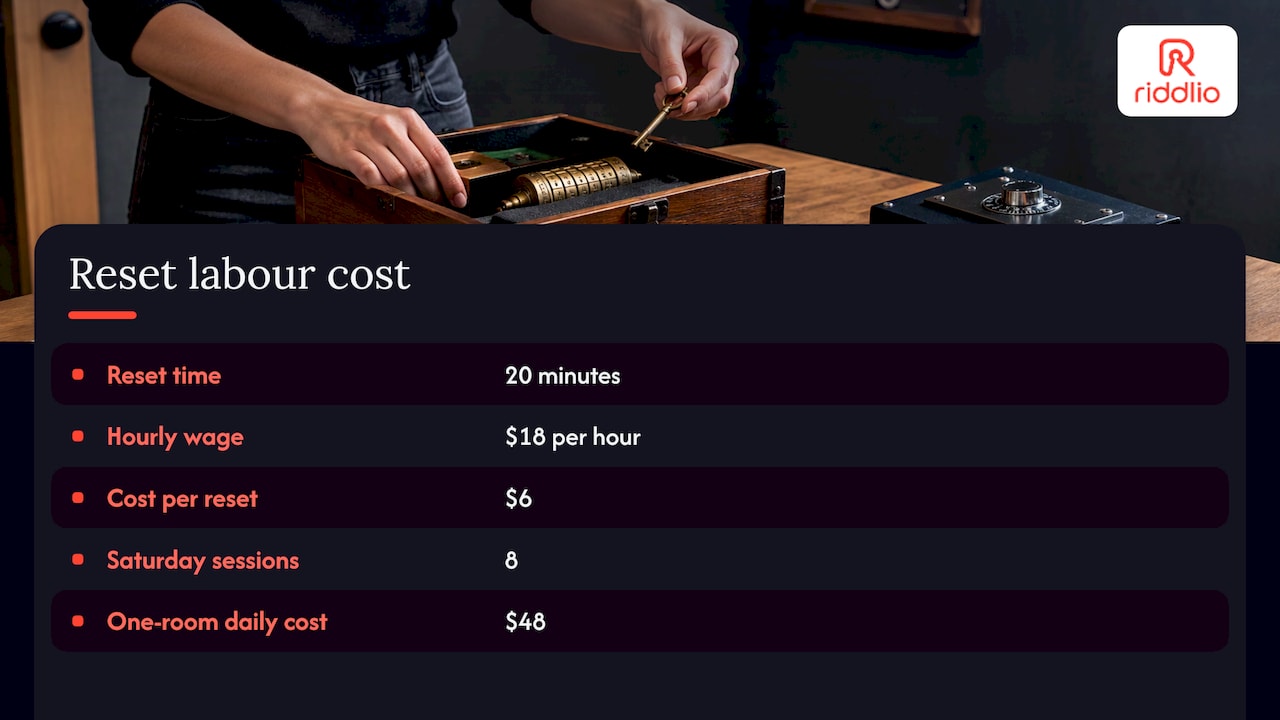
Reset time is paid time. The same bookkeeping firm works an example with a 20-minute reset at $18 per hour, which costs $6 per reset. Across eight Saturday sessions that is $48 for one room that day. It is an illustration with a made-up wage, so substitute your own rate. The point is that a longer reset costs both a sale and wages. It is also why a reset that regularly runs past the buffer is worth fixing rather than absorbing.
How to measure your own turnover
Start with the stopwatch. Advice for owners is to time ten resets and take the average before deciding whether to add a second prop set or a dedicated weekend resetter. Do it per room, not per venue.
- Define start and end. Start when the last player is out. End when the room is checked and ready.
- Time ten resets per room. Include a busy Saturday, since reset time is the first number to blow out on a Saturday. Use an experienced game master and a newer one, and note which was which.
- Separate cleaning from game readiness. Record how long the puzzle reset takes and how long the cleaning takes. If one dominates, that is where to improve.
- Set the buffer at the average plus a margin. Use the average as your reset figure, then add buffer for the final check and a late finish. Leave out the best-case run.
- Record every day. A reset time on the shift sheet, averaged weekly, shows drift before guests notice it.
A monthly review keeps it honest. One method pulls three numbers per room: planned slot length, actual slot length and on-time start rate. It sorts the gap by cause. Resets running long point to prop design or cleaning sequence, while late starts point to check-in or the brief. Change only the schedule or only the roster in a given month, and watch for four weeks before changing again.
Why compressing the reset backfires
There is a temptation to shorten the buffer when weekend demand is high. A 2026 operations article warns that squeezing resets creates the appearance of efficiency while staff rely on memory and defects get pushed to later. It also notes that a single late finish pushes every later booking back.
The cost of a missed step is concrete. A hiring guide for escape room operators notes that a missed combination lock means the next group starts inside a solved puzzle. The fix is a photo of the room in its correct starting state that the game master compares against before the next booking. A signed reset sheet with the time the room went ready gives you the data for the monthly review at the same time.
Some safety checks belong in every reset regardless of time pressure: clear the exit path, confirm the emergency release works and confirm the entry door is closed and latched. If a room fails that final check, it is not ready, however many minutes remain.
Reduce reset time without rushing
The durable gains come from the room, not from faster hands.
- Design for the reset. Choose locks that are quick to re-set, reduce small loose items and fasten down props that do not need to move, as one designer recommends.
- Use a master reset where possible. An experienced designer argues for a reset budget set before building, with a single switch to re-arm electronic locks and status lights for the game master.
- Follow one fixed route. Staff who work from the final puzzle backwards, in the same order every time, make fewer misses. Write that route down per room.
- Train in the order the work happens. Shadow a full shift, run one room with a trainer, then run a full slate solo.
- Log repeat failures. If the same lock or magnet fails weekly, fix it permanently. A weekly staff play-through catches puzzles that have become unsolvable through wear.
- Keep a room status board. For venues with several rooms, a simple In Session, Resetting, Ready board prevents groups being checked into unreset rooms.
Put the buffer into the booking calendar
A buffer that lives in a staff member’s head fails the moment a guest books online at 11 pm. The reset has to be part of the schedule the customer sees.
Riddlio’s buffer time between bookings setting lets operators set a buffer of 5 to 60 minutes, so a reset window is blocked from sale instead of relying on staff to defend it. That range covers a light reset in one room and a long rebuild in another. Set it per room using your measured averages, not one number for the whole venue.
For multi-room venues, turnover timing and staffing interact: two rooms finishing at once need two resetters or a staggered start. Riddlio’s guides on multi-room scheduling and staffing by demand walk through that planning. If you want to see how fully your calendar sells once turnover is built in, the slot utilization playbook covers it. Everything feeds from the same online booking calendar, so the slot the guest books is the slot you planned.
What this costs with Riddlio
Riddlio is booking and venue-management software built for escape room operators. Plans are billed monthly in USD: Starter at $29 per month, Pro at $79 per month and Unlimited at $199 per month, with Enterprise priced on request. The pricing is a flat subscription with no booking commission. Payment provider fees and SMS usage are separate, and features differ by plan, so check the pricing page for what each plan includes.

If you are comparing options, the escape room booking system page shows how availability, bookings, payments and waivers connect.
Your turnover checklist
- Define reset time as last player out to room ready, and use it in every room.
- Time ten resets per room, including a busy Saturday.
- Add up the cycle: brief, game, exit, reset, final check.
- Divide open minutes by slot length and round down.
- Enter the buffer in the booking calendar, per room.
- Sign off each reset and record the time.
- Review planned against actual slot length monthly.
- Fix the room when one keeps overrunning.
FAQ
How long should I leave between escape room bookings?
Most owners report 10 to 15 minutes for the reset itself, and a 2019 survey found an average of 12. Add the brief and a small margin, and plan for a 90 to 95 minute slot for a 60-minute game. Measure your own rooms before you settle on a figure, because lock-heavy rooms can take far longer.
Does turnover time include the briefing?
Turnover is usually the gap between one group finishing and the room being ready for the next. The briefing and check-in belong in the slot length, since they take room-schedule time even though they happen before the game. Counting them separately makes it easier to see whether a late start comes from the reset or from check-in.
Why does my reset take longer on weekends?
Busy days bring more groups, tired staff and more wear on props, and reset time is often the first number to slip on a Saturday. Check whether one room or one prop causes most of the overrun, and whether you have enough staff for rooms that finish together. A dedicated weekend resetter is one option to weigh once you have ten timed resets.
How do I stop online bookings clashing with a reset?
Block the reset time in the schedule itself. With Riddlio you can set a buffer between bookings from 5 to 60 minutes, so the calendar will not sell that window to another group.
Sources
- Reset Labor: The Silent Margin Killer in Escape Rooms
- State of Escape Room Industry Survey 2019 (Owner’s Survey)
- Escape Room FAQ: Plan Your Visit
- It’s Been Here All Along: Increasing Discomfort in Escape Rooms (UCF thesis, 2025)
- Scheduling escape room work so nothing slips
- Escape room metrics: monthly tracking without the noise
- Hiring and training escape room game masters
- Escape Room: Time Slots Per Day From Session And Reset
- The Room Must Forget You: Escape Room Reset Operations
- Reset Time: The Secret Weapon of a Profitable Escape Room
- Entertainment Venue Operations: Game Masters, Booking Systems