Give guests a 10 to 15 minute grace period, then cut their playtime to protect the scheduled end time, or treat the booking as a no-show past a hard stop. Charge a rescheduling fee for genuine no-shows but waive it if guests call ahead. Publish the rule everywhere, automate the reminders, and train staff to enforce it the same way every time. The templates and workflow below turn that one sentence into something you can paste into your booking system today.
TL;DR:
- Enforce a strict 10 to 15 minute grace period with fixed session end times, reducing late arrivals’ playtime without extending the slot.
- Use automated reminders at four contact points, including immediate SMS at session start, to prevent most late arrivals before they happen.
- Reserve 10 to 25 percent of each time slot for walk-up guests and late reassignments to absorb delays without disrupting subsequent bookings.
- Implement consistent staff procedures for marking late arrivals in the system, maintaining schedule integrity and providing clear documentation.
- Automate the entire policy enforcement with tools like Riddlio to minimize staff errors and disputes, starting at affordable plans for small venues.
Table of Contents
- The late arrival policy template every venue can copy
- How staff should enforce the policy on the day
- Why automated reminders cut late arrivals before they happen
- How much walk-up buffer should you build into each slot?
- Getting check-in right at the front desk
- Legal wording that protects you without alienating guests
- What operators consistently get wrong about lateness
- Let automation carry the policy you just wrote
- Sources
- FAQ
The late arrival policy template every venue can copy
A written late arrival policy only works if it answers five questions before a guest ever asks them: how early to arrive, what happens if they’re late, whether the room still ends on time, who to call, and what it costs to reschedule. Here’s a base template you can adapt in minutes.
“Please arrive [15] minutes before your scheduled start time to complete check-in and waivers. Guests arriving after the game has started will receive reduced playtime, as sessions end at the originally scheduled time to protect the next booking. Arrivals more than [20] minutes late will be treated as a no-show. Running late? Call [phone number] and we’ll do our best to accommodate you. No-shows forfeit their booking fee; a $[X] rescheduling fee applies to late cancellations within [24] hours.”
Three variants suit different venues:
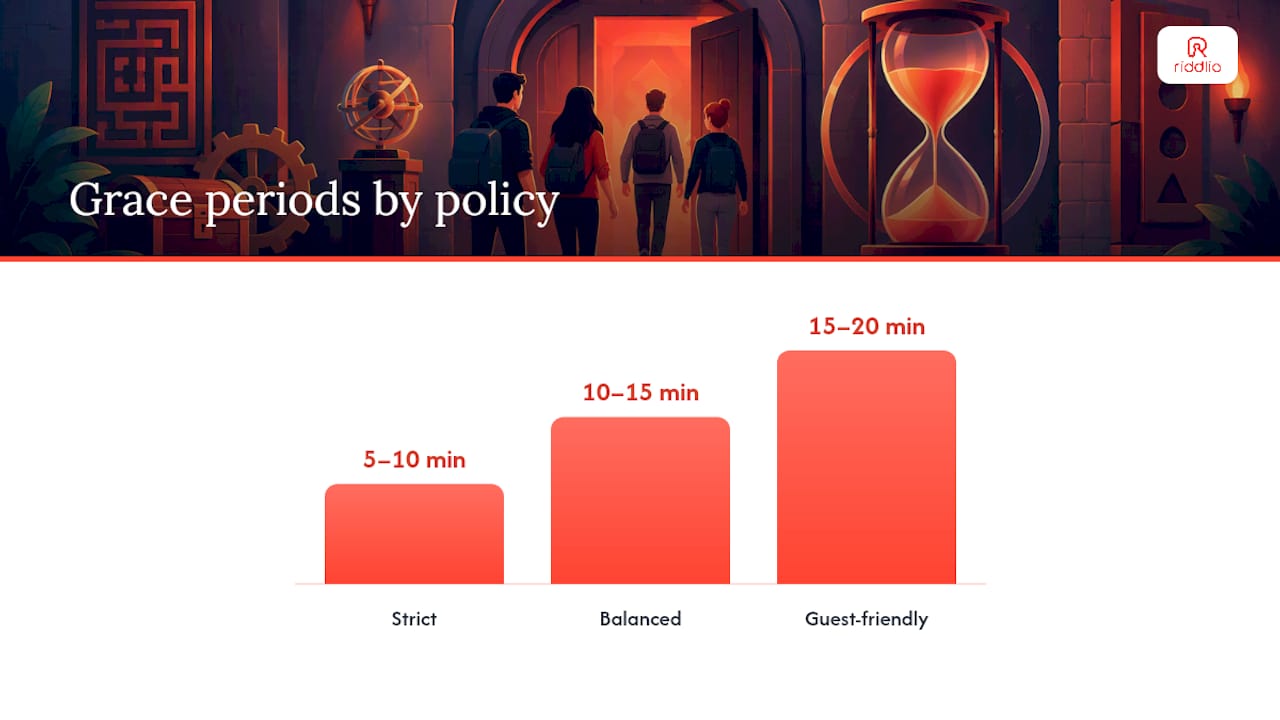
- Strict: 5 to 10 minute grace period, no reschedule offered, full forfeiture after the cutoff. Works for high-demand weekend slots where every minute of delay bleeds into the next group’s game.
- Balanced: 10 to 15 minute grace period, reduced playtime rather than outright forfeiture, small reschedule fee (commonly $10 to $20). This is the middle ground most venues land on.
- Guest-friendly: 15 to 20 minute grace period, free reschedule if guests call within 24 hours. Suits venues still building repeat custom or operating in a competitive local market.
Whichever version you pick, publish it in three places: the booking confirmation email, your terms and conditions page, and physical signage at the front desk. If you’re running bookings through a booking system, the same wording should also sit inside the widget itself, right where guests select their time slot.
How staff should enforce the policy on the day
Enforcement fails when it depends on staff memory. Build it into four checkpoints instead:
- Confirmation — sent the moment a guest books, restating arrival time and the grace period.
- Pre-arrival reminder — sent 24 to 48 hours out, then again roughly two hours before start.
- Mark-as-late at scheduled start — if a guest hasn’t checked in when the timer would normally begin, staff flag the booking as late in the system rather than guessing.
- Close or no-show after threshold — once the grace period lapses, the booking is closed and the slot is either held briefly for a walk-up swap or released.
The critical detail most venues miss: marking a booking late should never push back the session’s end time. If a group arrives 12 minutes late, they get a room that ends on schedule, not a full session that runs 12 minutes over. That single rule is what keeps every later slot on the day from sliding into a queue of overtired staff and frustrated groups.
Document every contact attempt, a missed call, a text sent, a voicemail left, because that record is your evidence if a guest disputes a fee later. Give managers discretion to override the policy for genuine emergencies; a rigid rule with zero flexibility creates more bad reviews than it prevents.
Pro Tip: Train staff to use one fixed phrase when a guest pushes back on reduced playtime: “Our rooms are timed so the next group isn’t affected, but I can see if we’ve got room to reschedule you.” It de-escalates without promising something you can’t deliver.
Why automated reminders cut late arrivals before they happen
Most late arrivals aren’t defiance, they’re guests who underestimated parking, traffic, or how long check-in actually takes. A four-touch reminder cadence heads that off:
- Booking confirmation, sent instantly.
- A reminder 48 to 24 hours before the session.
- A second reminder around two hours out, with specific arrival guidance (“arrive 15 minutes early to complete waivers”).
- An immediate SMS if a guest hasn’t checked in by session start, flagging the grace period countdown.
Each message should carry the same core fields: start time, recommended arrival time, whether a waiver needs signing on-site, a phone number, and the consequence for arriving too late. Repetition matters more than creativity here, guests skim messages, so the hard-stop consequence needs to appear in at least two of the four touches.
This is also where clear, self-service messaging beats discounting as a strategy for filling late inventory, since operators who give guests easy ways to reschedule capture more committed revenue without training customers to expect a discount for lateness. A platform like Riddlio’s SMS reminder system handles this cadence automatically and keeps a timestamped record of every message sent, which doubles as your dispute evidence.
How much walk-up buffer should you build into each slot?
Reserve 10 to 25% of each slot’s capacity for walk-ups and late reassignments rather than selling every seat. Museums and timed-entry attractions reserve roughly 10 to 20% of each slot specifically for walk-up demand, and the same logic holds for escape rooms: a small buffer absorbs the guest who arrives eight minutes late without forcing you to bump the group behind them.
Slot length should match session time plus reset time, with deliberate headroom rather than back-to-back bookings squeezed to the minute. Selling every seat to 100% capacity is the mistake attraction operators are warned against most often, because a single delayed group at 100% fill has nowhere to absorb the slippage.
For late-fill tactics, consider:
- Releasing unsold last-hour inventory dynamically once no-show risk is confirmed.
- Running a virtual queue for peak weekend windows so guests get a digital position instead of a physical line.
- Over-issuing bookings cautiously, operators running 15-minute slot systems commonly over-issue by 20 to 25% to cover predictable no-shows, a tactic worth testing carefully before scaling it.
Getting check-in right at the front desk
Physical check-in is where a good policy either holds or falls apart in front of a queue of impatient guests. Two tools do most of the work: QR-based reservation lookup and colour-coded entry markers.
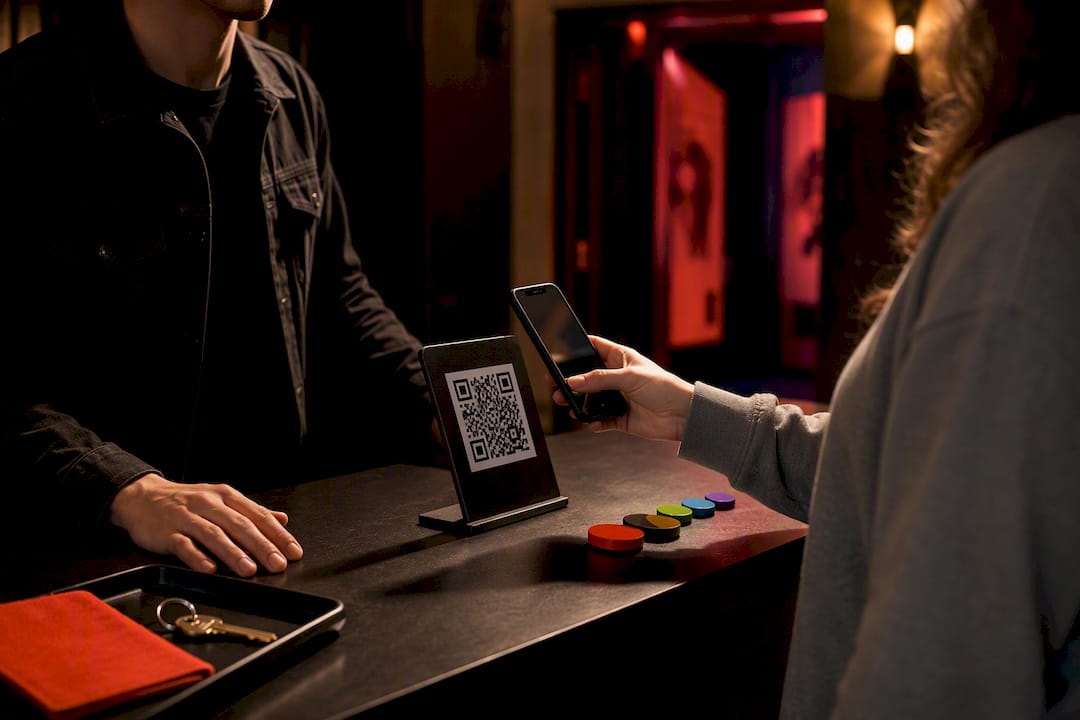
Scan the booking QR code or search by name, then hand over a Tyvek® wristband colour-coded to that time slot. Colour-coding by slot speeds visual verification across staff, so anyone on the floor can spot at a glance which group belongs where, no radio call needed.
Practical setup:
- Pre-sort wristbands by slot before doors open, not during the rush.
- Station two attendants at peak windows, one scanning, one banding.
- Hold a small reserve of unassigned wristbands for walk-up swaps.
A tight check-in script keeps things under 15 seconds per guest: confirm name, confirm party size, hand over the wristband, point to the waiting area. Anything longer and your grace period starts eating into itself before the group has even reached the room.
Legal wording that protects you without alienating guests
Keep it short: “Bookings are non-refundable for late arrivals or no-shows. Guests who contact us within [15] minutes of their start time may qualify for a reschedule at management’s discretion.” Link this line to your full terms and conditions rather than trying to cover every scenario in the confirmation email itself. Log every contact attempt as evidence if a dispute arises, and give managers clear authority to waive fees for documented emergencies. Consumer protection expectations vary by jurisdiction, so have a lawyer review the final wording before it goes live.
What operators consistently get wrong about lateness
Consistency beats leniency almost every time. A venue that enforces its grace period strictly nine times out of ten, then makes an exception on the tenth, trains guests to gamble on lateness. Scripted staff responses matter more than clever policy wording, because disputes escalate when a guest gets a different answer from two different staff members on the same day.
The most common pitfalls I see: overselling every seat in a slot, publishing a vague policy that only appears in fine print, and running check-in with no wristband or QR system at all, which forces staff to rely on memory during a rush. Fix those three and most lateness complaints disappear on their own.
— Iosif Beraru
Let automation carry the policy you just wrote
A policy is only as good as your ability to enforce it without a staff member babysitting every booking. Riddlio replaces manual phone calls and sticky notes with automated SMS and email reminders, a mark-as-late workflow that preserves your session end times, and timed slots that sync straight to your calendar, so the grace period you set actually gets applied the same way every single time.

Instead of hiring extra front-desk staff to chase down late guests, Riddlio’s booking and reminder system does it automatically, flags a booking the moment the grace period lapses, and gives your team a clean, timestamped record if a refund dispute comes up later. Plans start with the Starter tier at $29 a month, scaling up to Pro and Unlimited as your booking volume grows. If you’re still enforcing your late arrival policy by memory, book a look at Riddlio’s pricing page and see which tier fits your venue.
Sources
- How to manage timed entry at museums and exhibits
- Attraction capacity management
- Virtual queueing: museums & exhibitions (2026)
- Trends report: advance and last-minute demand
FAQ
How long should a grace period be for a late escape room booking?
Most venues set a 10 to 15 minute grace period, extending to 20 minutes for guest-friendly policies. Beyond that window, venues commonly treat the booking as a forfeited session rather than delaying the group behind them.
Does a late arrival get extra time added to their session?
No. The standard practice is to keep the scheduled end time fixed and simply reduce the late group’s playtime, which protects every booking scheduled after theirs.
Should venues charge a no-show fee or offer a reschedule?
Charge a no-show fee for guests who never call, but waive it or offer a free or low-cost reschedule for guests who contact the venue before their grace period expires. This rewards communication without punishing genuine emergencies.
How can automation reduce late arrivals?
A four-touch reminder cadence, confirmation, a 48 to 24 hour reminder, a two-hour reminder, and a same-day SMS, catches most guests before they’re running late. Tools like Riddlio’s automated SMS reminders handle this cadence without manual staff follow-up.
What should staff do when marking a booking as late?
Flag the booking as late in the booking system at the scheduled start time, keep the session end time unchanged, and log any contact attempts. This keeps later slots on schedule and gives you a clear record if the guest disputes the outcome.