
Tipping on a booking means two different things. For a guest, it is the cash or card tip you add for the people who deliver what you booked: the housekeeper, the tour guide, the game master. For a venue owner, it is a policy question: do you ask for tips at checkout, who keeps them, and what do the tax rules say? This guide covers both, with current US figures for guests first and a practical setup for escape room operators after.
TL;DR
- Guests: US hotel housekeeping is usually tipped $2–$5 per night, left daily, and tour guides commonly get 10%–20% of the tour cost.
- Check first whether a service charge or daily fee already covers gratuity. If it does, you usually add little or nothing.
- Venues: keep the tip out of the ticket price. Offer it as a separate, optional step so your pricing stays clean and your reporting stays accurate.
- Tips belong to the staff who earned them. Federal rules say employees must report $20 or more in a month to the employer, and managers cannot keep staff tips.
- Riddlio is flat-priced with no booking commission, so a tip never gets mixed into a percentage fee.
Table of Contents
- Tipping etiquette for guests in the US
- Should you tip at an escape room?
- Setting a tipping policy for your venue
- Booking-time tips versus after-game tips
- What the rules say about tips
- How operators can keep tipping tidy
- Perspective: keep the ticket price honest
- Run the booking side with Riddlio
- Other booking types where tips come up
- FAQ
- Sources
Tipping etiquette for guests in the US
The search results for this topic are dominated by hotel guides, so start there. The numbers below are customary, not legal requirements. They shift with the property, the room and the effort involved.
Hotel stays
AFAR’s 2026 US hotel guide puts housekeeping at $2–$5 per night, left daily, $2–$5 per bag for bellhops, $2–$5 for valet service and 15%–20% for room service. Other guides sit slightly higher. The Points Guy suggests $3–$5 per day for housekeeping, and AAA reports that the hotel union UNITE HERE recommends at least $5 per night.
Why daily? Staff rotate, so a single tip left on the last morning may miss the person who cleaned your room on day two. NerdWallet makes the same point, and adds that you can add about $1 per person for groups.
| Hotel service | Typical US tip |
|---|---|
| Housekeeping | $2–$5 per night (more at luxury properties) |
| Bellhop | $2–$5 per bag |
| Valet | $2–$5 |
| Room service | 15%–20% if no service charge is included |
| Concierge, hard-to-get reservation | About $10 |
| Concierge, extensive itinerary | $20–$50 |
All figures in the table come from AFAR’s guide.
How the amount changes
Three things move the number most:
- Room rate and type. AFAR says luxury properties can justify $5–$20 per day, especially with turndown, multiple rooms or a villa.
- Mess and special requests. Extra occupants, pets, children or an unusually messy room all justify adding to the base amount.
- Whether gratuity is already included. AAA’s tipping guide advises asking whether a hotel or resort includes gratuities in a daily fee before you tip on top.
One more practical rule: leave cash somewhere visible with a note saying it is for housekeeping. The Points Guy’s hotel guide recommends a desk or other clear surface, ideally with a note or envelope. And if no service was provided on a given day, CNBC’s etiquette experts say you need not tip for that day.
Tours and activities
For a guided tour, The Points Guy recommends 10%–20% of the overall tour cost, and on group trips drivers and local guides may also get a few dollars per day. Tipping is discretionary, and a quick, polite word at the end of the experience is how it usually works.
Should you tip at an escape room?
There is no fixed national figure for escape rooms, and we are not going to invent one. Game masters run the briefing, watch the cameras, give hints and reset the room, and many guests want to say thanks. Whether they can depends entirely on the venue’s policy. Some venues welcome tips, some ask guests not to, and some pay a wage that already reflects the role.
That gap is the real issue for operators. If guests do not know what is expected, they either feel awkward or they tip in ways you never planned for: cash handed to one staff member, a payment app link on the wall, a note on the feedback form. Each of these creates a tax and fairness question you then have to answer.
Setting a tipping policy for your venue
Pick one of three positions and say it clearly before the game, not after.
| Policy | How it works | Best for |
|---|---|---|
| No tipping | Staff are paid a full wage, and you say so on the booking page and at check-in | Venues that want a simple, premium feel |
| Optional tip, pooled | Guests can add a tip, and it is shared by the team on duty | Venues with several game masters per shift |
| Optional tip, individual | Guests tip the game master who ran their session | Small venues with one host per game |
Whichever you choose, three habits keep it clean.
Keep tips separate from the price. A tip is not revenue, and it should not be tied to the ticket. If you run dynamic pricing for peak and off-peak slots, a tip that sits inside the price distorts every number you use to judge a time slot. Show the ticket price, add tax, and make the tip an optional line afterwards.
Do not use a percentage default that surprises people. A preset of 20% on a group booking of eight can look large. If you offer presets, use flat amounts per team or per person that you would be comfortable defending, and always allow “no tip”.
Say who receives it. One sentence on the booking page, such as “Tips go to the game masters on shift”, answers the question before a guest asks it.
Booking-time tips versus after-game tips
Most venues ask the question at one of two moments.
At booking. The upside is that the money is collected with the rest of the payment. The downside is that the guest has not yet had the experience, so they are tipping on faith. Conversion also suffers when a booking form feels like a checkout with extras. For a $30 per person game, an extra field is a small friction, but friction at the final step is where bookings are lost.
After the game. The guest has just had the experience, the host is standing right there, and the tip reflects it. The downside is that it relies on a tablet, a card reader or a QR code at the front desk, and staff must not pressure anyone.
For most escape rooms, after the game wins on goodwill and booking time wins on collection. If you want booking-time tips, keep them optional, post-payment and clearly labelled. If you do not want them at all, say so, and let your payment setup stay a simple ticket price with a deposit or full payment.

What the rules say about tips
This is the part many owners learn too late. We are a software company, not your accountant or lawyer, so use this as a map and check the details with a payroll professional in your state.
- Tips belong to employees. The Department of Labor’s Fact Sheet 15 says a manager or supervisor may keep only the tips they receive directly from a customer for service they directly and solely provide. Employers cannot dip into the pot.
- Staff must report tips. The IRS says an employee who receives $20 or more in any month must report those tips to the employer by the 10th of the next month, and the employer must withhold federal income, Social Security and Medicare taxes on them. It also notes that tips added by card count, as do tips from tip-splitting arrangements.
- Tips can count toward wages in some cases. The Department of Labor’s hotel fact sheet says tips may count toward wages for employees who regularly receive more than $30 a month, subject to wage requirements. Your state may differ, so confirm locally before relying on a tip credit.
The practical consequence: card tips are easier to track than cash. Cash handed to a game master leaves no record, and a payment app link pinned to the wall leaves a record in someone’s personal account, not yours. A tip that runs through your payment processor can be reported by date, shift and staff member.
How operators can keep tipping tidy
A checklist you can apply this week:
- Decide your policy and write it in one sentence on the booking page.
- Train staff to answer “do you accept tips?” the same way every time.
- Send tips through your processor, not personal apps, so there is a record.
- Keep tip totals out of your revenue-per-slot reporting.
- Record how tips are split and who is on shift, so payroll can reconcile at month end.
- Review the policy once a year, especially if you change staffing.
Tips are also tied up with how you handle refunds and credits. If a game is cancelled, decide in advance what happens to any tip already taken. Our piece on why venues give credits instead of cash covers the refund side of that thinking.
Perspective: keep the ticket price honest
We built Riddlio for escape rooms, and the question we hear is rarely “how do I collect tips?” It is “how do I stop money getting messy?” Our view is that the booking price should say exactly what the game costs, and everything else should be a visible, optional extra.
That is also why we charge a flat monthly plan and no commission on bookings. A percentage fee on every transaction creates an odd incentive around any add-on, tips included. With a flat fee, a $10 tip is the team’s $10, not a number that shifts your software bill.
A tip policy is really a staffing policy. Venues that pay well and say so tend to need less on the tip front. Venues that depend on tips should be open about it and make sure the money reaches the people who earned it. Either way, the guest should never have to guess.
— Iosif Beraru
Run the booking side with Riddlio
Tipping is only one line in a booking flow. The bigger gains come from a calendar that cannot double-book, payments that reconcile and reminders that cut no-shows. Riddlio combines online booking, payment processing, SMS reminders, waivers and analytics in one system built for escape rooms.
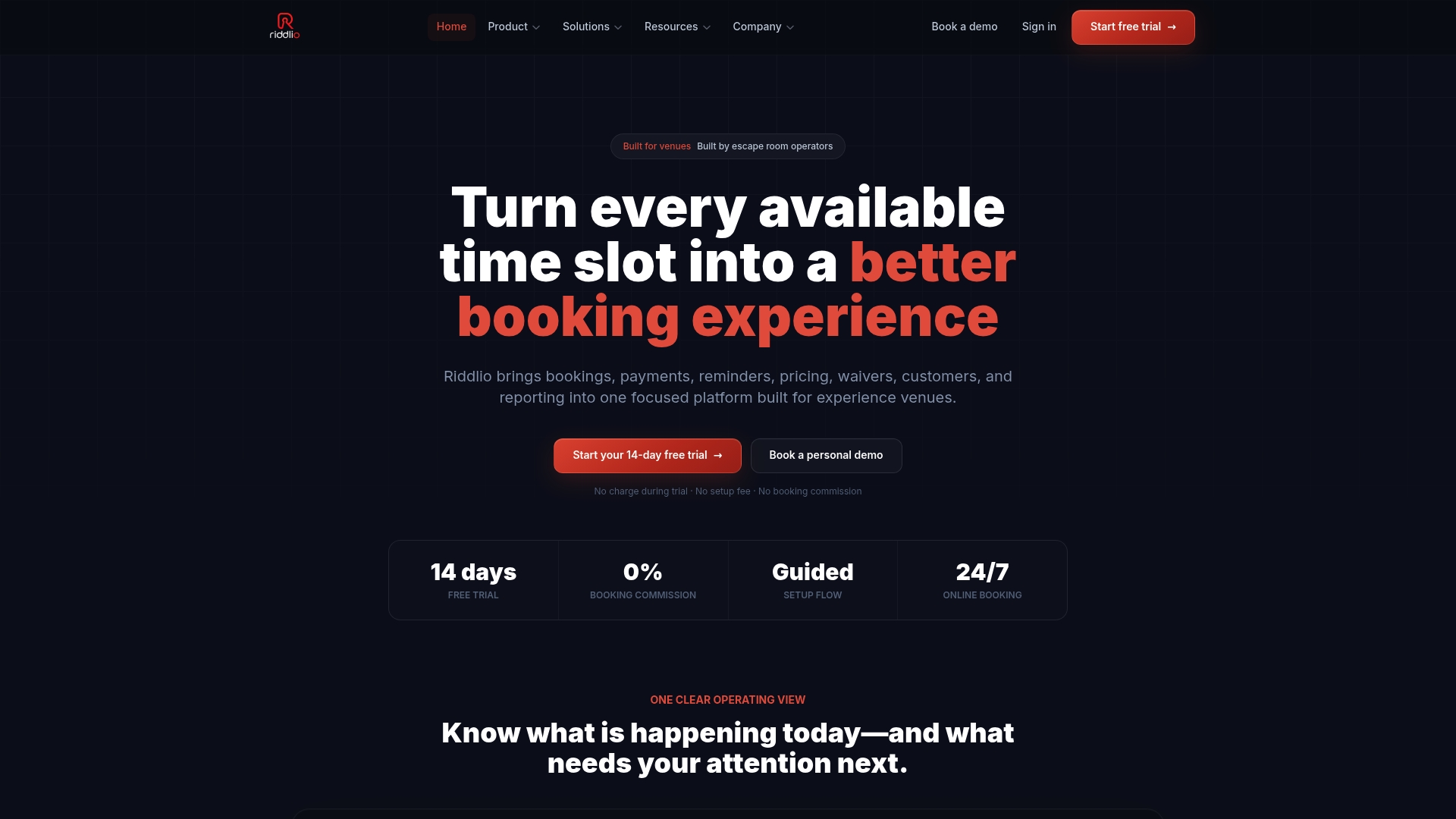
Plans are published at riddlio.com/pricing: Starter is $29 per month, Pro is $79 per month and Unlimited is $199 per month. Enterprise has no published price. You pay a flat monthly fee and no commission per booking.
Other booking types where tips come up
Escape rooms are not the only venues dealing with this. Tour operators, immersive experiences and corporate events all face the same choice about when and how to ask.
- Guided tours and activities. Guides are the classic tipped role, and the 10%–20% norm above applies. Operators often use tour and activity booking software to handle deposits and groups, and a short post-tour message works better than a field in the booking form.
- Corporate groups. Company bookings are usually paid by invoice, so tips are rare and often against internal expense policy. See our guide to corporate booking invoices for how to handle the paperwork.
- Gift vouchers. A voucher should cover the experience only. Do not build a tip into a voucher value, because the recipient decides on the day. Gift vouchers are cleaner when the amount is exactly the game price.
If your venue straddles several categories, our industries page shows how the same platform adapts.
FAQ
Do you tip on an online booking when you reserve?
Usually not at the time you reserve. For hotels, tips are given when service happens, such as daily for housekeeping. For tours and activities, the guest normally tips at the end. Only add a tip at booking if the venue clearly offers it and says who receives it.
How much should you tip hotel housekeeping per night?
Most US guides suggest $2–$5 per night, left daily with a note. Luxury hotels, large rooms, turndown service or a messy room can justify $5–$20. If the hotel charges a daily fee that includes gratuities, check what it covers before adding more.
Do escape room game masters expect a tip?
It depends on the venue. There is no national standard, so ask at check-in whether the venue accepts tips. If a venue says nothing, a sincere review or a repeat booking is always welcome.
Can an escape room owner keep the tips?
No, not from staff who earned them. Under the Department of Labor’s tipped-employee rules, tips belong to the employees, and managers may keep only tips they receive directly for their own service. Check your state’s rules and ask a payroll professional before setting up a pool.
Should a venue add tips to the ticket price?
We recommend against it. Keep the ticket price clean, show tax, and make any tip a separate optional step. That protects your pricing data and avoids surprising guests.
Sources
- How Much to Tip at Hotels in the U.S. (2026 Guide), AFAR
- Hotel Tipping: 5 Things Every Traveler Should Know, AAA Club Alliance
- Tipping Etiquette, AAA Club Alliance
- How Much To Tip Hotel Housekeeping?, NerdWallet
- How much should I tip when I travel?, The Points Guy
- What travelers need to know about tipping hotel staff, The Points Guy
- Places where you should always tip, say etiquette experts, CNBC
- Fact Sheet #15: Tipped Employees Under the FLSA, US Department of Labor
- Fact Sheet #45: Hotel and Motel Establishments Under the FLSA, US Department of Labor
- Taxpayers must report tip money as income on their tax return, IRS