Most activity providers will give you a full refund if you cancel before their stated deadline, typically somewhere between 48 hours and 14 days out. If the provider cancels on you, expect a full refund of the ticket price, though booking or platform fees sometimes stay in the provider’s pocket. Refunds land back on your original payment method, usually within 7 to 30 days.
TL;DR:
- Refunds for cancellations made within 48 hours to 14 days depend on activity size and type, with larger groups requiring longer notice periods.
- When a provider cancels an event, participants are typically entitled to a full refund, a reschedule, or a voucher, often processed within 7 to 14 business days.
- Add-ons like transport or meals may have separate refund deadlines, requiring careful review of specific policies before canceling.
- Refunds go back to the original payment method, with processing times varying from a few days to a month, depending on the operator.
- Third-party bookings or resellers may extend refund timelines up to 30 days, and initiating requests through the correct platform can prevent delays.
Table of Contents
- General refund rules for organised activities and programmes
- Cancellation windows and timelines: how deadlines scale with group size and event type
- Provider-cancelled events versus participant cancellations
- Credits, vouchers and activity-change vouchers: what they mean for you
- How to request a refund: step-by-step and what documentation helps
- Special cases: memberships, multi-day trips, passes and airline-packaged bookings
- Operational best practices from a booking-platform perspective
- Legal rights and consumer protection regulations related to refunds
- How refunds are processed for third-party bookings or resellers
- Author perspective: clearer policies protect customers and venues
- Policy examples and resources to read next
- Sources
- FAQ
General refund rules for organised activities and programmes
Every activity refund policy for activities reads a little differently, but the bones are usually the same. There’s a cutoff date, a rule about who keeps what, and a promise about when your money comes back.
Municipal recreation programs tend to be the clearest about this. San Diego Parks and Recreation, for instance, publishes a straightforward cancellation and transfer policy that spells out timing and eligibility rather than burying it in fine print. Private tour operators and escape rooms vary more, but the pattern holds.
A few things show up again and again:
- Deposits are often the first thing you lose if you cancel late, even when the rest of the booking is refundable.
- Processing fees and payment gateway charges are commonly non-refundable, because the provider already paid them to a third party.
- Refunds almost always go back to the card or account you paid with, not as cash or a bank transfer to a different account.
- Processing itself can take anywhere from a few business days to a full month, depending on the operator’s payment system and whether a human needs to approve it manually.
Read the cancellation section of any booking confirmation before you pay, not after something goes wrong.
Cancellation windows and timelines: how deadlines scale with group size and event type
Cancellation deadlines aren’t arbitrary. They scale with how hard it is for the provider to resell your spot, and larger bookings are harder to fill on short notice.
- 48 to 72 hours covers most standard tours, single-session classes and small group activities. Activities Hawaii uses this tier for its everyday bookings, giving both sides a workable buffer without locking customers in for weeks.
- 7 days typically applies once you’re booking for a larger group. A provider losing eight seats has a much harder resale problem than losing one, so the window stretches.
- 14 to 30 days shows up for multi-day trips, custom events and specialised experiences, where the provider may have already paid for guides, gear or venue hire on your behalf.
Add-ons complicate this further. Transport, equipment hire and catered meals frequently carry their own refund deadlines, separate from the core activity, because the provider is often paying a third party for those extras well ahead of your visit. Cancel your escape room slot with plenty of notice but forget the add-on meal package has its own 14-day cutoff, and you might get the room fee back while losing the food cost entirely. Always check whether add-ons are covered under the main policy or sit outside it.
Provider-cancelled events versus participant cancellations
The rules flip depending on who pulls the plug. When you cancel, you’re bound by the provider’s deadline. When the provider cancels, you’re generally owed your money back.
Participants who cancel outside the stated window typically forfeit part or all of their payment. Providers who cancel an event, however, are expected to make it right, and most reputable operators do.
When an activity or event is cancelled by the provider, participants are generally entitled to a full refund of the ticket face value, though platform service fees are often left out unless the operator says otherwise. Refunds for provider-cancelled events are typically processed within 7 to 14 business days, noticeably faster than the up-to-30-day window some operators quote for participant-initiated cancellations.
When a provider cancels, you’ll usually see one of three outcomes offered:
- A full cash refund back to your original payment method.
- A reschedule to another available date at no extra cost.
- A credit or voucher, particularly if the cancellation was weather-related and rebooking is straightforward.
Force majeure clauses matter here too. Multi-day events increasingly spell out that refunds don’t apply for cancellations caused by unsafe conditions such as poor air quality or extreme weather, even though the event itself didn’t go ahead as planned. That distinction between “provider chose to cancel” and “provider was forced to cancel by conditions outside their control” is where a lot of disputes start, so read that clause specifically rather than assuming any cancellation equals an automatic refund.
Credits, vouchers and activity-change vouchers: what they mean for you
Cash is expensive for a venue to hand back. Credits and vouchers keep money inside the business and encourage you to rebook rather than walk away, which is exactly why most operators default to them for cancellations made inside the standard window.
Big Sky Resort’s easy change policy illustrates the logic: credits protect the venue’s cash flow and nudge you toward a future visit rather than a refund. It’s not a hostile move, it’s just better for the provider’s books, and often faster for you than waiting on a bank to process a reversal.
Common voucher terms to watch for:
- A 12-month expiry window, after which the credit simply disappears.
- Non-transferability, meaning you can’t hand it to a friend or resell it.
- Exclusions on certain inventory, such as season passes, gift cards or specially priced events, as Mammoth Mountain’s activity-change terms make explicit.
Pro Tip: If a genuine medical issue or a provider-side error caused your cancellation, ask directly for a cash refund instead of a credit. Most venues will make an exception when you can show the credit isn’t reasonable for your situation, particularly with documentation in hand.
How to request a refund: step-by-step and what documentation helps
A refund request that’s missing information sits in someone’s inbox longer than it needs to. Follow a clear sequence and you’ll usually get a faster answer.
- Find the accepted request channel first. Many operators state clearly that voicemail, text or social media messages won’t be accepted as valid cancellation notice, only email or a specific online form.
- Include your booking reference, the purchaser’s name, and the original booking date in the first message. Guessing games slow everything down.
- Attach supporting documentation if you’re claiming an exception, such as a medical certificate or evidence of a travel disruption.
- Send the request before the deadline, not on it. Providers dealing with a flood of last-minute requests near a cutoff are slower to respond.
- Wait a reasonable period, generally 7 to 10 business days, before following up. If nothing’s moved by the outer edge of the provider’s stated window (up to 30 days), follow up in writing and reference your original request date.
Special cases: memberships, multi-day trips, passes and airline-packaged bookings
Standard cancellation rules bend or break entirely for a handful of booking types.
- Memberships and season passes are commonly non-refundable outright, or refundable only on a prorated basis for the unused portion. Check the membership terms specifically rather than assuming the general activity policy applies.
- Multi-day tours and events tend to favour transfers or deferrals over straight refunds, and a deferral for medical reasons usually requires documentation, as Cascade.org’s rides and events policy sets out with date-specific deadlines.
- Airline-packaged bookings, gift cards and promotional coupon codes are usually the strictest category of all, often carrying no-refund terms with no exceptions listed.
Operational best practices from a booking-platform perspective
Fair refund policies aren’t just good customer service, they’re good operations. Automated reminders and deposit collection reduce no-shows enough that some venues can afford to offer more generous cancellation windows without bleeding revenue, and platforms built for online bookings with deposit handling make that trade-off easier to manage.
The policy language worth favouring, whether you’re booking or running the venue, includes:
- An explicit deadline stated in hours or days, not vague phrasing like “shortly before your visit”.
- A named refund method, so you know whether you’re getting cash back or store credit before you cancel.
- Documented exceptions for medical situations or force majeure events, rather than leaving it to a manager’s mood on the day.
Automation speeds up the boring parts too. A payment failure recovery process built into a booking platform can process a standard refund in minutes rather than days, while anything involving manual review, like a goodwill exception outside policy, still needs a human to sign off, which is where those longer 30-day windows usually come from.
Legal rights and consumer protection regulations related to refunds
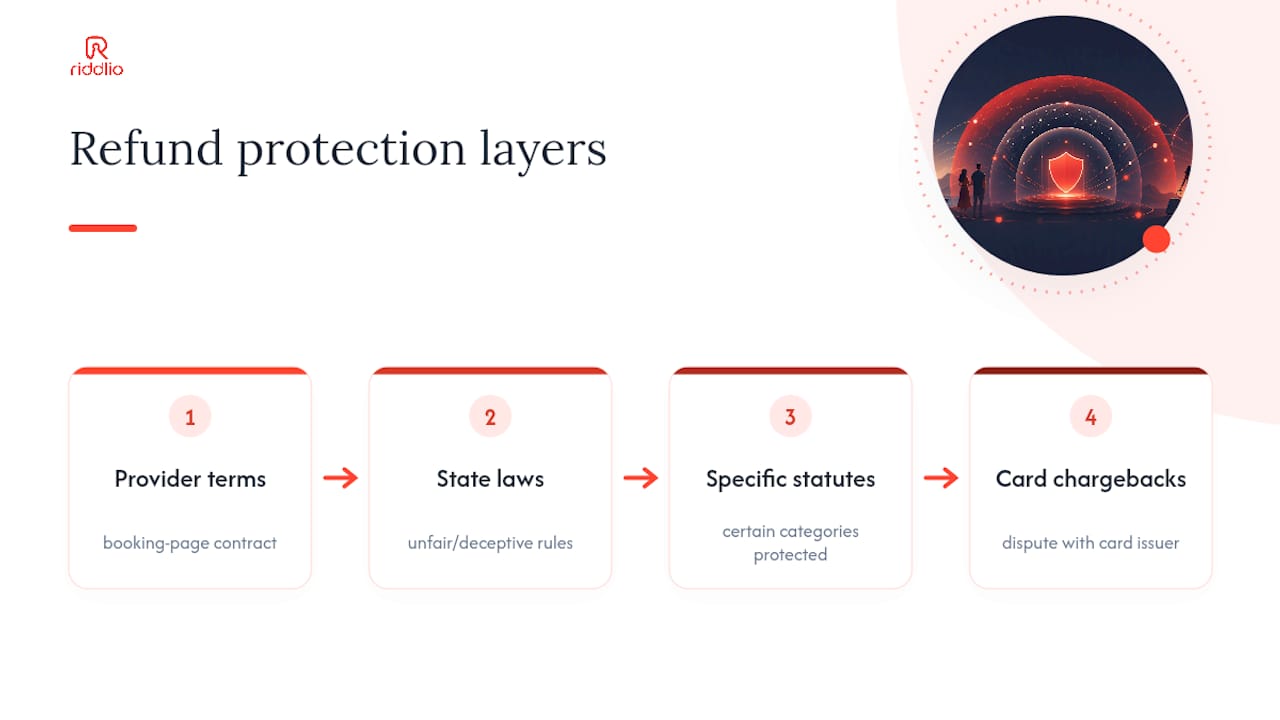
There’s no single federal law in the US that forces every activity provider to offer refunds. Consumer protection here mostly comes from contract law and state-level rules on unfair or deceptive business practices, not a blanket refund mandate.
What this means practically: the provider’s own published terms are the main contract governing your refund, so the language on the booking page carries real legal weight. If a provider fails to deliver the activity as advertised, misrepresents what you’re buying, or cancels without honouring its own stated refund terms, that can fall under state consumer protection statutes covering deceptive trade practices. Several states also have specific rules for particular categories, like health club memberships or travel services, that mandate cooling-off periods or prorated refunds regardless of what the contract says.
Credit card chargebacks offer a separate layer of protection. If a provider refuses a refund it owes under its own policy, or fails to deliver the service entirely, disputing the charge with your card issuer is often the most direct route to getting your money back, particularly for larger amounts where informal negotiation with the provider has stalled.
None of this replaces reading the actual policy before you book. Providers are legally allowed to set their own refund terms in most everyday cases, provided those terms are disclosed clearly at the point of sale. The law steps in mainly when a provider hides its terms, misrepresents the activity, or simply refuses to honour the rules it published itself.
How refunds are processed for third-party bookings or resellers
Book through a reseller or marketplace rather than directly with the venue, and the refund path gets a step longer. Your payment went to the platform first, and the platform typically has to settle with the venue before it can settle with you.
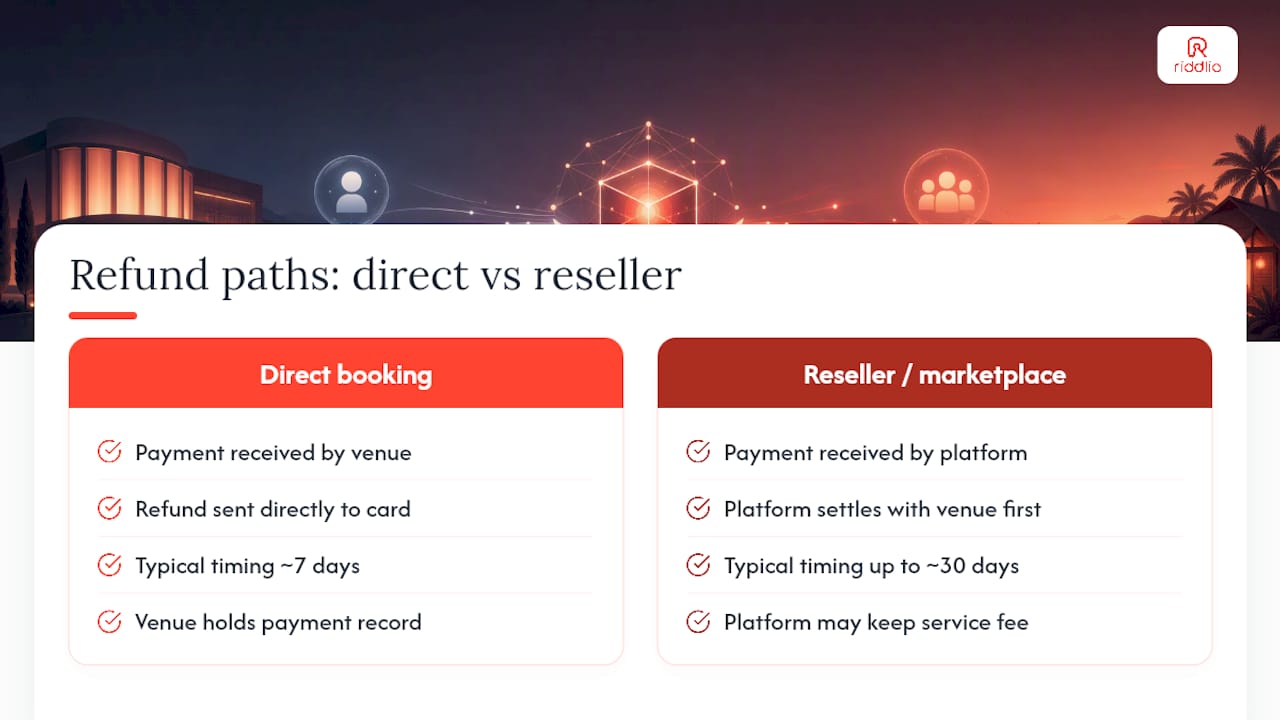
This matters for timing. A direct booking refund might clear in a week; a reseller refund can take closer to the 30-day end of the range, because the marketplace often needs the original operator to confirm the cancellation before releasing funds back to your card. Some marketplaces also apply their own service fee on top of whatever the venue charges, and that fee is rarely refundable even when the underlying booking fee is.
The practical fix is knowing who to contact first. If you booked through a third party, start your refund request with that platform, not the venue, since the venue often has no direct record of your payment and can’t process a refund it never received. Keep your marketplace booking confirmation handy, since it usually carries a different reference number to the one the venue itself would use, and mixing the two up is a common cause of delayed responses.
Author perspective: clearer policies protect customers and venues
Transparent deadlines cut down on disputes because nobody’s guessing what happens next. Vague policies breed frustration on both sides, and that frustration usually lands on a support inbox that didn’t need the extra load.
Every activity venue should publish, in plain sight: the exact cancellation deadline, the refund method, a direct contact for requests, group-size rules, and documented exceptions for medical or force majeure situations. That’s not complicated. It’s just rarely written down clearly enough.
— Iosif Beraru
Policy examples and resources to read next
Compare policy language directly against providers like San Diego Parks and Recreation, Cascade.org and Gulf Shores & Orange Beach’s guidance on cancellation policy design for a sense of how good policies read in practice.
Venues considering how their own refund terms hold up against customer expectations, and how much manual admin those terms create, can see how Riddlio’s booking and payment tools handle deposits, automated reminders and refund processing across plans like Starter, Pro and Unlimited.
Sources
- Recreational programs refund and transfer policy | San Diego Parks and Recreation
- Cancellation policy | Activities Hawaii
- Activity change & cancellation | Mammoth Mountain
- Cascade
FAQ
What is a typical refund policy for activities?
A typical policy gives you a full refund if you cancel before a set deadline, commonly 48 hours to 14 days ahead, with money returned to your original payment method. If the provider cancels, refunds are usually processed within 7 to 14 business days and cover the full ticket price.
Can I still get a refund after the cancellation deadline has passed?
Generally, no, not as a straight cash refund. Some providers offer a credit or voucher instead for late cancellations, and exceptions are sometimes made for documented medical emergencies or provider-side errors.
Can an activity provider set a 14-day cancellation policy?
Yes. Providers running multi-day trips, custom bookings or specialised events commonly use windows of 14 to 30 days, since they’ve often already committed money to guides, gear or venue costs on your behalf.
What are the rules regarding refunds when the provider cancels?
When a provider cancels, you’re generally entitled to a full refund of the ticket price, though platform fees may be excluded depending on the operator’s terms. Some providers offer a reschedule or credit instead of cash, particularly for weather-related cancellations covered by force majeure clauses.