
For an escape room, a split payment usually means one of two things: several players each paying their share of a single booking, or one organizer paying in stages, with a deposit now and the balance later. Both work best when the booking, the payment and the reminders sit in one system. The slot stays tied to the money, and nobody on your team is chasing a group chat. That is the idea behind Riddlio’s escape room booking system, which keeps bookings, payments, customer messages and reporting together.
This guide covers the payment models venues use, what each costs in card fees, and what to do when a share is missing. It is written for owners and managers who want fuller rooms and fewer no-shows.
TL;DR
- Split payments for groups come in two forms: several people each paying toward one booking, and one organizer paying a deposit first and the balance later. Most escape rooms start with the second.
- A deposit that holds the slot, with the balance due before the date, protects your capacity better than payment on arrival.
- Card fees have a fixed part (30¢ per charge on US Stripe pricing), so many small per-person charges cost more than one larger charge.
- Decide your rules for unpaid shares, cancellations and refunds before you sell the first group slot, and publish them.
- Automated reminders by SMS and email do the chasing for you.
Table of Contents
- What split payment means for a group booking
- Three ways to collect from a group
- What it costs: card fees on split payments
- Setting up split payments step by step
- When someone’s share doesn’t arrive
- Protecting card data and staying compliant
- What to measure
- Our perspective
- Put it into practice
- FAQ
- Sources
What split payment means for a group booking
A split payment is a single bill settled in several transactions, by different people or with different methods. Payments provider Planet separates two ideas that are easy to confuse. Splitting the bill divides the items, so each person pays for what they ordered. Splitting the payment divides the total, so several people pay toward one bill, either equally or in chosen amounts.
Escape rooms sell a room for a team, not individual items, so the second idea is the relevant one. The same source lists four forms merchants see. Two matter to you:
- Split by payer: several people each pay part of one booking. This is the most common form for group bookings.
- Split tender: one customer pays with more than one method, for example a card plus a gift voucher.
The other two, hotel-style split folios and partial authorizations, rarely come up at an escape room desk.
Your reader here is you, the operator, not the players. The question is not how friends settle up among themselves. It is how you get the full booking value in before the group walks in, without extra admin.
Three ways to collect from a group
Venues tend to land on one of three models. Each fits a different kind of booking.
1. One payer, deposit plus balance
The organizer books, pays a deposit to hold the slot and pays the rest before or at the game. This is the simplest model and the one most venues publish.
Real venue policies show the pattern. 21 Keys Escapes in Colorado Springs asks for a 50% deposit to reserve a large group, with the final head count and balance due two weeks before the event. One Way Out Escape Rooms in Lynchburg, Virginia takes a $50 deposit per game for team-building reservations, with the balance payable on arrival. Game On Escapes requires a deposit to book online, settles the balance on site by final player count and lets groups split the bill among themselves.
The lesson is that your deposit amount and balance date are policy choices, and they differ by group size. A large corporate group justifies a larger deposit and an earlier balance date than a family of four.

2. Each player pays their own share
Here every guest gets a link or checkout for their part. The booking shows who has paid and how much remains until the total is covered. It removes the organizer from the role of banker, which is often the reason large groups stall: one person fronts $300 and waits weeks to be repaid.
The trade-off is volume. A 10-person group becomes ten card transactions, ten confirmations and ten potential failures. That is workable when payments, confirmations and reminders are automated, and tiring when your staff do it by hand.
3. Hybrid: deposit up front, balance on the day
Many venues take a deposit online and let the group settle the remainder at the desk, sometimes with several cards. This keeps the online flow simple and still locks the slot. The desk then handles the split tender at the counter, which is quick for small teams and slower for a 15-person birthday party.
| Model | Best for | Main risk |
|---|---|---|
| One payer, deposit plus balance | Corporate, birthday and team-building groups | Organizer carries the cost and may cancel late |
| Each player pays their share | Friends and public sessions with mixed groups | More transactions, more unpaid shares to chase |
| Deposit online, balance at the desk | Small to mid-size groups | Desk time and no-shows after the deposit |
What it costs: card fees on split payments
Splitting payments multiplies the number of card transactions, and card pricing has a fixed part that does not shrink with the amount. Stripe’s US standard rate is 2.9% plus 30¢ per domestic card charge, with extra charges for international cards, currency conversion and manually keyed cards. Square’s published online rate is 2.9% plus 30¢ on paid plans, with a higher rate for keyed entries. Rates change, so check your processor’s current schedule before you set prices.
A worked example makes the effect visible. Take a team-building booking priced like One Way Out’s, where additional tickets are $35 each. Say ten players at $35, a $350 booking:
- Paid as one charge: 2.9% of $350 is $10.15, plus 30¢, so $10.45.
- Paid as ten $35 charges: each costs $1.015 plus 30¢, about $1.32, so roughly $13.15 in total.
The gap is about $2.70 on a $350 booking, or around 0.8 percentage points. It is small per booking, and it adds up across a busy weekend of group sessions. The fixed 30¢ is 6% of a $5 payment but only 0.06% of a $500 one, which is why very small separate charges are the expensive case.
Two practical conclusions follow. Keep your minimum per-person payment sensible, and use a deposit plus balance for larger groups so most of the money moves in a few bigger charges. Whether you absorb card costs or reflect them in pricing is your call, and it belongs in your pricing plan alongside peak and off-peak rates. Dynamic pricing for groups, peak and off-peak is one place that decision shows up.
Setting up split payments step by step
Below is the routine, with the points where it usually goes wrong.
Step 1: Set the deposit and the balance date
Pick a deposit that is meaningful enough to deter casual bookings, for example the 50% that 21 Keys uses for large groups, or a fixed amount per game as One Way Out does. Then fix when the balance is due. Two weeks out is a common rule for large groups; shorter for small ones.
Where it goes wrong: a deposit that is too low makes no-shows cheap for the group and expensive for you. A balance date that is too early frustrates organizers who are still counting heads.
Step 2: Decide who pays: the organizer or each player
Offer the organizer-pays route as the default, since it needs the fewest transactions. Add per-player payment for groups where the organizer does not want to front the cost. Decide the minimum share so you are not processing tiny charges.
Where it goes wrong: leaving the booking in a half-paid state with no rule. Decide in advance whether a slot is held only when a deposit lands, or when the full amount does.
Step 3: Connect payments to the booking
The payment must attach to the specific session, player count and room, so that the calendar reflects reality. Riddlio supports payment processing through Stripe, Square and PayPal, alongside the bookings and availability it already manages for your rooms. That keeps your schedule and your money in the same record, so a held slot is not a guess.
Where it goes wrong: running bookings in one tool and payments in another, then reconciling by hand on Monday morning.
Step 4: Automate the reminders
Most unpaid balances are forgotten, not refused. A reminder before the balance date, and another before the game, recovers a large share of them. Riddlio sends automated SMS reminders and email reminders, so your team does not write the nudges.
A staged pattern works well in practice. One booking-platform company describes a cascade of nudges at 7, 14 and 21 days, with the organizer pinged for personal follow-up only at the end, and argues it lets most attendees pay in the first week. You can adapt the same spacing to your own balance deadline: a gentle first message, a firm deadline reminder, then a personal call from you for large groups only.
Step 5: Publish the cancellation and refund rules
State them where players book. Game On Escapes allows free rescheduling or cancellation with at least 24 hours’ notice, and treats a late arrival beyond 15 minutes as a no-show with a non-refundable deposit. Others, like 21 Keys, refuse refunds for missing participants after final payment. Pick what suits your cost structure and say it plainly. Many venues also issue credit rather than cash; Riddlio’s piece on why venues give credits, not cash explains the reasoning.
Where it goes wrong: rules buried in terms, which turns every dispute into a chargeback.
When someone’s share doesn’t arrive
This is the question that decides whether split payments help or hurt. Plan for three cases.
A card fails. Treat it as a retry, not a lost booking. Contact the payer quickly with a fresh link. Riddlio’s payment failure recovery playbook walks through the routine.
The group doesn’t complete the total. You need a rule: release the slot back to your calendar by a set time, or keep it and collect the rest at the desk. Event venues face the same decision when guests leave a payment unfinished, and a venue booking workflow planning guide shows how an event space sequences it. For an escape room, where a held room is a sold-out hour you could have resold, a firm release time protects capacity.
Someone cancels. With a deposit-and-balance model, the organizer decides who stays. With per-player payments, refund policy should be per person, so one cancellation does not unwind the whole booking. A major reason to fix this in your policy: when one guest leaves, you need the head count and the revenue to adjust together.
Worth knowing: disputes are the costly end of unpaid or contested shares. Riddlio’s guide to booking chargeback controls covers the habits that reduce them, and clear, published terms are the first.

Protecting card data and staying compliant
Taking payments from many individuals means handling more card details, which makes PCI compliance (the card industry’s security standard) a real concern. The safest setup keeps card data with the payment processor so your own systems never hold it. Riddlio’s PCI compliance guide for escape room owners explains what the standard asks of a booking business. Refund law also varies by state, so write your policy with your own state’s rules in mind.
What to measure
Split payments only pay off if you can see them working. Track these from your booking reports:
- No-show rate by payment model. Do groups with deposits show up more reliably than those paying on arrival?
- Time from booking to full payment. If it stretches, your reminder timing needs work.
- Released slots and their resale. How many held-but-unpaid slots did you free, and how many were sold again?
- Revenue per booking and per session. Group rates against public-session rates tell you whether your pricing leaves money on the table.
Riddlio includes reporting and analytics, so booking and revenue performance sit beside the bookings themselves rather than in a spreadsheet you rebuild each month.
Our perspective
Group payments look like a payments problem, but for an escape room they are a capacity problem. A room that is held and never paid for is an hour you could have sold.
That is why we build Riddlio around the whole booking, not around the card form. Bookings, availability, payments, reminders and reporting live in one place, designed for how escape rooms work: player numbers, room availability and group bookings.
Our advice to operators is simple. Take a deposit that means something, set a balance date, tell groups the rules before they pay, and let automated reminders do the chasing. Then use your reports to see which groups pay on time and adjust.
When the slot, the money and the message all sit in one record, your team spends the week running games, not reconciling spreadsheets.
Iosif Beraru
Put it into practice
If you are running group bookings across a spreadsheet, a payment app and a message thread, that is the setup to replace. Riddlio plans start at $29 a month on Starter, with Pro at $79 a month and Unlimited at $199 a month; Enterprise has no published price. See what each includes on the pricing page, or look at the escape room payment processing page if payments are your first concern.
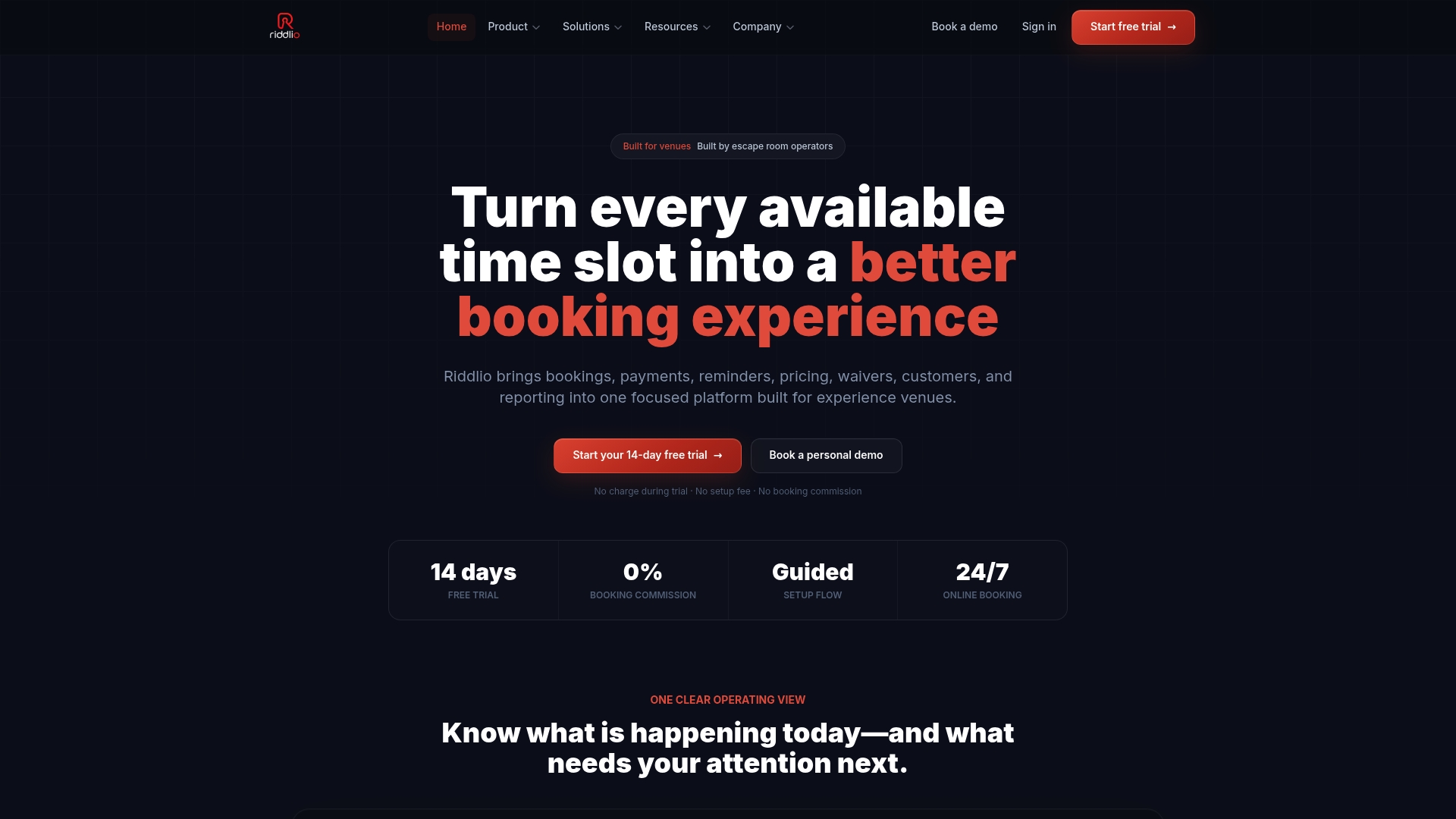
Bookings, payments and reminders in one system means a group booking is a single record from the first deposit to the final game.
FAQ
Does splitting a payment cost more in card fees?
Usually a little. With US Stripe pricing of 2.9% plus 30¢ per domestic card charge, ten $35 payments cost about $2.70 more than one $350 payment. The fixed 30¢ bites hardest on small amounts, so avoid very small per-person charges.
Should I ask for a deposit or full payment up front?
A deposit is the common choice for groups. Venues publish figures such as 50% to reserve a large group, or a fixed amount per game, with the balance due before or on the day. Choose the level that makes a no-show costly enough to matter, and publish it at booking.
What happens if one person in the group doesn’t pay?
Set the rule before it happens. Either release the slot back to your calendar at a stated time, or hold it and collect the shortfall at the desk. Automated reminders by SMS and email, sent before the balance date, resolve most cases.
Can players cancel individually?
That is a policy choice. Some venues allow free changes with 24 hours’ notice, others refuse refunds once final payment is made. If you take per-player payments, define refunds per person so one cancellation does not affect the rest of the booking.
Sources
- What is a split payment? | Planet
- Large Group Bookings | 21 Keys Escapes
- Team Building | One Way Out Escape Rooms
- FAQs | Game On Escapes & More
- Stripe Fees Explained for Marketplace Operators (2026) | DropDesk
- Best Payment Processors for Marketplaces 2026 | myPayAdvisor