Seasonal pricing means charging more when demand predictably peaks and less when it predictably drops, so revenue evens out across the year instead of collapsing in your quiet months. The single best first move is a simple two-tier model: one peak rate, one standard rate, tested for a defined stretch before you touch anything else. Get this right and you’ll see steadier bookings and stronger revenue per available slot, not just a discount that trains customers to wait for it.
TL;DR:
- Using a simple two-tier model with peak and standard rates can stabilize revenue and bookings without training customers to wait for discounts.
- Analyzing a minimum of 12 months of your booking data helps accurately identify seasonal peaks and shoulder periods for effective pricing adjustments.
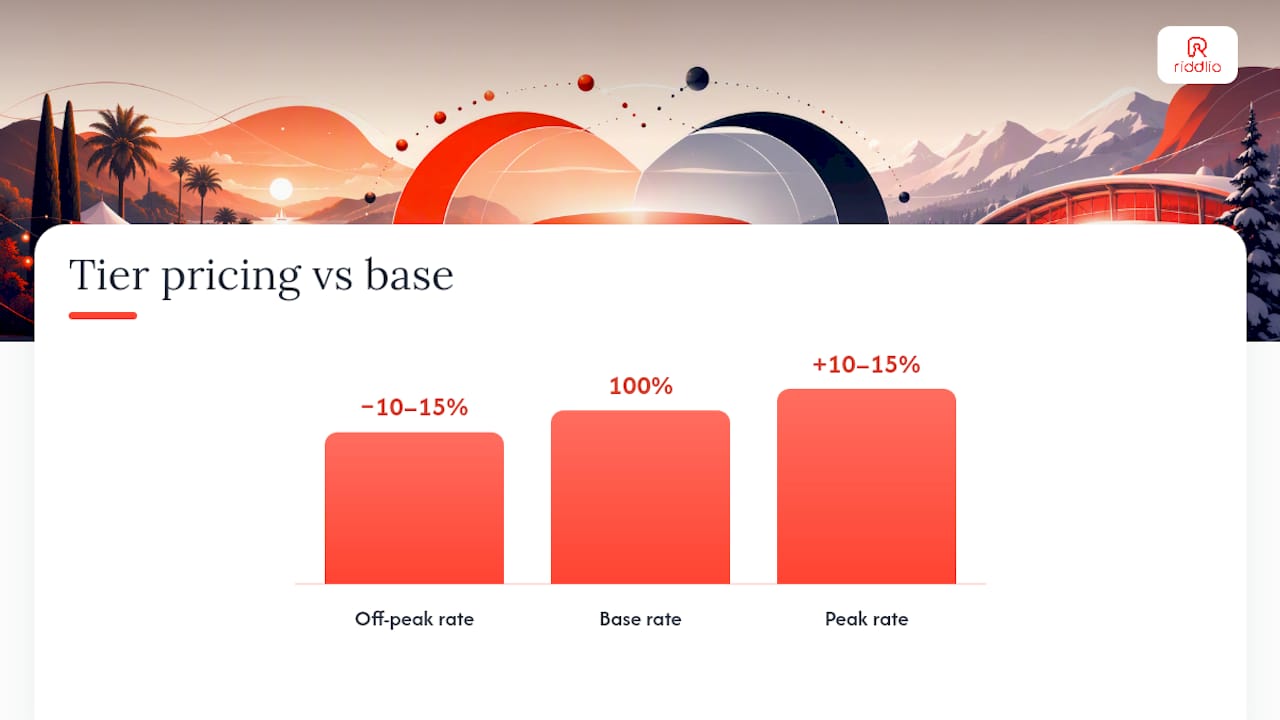
- Base rates should be calculated from fixed and variable costs, with peak prices set 10 to 15% above and off-peak 10 to 15% below the base rate, never discounting below your price floor.
- Running testing for 8 to 12 weeks and tracking revenue, occupancy, conversion, and margin ensures seasonal pricing effectively increases overall profitability rather than just shifting demand.
- Automating pricing with tools like dynamic pricing platforms prevents system mismatches and saves time, especially for timed-booking venues with fluctuating demand.
Table of Contents
- What is seasonal pricing, and how does it differ from dynamic pricing?
- Why seasonal pricing matters for revenue, capacity and cash flow
- How to identify your seasons using your own booking data
- Setting base rates, seasonal uplifts and price floors
- Tactical seasonal moves by industry
- Tools, automation and when manual pricing is enough
- Testing, KPIs and how long to run the experiment
- Implementation checklist and how to talk to customers about it
- Why timed-booking venues need this more than most
- What most seasonal pricing advice gets wrong
- Get your seasonal rates live without the manual juggling
- Sources
What is seasonal pricing, and how does it differ from dynamic pricing?
Seasonal pricing raises or lowers prices around demand patterns you can see coming: school holidays, weekends, tax season, the week before Christmas. It’s sometimes called time-based pricing or peak/off-peak pricing, and it’s built on a calendar, not a live feed.
Dynamic pricing and surge pricing are different animals. They adjust prices in real time based on current demand, inventory, or competitor moves, the way rideshare apps or airlines do it. Seasonal pricing is slower and more predictable, which is exactly why it suits small and mid-sized operators. You’re not reacting minute to minute. You’re setting a plan based on last year’s calendar, this year’s events, and the shoulder periods in between.
Why seasonal pricing matters for revenue, capacity and cash flow
Charging more in peak periods and less in slow ones doesn’t just add margin, it stops your cash flow from lurching between feast and famine. American Express notes that seasonal pricing helps businesses bring in sales during slow seasons precisely because it prices for the demand curve rather than a flat rate all year.
It also solves a capacity problem: full slots in peak periods earn what they’re worth, and discounted off-peak slots pull in bookings that would otherwise sit empty. The risk sits in execution. Discount too visibly or too often, and regulars start assuming your “real” price is the low one, which erodes margin exactly where you were trying to protect it.
How to identify your seasons using your own booking data
Skip the guesswork. Your own numbers already show your seasons, you just have to pull the right exports and read them properly.
Start with at least 12 months of history if you have it, six at a minimum. Pull:
- Sales or bookings by date, broken down by day of week and time slot
- Lead time between booking and visit (short lead time often signals impulse or last minute demand)
- Cancellation and no show rates by period
- Any known events, school holidays, or local calendar spikes that line up with demand jumps
Look for repeatable patterns, not one-off spikes. A single busy Saturday means nothing. Three Saturdays in a row around the same date each year means something. Watch too for mini-seasons inside your main season, like a midweek lull even during your busiest month, because that’s often where off-peak pricing earns the most.
Setting base rates, seasonal uplifts and price floors
Your base rate should come from a break-even calculation first, not a competitor’s website. Add up fixed costs (rent, staff, insurance) plus variable costs per booking, divide by expected volume, then layer on your target margin. That’s your floor rate, the price below which you’re losing money or working for nothing.
From there, build your tiers:
- Peak rate: typically 10 to 15% above base, sometimes more for high demand events
- Off-peak rate: 10 to 15% below base, or hold the price and add value instead (extra time, a bonus feature, a small perk)
- Price floor: a hard number you never discount below, regardless of how quiet the calendar looks
- Protected ceiling: a cap on peak pricing so a single busy week doesn’t damage trust with regulars
Practitioner guidance on peak and off-peak pricing backs this range: modest 10 to 15% adjustments in each direction tend to shift demand without triggering pushback, and they give you room to test before committing to anything bigger.
Pro Tip: Add value in your off-peak slots before you cut-price. A bonus 15 minutes or a small extra costs you little and protects your rate card better than a straight discount does.
Tactical seasonal moves by industry
The mechanics change depending on what you sell, but the logic holds everywhere: charge more when everyone wants in, charge less (or add value) when they don’t.
- Retail — Bundle slow movers with popular items during shoulder periods, and hold your price floor firm through big discount events like Black Friday. Holiday pricing strategies need planning months out, not the week before.
- Hospitality — Adjust average daily rate by season, add minimum night stays on peak weekends, and price rooms by booking lead time, since last minute bookers often pay more for certainty.
- Services — Name your off-peak slots something appealing rather than apologetic, and offer a small incentive for midweek appointments to smooth your calendar.
- Entertainment and venues — Use group pricing to fill larger capacity, add event premiums for holidays and school breaks, and run weekday promos to balance a weekend heavy calendar. The live events sector has leaned on dynamic and tiered ticket pricing for years to manage exactly this kind of demand swing.
Tools, automation and when manual pricing is enough
You don’t need software on day one. A spreadsheet and a two-tier plan will tell you almost everything you need to know about whether seasonal pricing works for your business.
Automation earns its cost once manual updates start causing errors or eating hours. Signals it’s time to invest:
- Your catalogue or slot count has grown past what one person can update by hand each week
- Competitors move prices often enough that manual tracking is a full-time job
- Transaction volume is high enough that a pricing mistake costs real money, fast
A meta-synthesis on dynamic pricing found that smaller operators often lack the forecasting tools to jump straight to complex, real-time pricing, and do better starting with a simple structured model first. Before any automation goes live, check that your booking calendar, payment processor, and confirmation messages will all show the same price, every time.
Testing, KPIs and how long to run the experiment
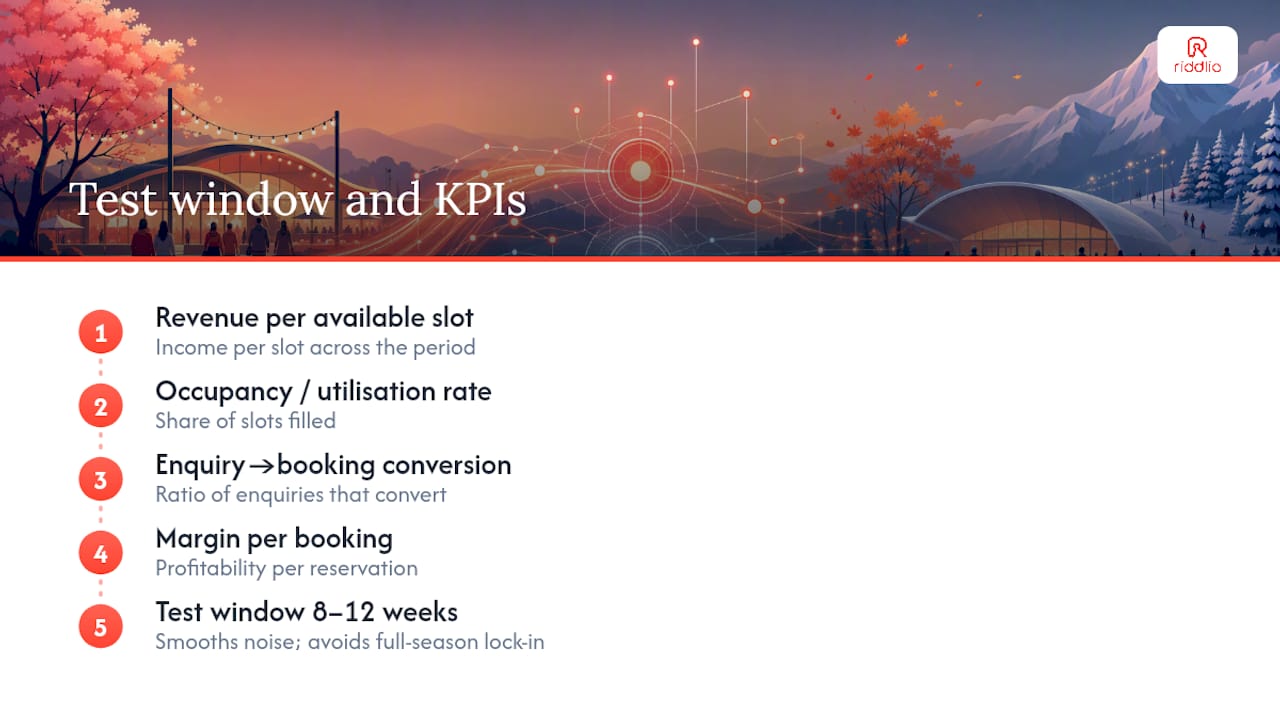
Track four numbers: revenue per available slot (or room, or unit), occupancy or utilisation rate, conversion rate from enquiry to booking, and margin per booking. Together they tell you whether seasonal pricing is actually working or just moving bookings around without adding revenue.
Run the test for 8 to 12 weeks before drawing conclusions. That window is long enough to smooth out one-off noise (a single bad weekend, a local event) but short enough that you’re not locked into a losing structure for a full season. This lines up with practitioner guidance recommending 8 to 12 week test periods for peak and off-peak pricing changes.
Watch for the difference between shifted and incremental bookings. If your off-peak slots fill but your peak slots empty out by the same amount, you’ve moved demand, not grown it. Real success looks like a rise in total revenue per available slot across the whole period, not just a fuller Tuesday.
Implementation checklist and how to talk to customers about it
Sequence matters here. Skip a step and you’ll either confuse customers or break your own systems.
- Pull your data and confirm your seasons and mini-seasons
- Set your base rate, tiers, and price floor
- Update your booking system, payment processor, and confirmation templates so every price matches
- Notify regular customers directly before the public rollout
- Launch the new pricing structure
- Monitor your four KPIs weekly for the first month, then monthly
Frame off-peak pricing as a positive, not a discount. “Early Bird Tuesday” or “Midweek Special” reads as a perk; “off-peak discount” reads as leftover stock. Update every system before you announce anything publicly, since a mismatch between your booking calendar and your checkout price is one of the fastest ways to lose customer trust.
Pro Tip: Send regulars a short heads up before the public announcement. A five-minute email avoids the “why did the price change on me” message you’ll otherwise get on launch day.
Why timed-booking venues need this more than most
Businesses selling fixed time slots, like escape rooms, tours, and appointment services, feel seasonal demand swings harder than most, because an empty 7pm Tuesday slot can’t be sold later. Riddlio’s dynamic pricing tools let venues set peak and off-peak rates directly on the booking calendar, so the price a customer sees always matches what they’re charged.
What most seasonal pricing advice gets wrong
Most guides treat seasonal pricing as a spreadsheet exercise. It’s not. It’s a trust exercise first. I’ve seen more pricing rollouts fail from a mismatched confirmation email than from picking the wrong percentage. Start modest, test for 8 to 10 weeks, name your off-peak slots something a customer would actually want to book, and get every system talking before you tell a single customer. The maths is the easy part.
— Iosif Beraru
Get your seasonal rates live without the manual juggling
Running a two-tier pricing test by hand works fine for a few weeks, but once you’re juggling peak rates, off-peak specials, and event premiums across a full calendar, spreadsheets start dropping the ball, usually right when a customer’s confirmation email doesn’t match what they paid. Riddlio is built specifically for timed-booking venues that need pricing, calendar, and payments to stay in sync automatically.

The platform’s dynamic pricing feature lets you set peak, standard, and off-peak rates directly against your slots, with automated SMS reminders and confirmations pulling the correct price every time, no manual double-checking required. Pair that with real-time analytics on occupancy and revenue per slot, and you’ve got the exact KPI tracking this article recommends, built into the system you already book from. If you’re ready to move past the spreadsheet stage, take a look at Riddlio’s booking calendar and start a trial.
Sources
- Why seasonal pricing may help bring in sales during slow seasons — American Express
- Meta-synthesis on dynamic pricing effects and application to brick-and-mortar service businesses (2021)
- Peak and off-peak pricing: a guide for service businesses — Reservio Blog