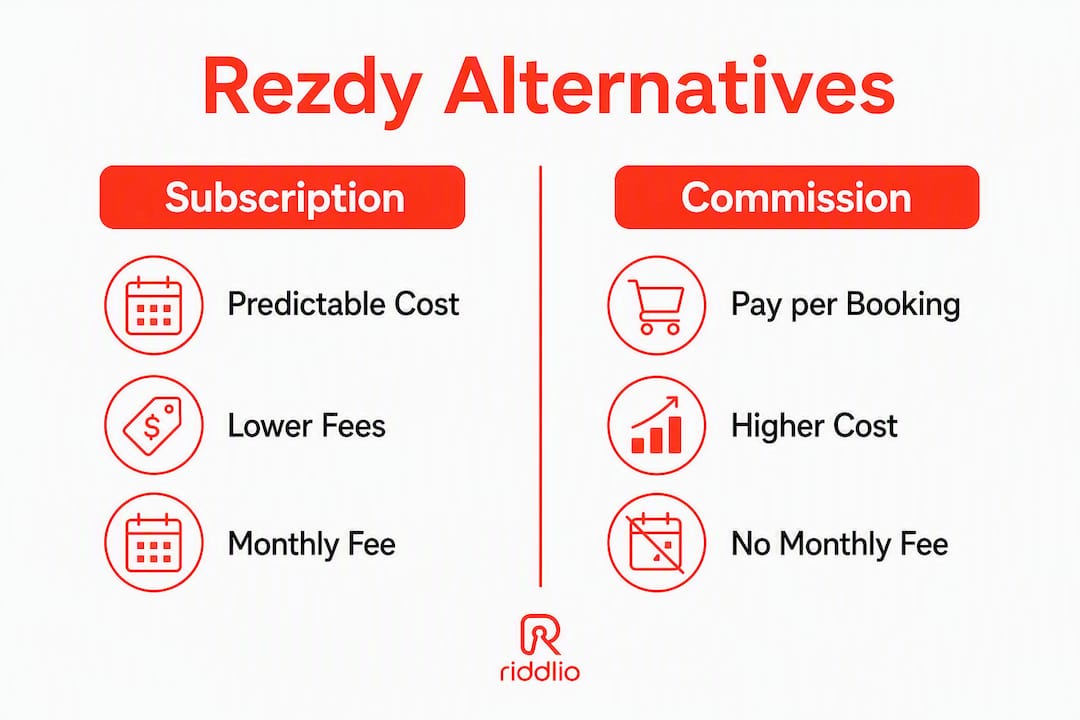
For most Australian tour and activity operators, the right Rezdy alternative comes down to one decision: subscription or commission. Subscription-first platforms suit operators with steady direct booking volume who want predictable costs. Commission-first managed platforms work for newer or seasonal operators who want zero upfront cost and hands-on setup. For escape-room venues specifically, a vertical specialist like Riddlio is the stronger fit, combining slot management, waivers, dynamic pricing, and SMS reminders in one purpose-built system.
Best for at a glance:
- Small or seasonal operator: Entry-level field apps or commission-first managed platforms keep upfront costs low when monthly volumes are unpredictable.
- High-volume direct-booking operator: Subscription-first mid-market platforms become cheaper once direct bookings exceed a modest monthly threshold.
- Agency or OTA-reliant operator: Enterprise distribution platforms with deep GDS and OTA channel manager integrations.
- Escape-room venue: Riddlio, built specifically for the entertainment space with slot optimisation, waivers, voucher redemptions, and staff scheduling.
| Model | Core trade-off |
|---|---|
| Subscription (flat monthly fee) | Predictable cost; lower per-booking cost as volume grows |
| Commission-first (e.g. ~6% per booking) | No monthly fee; cost compounds quickly with volume |
Pro Tip: If your direct bookings already exceed a modest monthly volume at an average order value above $80, run a 12-month cost model. Subscription platforms typically become cheaper past that threshold, and the savings compound as you invest in direct-channel growth.

Table of Contents
- How do the top Rezdy alternative categories compare for Australia?
- How do you choose the right Rezdy alternative for your business?
- What do the different platform categories actually offer?
- Subscription vs commission: what does it actually cost Australian operators?
- Red flags to watch for when choosing a Rezdy alternative
- Key takeaways
- Riddlio: purpose-built for escape-room venues
How do the top Rezdy alternative categories compare for Australia?
The table below maps the eight platform categories Australian operators encounter most often. Use it to filter by your business model before reading the detailed profiles.
| Category | Best for | Pricing model | Typical starting cost | Booking fees / commission | Key features | OTA integrations | AU support | Free trial |
|---|---|---|---|---|---|---|---|---|
| Subscription-first mid-market | Growing operators, 40+ bookings/month | Flat monthly subscription | — | Low or zero direct-booking fee | Channel manager, POS, API, waivers, vouchers | Viator, Tripadvisor, GetYourGuide | Yes | Yes, 30 days |
| Commission-first managed | New or low-volume operators | Zero monthly fee + ~6% commission | $0 upfront | ~6% per online booking | Managed setup, booking widget, basic reporting | Viator, Tripadvisor | Yes (US-led) | No; managed onboarding |
| Entry-level field / box-office apps | Walk-up and small venues | Low flat fee or freemium | ~$0–$30/month | Low or nil | POS, basic calendar, cash handling | Limited | Varies | Yes |
| Enterprise distribution platforms | High-volume, multi-location | Higher subscription or custom | — | Low direct; OTA pass-through applies | Full channel manager, GDS, API, multi-location | Extensive GDS + OTA | Varies | Demo only |
| Vertical specialist (escape rooms) | Escape-room venues | Subscription tiers | Varies by tier | Low or zero direct-booking fee | Slot optimisation, waivers, vouchers, SMS, staff scheduling | Select OTAs | Yes | Yes |
| Marketplace-heavy / OTA-first | Operators relying on reseller volume | Commission or listing fee | Low or $0 | 15–30% reseller margin | Listing management, basic booking | OTA-native | Limited AU | No |
| Developer-first / API platforms | Tech-capable operators, custom builds | Usage or subscription | Varies | Low | Open API, webhooks, custom widgets | Custom | Limited | Sandbox |
| Low-cost global SaaS | Budget-conscious, low complexity | Low flat fee | — | Low | Basic booking, calendar, payments | Limited | Limited AU | Yes |
Most important row for Australian operators: The commission-first managed category. Passing platform commission on to customers can make your direct channel more expensive than your reseller channel, which shifts demand away from the bookings you actually profit most from.
Watch for hidden costs: Payment gateway margins (typically 1.5–2.9% on top of platform fees), OTA channel pass-throughs, and website builder charges are rarely included in headline pricing.
How do you choose the right Rezdy alternative for your business?
Start with the subscription-versus-commission decision, because it determines your cost structure for years. Then layer in operational and compliance requirements.
Subscription vs commission: four questions to answer first
- How many direct bookings do you take per month, and what is your average order value?
- What percentage of your revenue comes through OTAs or resellers versus your own website?
- Do you have the technical capacity to manage a self-serve setup, or do you need a managed onboarding?
- Are you investing in SEO, Google Ads, or direct-channel marketing? If yes, a subscription model protects the margin those campaigns generate.
Subscription-based systems reward direct-channel investment because every booking you drive yourself costs nothing extra. Commission models erode that margin at the exact moment your marketing starts working.
Operational criteria checklist
- Multi-location and group bookings: — Does pricing and availability management scale across multiple rooms or sites?
Commercial and compliance checks
GST compliance matters. Confirm the platform produces tax invoices and handles GST-inclusive pricing correctly for Australian payouts. Check which payment gateways are supported — Stripe and Square are the most common in Australia, and gateway margins vary. Ask about contract length: month-to-month terms give you exit flexibility; annual contracts often come with a discount but lock you in before you have proven conversion data.

Comparison directories often list many alternatives but rarely confirm Australian availability or published pricing. Always verify directly with the vendor.
Vendor selection process
Shortlist three platforms. Run a live trial with real bookings, not a sandbox demo. Measure booking conversion rate on your widget, reconciliation accuracy against your accounting software, and how long support takes to respond during AEST business hours. Negotiate onboarding scope and marketplace terms before signing.
Pro Tip: Build a 12-month cost model using three inputs: your current monthly booking volume, your average order value, and the platform’s commission rate or monthly subscription fee. Add gateway fees and any OTA pass-through. Compare that total against a subscription platform’s annual cost to find your break-even point before you commit.
What do the different platform categories actually offer?
The eight categories below map to the comparison table above. Use these profiles to identify which category matches the vendors you are already evaluating.
Subscription-first mid-market platforms
These are the closest direct substitutes for Rezdy. They charge a flat monthly fee, offer a channel manager connecting to major OTAs, and provide a booking widget you embed on your own site. API access is usually available on mid-to-upper tiers. Waivers and vouchers are common inclusions.
- Core strengths: Predictable cost, strong OTA connectivity, good self-serve documentation.
- Likely hidden costs: Higher tiers required for API access; some charge extra for the channel manager module.
- Operational fit: Best for operators with 40+ bookings per month who manage their own website.
- Red flag: If the vendor cannot confirm real-time availability sync with Viator for Australian listings, the channel manager is not production-ready for this market.
Commission-first managed platforms
Zero monthly fee sounds attractive. The catch is that managed platforms trade upfront fees for per-booking commissions, and those commissions compound fast. The setup is handled for you, which suits operators who lack technical resources. Support tends to be strong initially but is often US-based.
- Core strengths: No upfront cost, managed migration, strong OTA relationships.
- Likely hidden costs: ~6% per online booking; passing this to customers can undercut your direct channel pricing.
- Operational fit: New operators or those with fewer than 30–40 bookings per month.
- Red flag: If the vendor encourages you to pass the commission surcharge to customers, your direct booking price will exceed your OTA price. That is a structural problem for retention.
Entry-level field / box-office apps
Designed for walk-up venues, markets, and small operators who need a POS and a basic calendar. Integrations are limited. These platforms rarely support a full channel manager or API.
- Core strengths: Simple, low cost, good for cash and card walk-up sales.
- Likely hidden costs: Upgrade fees when you outgrow the basic tier; limited reporting.
- Operational fit: Seasonal operators, market stalls, small guided tours with minimal online booking.
- Red flag: No API means you cannot connect to accounting software or OTAs as you grow.
Enterprise distribution platforms
Built for high-volume, multi-location operators with complex distribution needs. GDS connectivity, advanced reporting, and multi-currency support are standard. Cost reflects the complexity.
- Core strengths: Deep OTA and GDS integrations, multi-location management, advanced analytics.
- Likely hidden costs: Custom pricing, long implementation timelines, dedicated account management fees.
- Operational fit: Large operators, attractions, or groups running 500+ bookings per month.
- Red flag: Overkill for single-venue operators; implementation scope often exceeds what small teams can manage.
Vertical specialists (escape-room focused)
Purpose-built for a specific venue type. Riddlio sits in this category, combining booking management, payments, waivers, slot optimisation, dynamic pricing, SMS reminders, and staff scheduling in one system designed for the entertainment space. The feature set maps directly to how escape-room venues actually operate, rather than being adapted from a generic tour-operator template.
- Core strengths: Slot utilisation tools, waivers at check-in, voucher management, automated SMS reminders, AI-assisted analytics.
- Likely hidden costs: Fewer than generic platforms; check tier limits on rooms or locations.
- Operational fit: Escape-room venues of any size, from single-room startups to multi-venue groups.
- Red flag: If a vendor claims to be “escape-room focused” but cannot demonstrate slot-level availability management and digital waiver capture, it is a generic platform with a marketing label.
Marketplace-heavy / OTA-first platforms
These function more as listing aggregators than booking management systems. Revenue comes from reseller margin (typically 15–30%), not platform fees. Useful for discovery, not for direct-channel management.
- Core strengths: Broad consumer reach, no setup required.
- Likely hidden costs: High reseller margin; no direct relationship with the customer.
- Operational fit: Operators who want volume without managing their own marketing.
- Red flag: No direct booking widget means you own no customer data.
Developer-first / API platforms
Open APIs, webhooks, and custom widget builders. Requires a developer to implement. Powerful for operators with technical resources who need a custom booking flow.
- Core strengths: Maximum flexibility, custom integrations, white-label capable.
- Likely hidden costs: Developer time is the real cost; ongoing maintenance as APIs evolve.
- Operational fit: Tech-capable operators or those with an in-house developer.
- Red flag: No support for non-technical staff; breaks when the API changes.
Low-cost global SaaS with limited Australian support
Affordable, widely available, but built for global markets. GST handling, local payment gateways, and AEST support hours are often afterthoughts.
- Core strengths: Low price, easy setup, broad feature set at the basic level.
- Likely hidden costs: Currency conversion fees, limited GST reporting, no local support.
- Operational fit: Operators with simple needs and no Australian compliance requirements.
- Red flag: If the vendor cannot confirm AUD payouts and GST-compliant invoicing, you will create accounting problems.
Pro Tip: When evaluating any platform, ask specifically: “Does your channel manager support real-time availability sync with Viator for Australian operators?” A vague answer means it does not.
Subscription vs commission: what does it actually cost Australian operators?
For many established Australian operators, a predictable subscription model is cheaper once monthly direct bookings exceed a modest threshold. Here is why that matters in practice.
Commission-first platforms commonly charge a percentage per online booking. At low volumes, that is manageable. At higher volumes, the fees compound quickly.
| Monthly bookings | Avg order value | Commission model (6%) | Subscription model | Monthly saving on subscription |
|---|---|---|---|---|
| — | — | — | — | Less on commission |
| 40 | — | — | — | Savings on subscription |
| — | — | — | — | Savings on subscription |
| — | $— | — | — | Savings on subscription |
The break-even point in this example sits between several dozen bookings per month. Most operators with a functioning direct-booking website cross that threshold within a few months of launch.
The 6% figure matters beyond the platform fee. Australian distribution dynamics mean that passing a commission surcharge on to customers can make your direct booking price higher than your OTA price. When that happens, you are inadvertently training customers to book through resellers, which costs you the customer relationship and the margin.
Other cost variables to factor into your 12-month model:
- Onboarding fees: Some managed platforms charge a one-off setup fee on top of commission.
- Website builder charges: Several platforms bundle a hosted booking page and charge separately for a custom domain or widget embed.
- Payment gateway margins: Stripe typically charges 1.7% + $0.30 per transaction in Australia for domestic cards. That sits on top of any platform fee.
- OTA pass-through: When a booking comes through Viator or GetYourGuide, the OTA takes its margin regardless of your platform model. Factor that separately from your direct-booking cost.
Operators with steady volumes often underestimate the compounding effect of per-booking commissions on their marketing spend. Every dollar you spend on Google Ads driving a direct booking is partially offset by the commission on that booking if you are on a commission-first platform.
How we chose and categorised these alternatives
The eight categories in this guide were built from four inclusion filters:
- Feature completeness: Does the platform cover the core operator checklist (channel manager, POS, waivers, vouchers, API, staff scheduling)?
- Australian availability and support: Is the platform actively used by Australian operators, and does it offer AEST-hours support?
- Pricing model visibility: Does the vendor publish pricing, or require a sales call to get a number?
- Integration depth: Does the platform connect to Viator, Tripadvisor, and local Australian resellers with real-time sync?
Sources used include vendor documentation, published comparison studies, operator-focused analysis of the Australian market, and Capterra’s Australian alternatives listings. Vendors were mapped to anonymised categories based on their dominant pricing model, onboarding approach, and primary feature set rather than marketing positioning.
Direct competitor brand names are excluded from this guide. The categories are designed to help you identify where a vendor you are already evaluating sits, not to pre-select a shortlist for you.
Red flags to watch for when choosing a Rezdy alternative
Most operators discover platform problems after they have migrated. These are the warning signs worth catching before you sign.
Opaque pricing. If a vendor will not publish a pricing page and insists on a discovery call before sharing numbers, that is a signal the pricing is complex, variable, or unfavourable. You cannot build a cost model without real numbers.
No data export on exit. Ask specifically: “Can I export my full customer database, booking history, and waiver records in a standard format?” If the answer is vague, your data may be held hostage to the platform. This is a contract negotiation point, not a feature request.
Commission pass-through encouraged. As noted above, any vendor that suggests passing their commission to your customers as a surcharge is setting up a pricing problem for your direct channel. Decline.
Australian support in name only. “We support Australian operators” sometimes means a US-based team available from 9 AM EST, which is 1 AM AEST. Confirm actual support hours in your time zone before committing.
No real-time OTA sync. Batch-sync or manual availability updates to Viator create double-booking risk. Real-time two-way sync is the minimum standard for any operator running OTA volume alongside direct bookings.
Trial with fake data only. A sandbox demo does not tell you how your booking widget converts on your actual website with your actual customers. Insist on a live trial period with real bookings before committing.
Lock-in without proven conversion. Annual contracts are reasonable once you have validated the platform. Signing a 12-month contract before running a live trial is a risk you do not need to take.
Key takeaways
For Australian tour and activity operators, the subscription model almost always wins on cost once direct bookings reach a modest monthly volume, and escape-room venues specifically get the strongest operational fit from a vertical specialist like Riddlio.
| Point | Details |
|---|---|
| Subscription beats commission at scale | Once direct bookings exceed a modest monthly volume at a typical order value, a monthly subscription can save significant costs versus a commission model. |
| Australian distribution risk is real | Passing commission surcharges to customers can make direct bookings more expensive than OTA bookings, shifting demand to resellers. |
| Escape rooms need a vertical specialist | Generic tour platforms lack slot-level availability management, digital waivers, and voucher redemption built for the entertainment space. |
| Always run a 12-month cost model | Include gateway fees, OTA pass-throughs, and onboarding costs, not just the headline subscription or commission rate. |
| Riddlio for escape-room venues | Riddlio combines slot optimisation, waivers, dynamic pricing, SMS reminders, and staff scheduling in one purpose-built system for escape-room operators. |
The trade-offs Australian operators keep getting wrong
Australian operators tend to focus on the headline fee and miss the structural cost. A commission-first platform looks free until you are running 80 bookings a month and paying the equivalent of a mid-tier subscription in fees, without any of the direct-channel control a subscription gives you.
The deeper issue is distribution. In Australia, passing a platform commission on to customers can make your direct booking price higher than your OTA price. That is not just a margin problem. It is a customer behaviour problem. Once customers learn that booking through Viator is cheaper than booking on your website, you lose the direct relationship and the data that comes with it.
Three mistakes worth avoiding:
- Overlooking pass-through fees. OTA margin sits on top of your platform cost. Model them separately and together.
- Underestimating onboarding scope. Migrating booking history, customer records, and waiver templates takes longer than vendors suggest. Build two to four weeks of parallel running into your timeline.
- Ignoring API openness. If you ever want to connect your booking platform to your CRM, accounting software, or marketing tools, a closed API will stop you. Ask for the API documentation before you sign.
Pro Tip: Run a live booking week on the new platform before you fully migrate. Use it on a single product or time slot, measure widget conversion against your current platform, and reconcile the payout against your accounting software. That one week will surface more problems than any demo.
Riddlio: purpose-built for escape-room venues
If you run an escape room, the generic tour-operator platforms in this guide will cover the basics but miss the details that matter most: slot-level availability, digital waivers at check-in, voucher redemptions, and automated SMS reminders that cut no-shows. Riddlio is built specifically for that operational reality.

Where a subscription-first mid-market platform gives you a booking widget and a channel manager, Riddlio’s escape room booking system gives you an all-in-one operational view: real-time analytics, dynamic pricing for peak and off-peak slots, staff scheduling, self check-in kiosk support, and AI-assisted reporting. The difference is not a feature list. It is whether the platform was designed around how escape rooms actually run.
Key features matched to the operator checklist:
- Online booking calendar with real-time slot availability and white-label widget
- Payment processing with Stripe integration and GST-compliant invoicing
- Automated SMS and email reminders to reduce no-shows
- Digital waivers captured at booking or check-in
- Dynamic pricing for peak periods, group sizes, and promotional rates
- Staff scheduling and session assignment
- Gift voucher sales and redemptions
- AI-assisted analytics for slot utilisation and revenue reporting
Escape-room operators evaluating Rezdy alternatives should trial Riddlio directly. Visit riddlio.com to start a trial or book a walkthrough of the platform with your own venue’s setup.
Sources and further reading
The findings and cost comparisons in this guide draw on the following sources:
- FareHarbor vs Rezdy 2026: True Cost Compared (Calculator) | Hamza Liaqat — commission benchmarks, break-even modelling, and subscription vs commission economics.
- Rezdy vs FareHarbor: Booking System Comparison for Australian Operators | Bookable Tourism — Australian distribution dynamics, pass-through fee risks, and operator cost modelling.
- Alternatives to Rezdy | Capterra Australia — verified user reviews and feature ratings for platforms in the Australian market.
- FareHarbor vs Rezdy 2026 Comparison | Software Advice — side-by-side feature ratings including channel connectivity, ease of use, and value for money.
- 10 Best Rezdy Alternatives | SoftwareSuggest — directory listing used to cross-check platform availability and pricing visibility.
- FareHarbor vs Rezdy | Chaty.ai — onboarding and managed-platform trade-off analysis.
- Riddlio vs comparison page | Riddlio — Riddlio’s feature positioning for the escape-room vertical.
- Riddlio vs Rezdy | Riddlio — direct feature comparison for escape-room operators evaluating Rezdy.