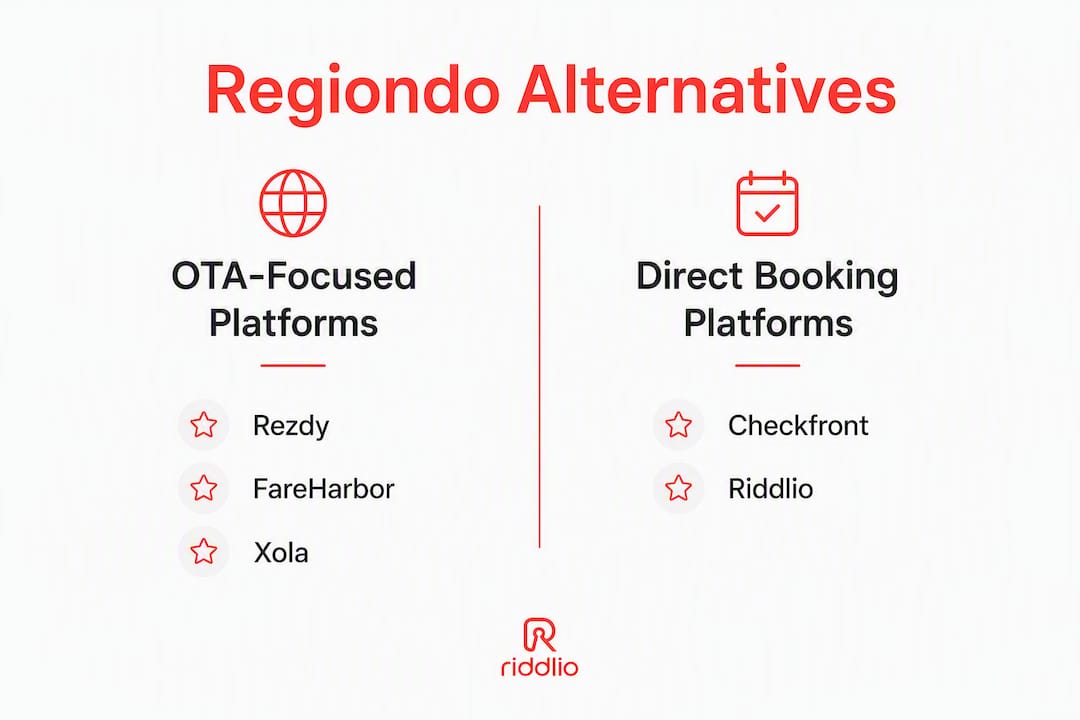
For Australian tours, activities, and escape room venues, the best Regiondo alternatives split cleanly into two camps: distribution-first platforms like Rezdy and FareHarbor for operators who depend on OTA resellers, and operations-first platforms like Checkfront, Xola, and Riddlio for venues running direct bookings with tight scheduling demands.
Here is the shortlist verdict at a glance:
- Rezdy — best for operators who need agent marketplace reach and OTA connectivity across Australia’s inbound tourism market.
- FareHarbor — best for mid-to-large activity operators wanting a no-subscription model with strong channel management.
- Checkfront — best for multi-product operators (tours, rentals, activities) who want a flat subscription and solid API access.
- Xola — best for experience venues prioritising conversion-focused booking widgets and upsell tools.
- Riddlio — the recommended choice for escape room venues in Australia, combining room-specific scheduling, deposits, waivers, SMS reminders, and local payment processing in one purpose-built platform.
The single most important thing to decide before you shortlist anything: do you earn most of your revenue through resellers and OTAs, or through direct bookings on your own site? That answer determines which camp your platform should come from.
Table of Contents
- How do the top Regiondo alternatives compare at a glance?
- How do these alternatives actually differ from Regiondo?
- What should you check before choosing a Regiondo alternative in Australia?
- What do the main alternatives actually offer Australian operators?
- Why Riddlio suits escape room operators in Australia
- Key takeaways
- The platform choice most operators get wrong
- Riddlio is built for escape room venues that book direct
- Useful sources and further reading
How do the top Regiondo alternatives compare at a glance?
| Platform | Best for | Pricing model | Key operational features | Distribution / OTA | Australia localisation | Reporting | Support & onboarding |
|---|---|---|---|---|---|---|---|
| Rezdy | Tour operators, OTA-dependent venues | Per-booking fee + subscription tiers | Booking calendar, manifests, channel manager | a large network of agents and resellers | Stripe, local payments, GST invoicing | Standard booking reports | Self-serve docs, email support |
| FareHarbor | Mid-large activity operators | No subscription; per-booking fee | Waivers, deposits, POS, multi-resource | Strong OTA/channel connections | Local payment options, GST support | Revenue and channel reports | Managed onboarding, dedicated rep |
| Checkfront | Multi-product operators | Flat monthly subscription tiers | Deposits, inventory, API, CSV import | Moderate OTA integrations | Stripe, local payments, GST | Custom reports | Self-serve + onboarding support |
| Xola | Experience venues, upsell-focused | Per-booking fee model | Booking widgets, upsells, waivers | OTA connections available | Stripe payments, GST invoicing | Conversion and revenue analytics | Managed onboarding |
| Riddlio | Escape room venues | Flat monthly subscription tiers | Scheduling, waivers, deposits, SMS reminders, self check-in kiosk, dynamic pricing, gift vouchers | Direct booking focus | Stripe, Square, PayPal; GST invoicing | Real-time slot utilisation analytics | Managed migration, local support |
Key trade-offs to notice from this matrix:
- Rezdy’s agent network of 12,000+ resellers is genuinely powerful for inbound tourism operators, but that reach comes with per-booking fees layered on top of subscription costs.
- FareHarbor removes the subscription line item, but its per-booking fee still applies to every transaction, which can hurt high-volume, short-duration venues like escape rooms.
- Riddlio is the only platform here built specifically for escape room operations, covering multi-player room scheduling, automated waivers, and self check-in without requiring third-party add-ons.
- Checkfront suits operators running several different product types (tours, rentals, classes) from one account more than it suits single-venue escape room operators.
How do these alternatives actually differ from Regiondo?
Switching away from Regiondo typically changes three things immediately: how clearly you can see your total cost per booking, how much OTA reach you retain, and which operational features come native versus requiring workarounds.
Concrete differences operators notice when they move:
- Pricing transparency. Regiondo advertises flat monthly plans but applies additional per-booking fees that are not prominently disclosed. Third-party evaluations report these as roughly ~3% plus a per-ticket fee on top of the €59/mo and €99/mo plans. Alternatives vary: some publish a single flat fee per booking, others bundle everything into a subscription.
- Deposit and instalment handling. Operators selling multi-day experiences or group bookings often find Regiondo does not surface deposit or instalment features on public pages, forcing manual workarounds. FareHarbor and Checkfront handle deposits natively; Riddlio does too.
- Channel manager behaviour. Distribution-first platforms maintain live connections to OTAs like Viator and GetYourGuide. If you move to an operations-first platform, you may lose automated channel sync and need to manage OTA availability manually or via a third-party channel manager.
- Multi-resource scheduling. Escape rooms and multi-room venues need a booking to consume the correct inventory slot across players, rooms, and staff. Distribution-first platforms often lack the nuanced multi-player resource management that short-duration, high-turnover venues require.
- Per-booking vs flat fee economics. Hidden costs on distribution-first platforms can erode margin: per-booking fees stacked with payment processing and channel commissions can make a high-volume escape room pay significantly more than a flat-subscription alternative.
Pro Tip: Model your true cost per departure before you sign anything. Take your average booking value, multiply it by your monthly booking volume, then apply each platform’s fee structure. On a $120 booking, the difference between a flat 2% fee and a reported ~3% fee translates to a few dollars per booking, adding up notably over many bookings each month, before payment processing costs. Run that number against the subscription price of an operations-first platform and the comparison often looks very different.
What should you check before choosing a Regiondo alternative in Australia?
The first question to answer is whether your business depends on OTA resellers for revenue. If a significant share of your bookings come through Viator, GetYourGuide, or similar channels, a distribution-first platform is worth the extra fee complexity. If you sell primarily direct, an operations-first platform with native deposits, instalments, and scheduling will almost always cost less and do more of what you actually need.
Shortlisting checklist:
- Business model alignment — does the platform serve direct-to-consumer, reseller-dependent, or hybrid revenue models?
- Pricing transparency — can you see the total fee per booking (subscription + per-booking + payment processing) without a demo?
- Deposit and payment plan support — does the platform handle deposits and instalments natively, or do you need a workaround?
- Multi-resource scheduling — can a single booking consume the correct room, staff, and equipment slots simultaneously?
- GST invoicing and local payment methods — does the platform generate GST-compliant invoices and support Stripe, Square, or PayPal in Australia?
- Integration needs — does it connect to Xero or MYOB for accounting, and to Mailchimp or similar for marketing?
- Reporting depth — can you see slot utilisation, revenue per room, and no-show rates without exporting to a spreadsheet?
- Support SLAs and migration assistance — is there a dedicated onboarding contact, and will they help you import existing bookings?
Questions to ask on a vendor demo:
- “Show me how a multi-player booking consumes inventory across two rooms simultaneously.”
- “What does a GST invoice look like when it is sent to a customer?”
- “How do I import my existing customer and booking data, and what format does it need to be in?”
- “What is your average response time for support tickets during AEST business hours?”
Migration effort by complexity:
- Low effort (under two weeks): single-venue operators with under 12 months of booking history, clean CSV exports, and no OTA channel connections.
- Medium effort (two to four weeks): operators with multiple products, existing OTA connections, and customer waiver records to migrate.
- High effort (four to eight weeks): multi-location operators with complex resource rules, instalment payment histories, and custom integrations.
Red flags to walk away from:
- Fees that only appear in a contract, not on the pricing page.
- No CSV or API import tool for existing booking data.
- No GST invoice generation or Australian payment gateway support.
- Support only available via a ticketing system with no phone or live chat option.
- No free trial or sandbox environment to test key workflows.
Pro Tip: Before you commit to a full migration, run your three most complex booking scenarios in the free trial: a multi-player group booking, a deposit-only reservation, and a gift voucher redemption. If any of those break or require a workaround, you will hit that wall in production.
What do the main alternatives actually offer Australian operators?
Rezdy
Rezdy is built around distribution. Its agent network of 12,000+ resellers makes it the strongest option for inbound tourism operators whose revenue depends on OTA channels. The platform handles booking manifests, channel management, and agent commissions well.

Pros: Large reseller network, strong OTA integrations, Australian-founded with local support, GST invoicing available. Cons: Per-booking fees on top of subscription costs; less suited to single-venue, high-turnover operations like escape rooms; multi-resource scheduling is not its strength.
Best for: Tour operators, activity providers, and experience venues with significant OTA or reseller revenue. Migration note: CSV import available; OTA channel connections require manual reconfiguration.
FareHarbor
FareHarbor removes the monthly subscription entirely, charging only per booking. That sounds appealing until you model it against volume: at high booking frequency, the per-booking fee adds up faster than a flat subscription. It handles waivers, deposits, and POS natively, and its managed onboarding is one of the better experiences in the category.
Pros: No subscription fee, strong waivers and deposits, managed onboarding, good OTA connections. Cons: Per-booking fees can be costly for high-volume venues; pricing is not publicly listed and requires a sales call.
Best for: Mid-to-large activity operators with moderate booking volumes and a need for strong channel management. Migration note: Managed migration support included; API available for custom integrations.
Checkfront
Checkfront suits operators running multiple product types from one account. Its flat subscription tiers and open API make it a reasonable choice for businesses that need flexibility and developer access. Market consolidation has improved its integration options, though some operators note that feature development has slowed compared with more agile purpose-built platforms.
Pros: Flat subscription pricing, strong API, multi-product support, CSV import for migration. Cons: Not purpose-built for escape rooms; multi-player room scheduling requires configuration; support is primarily self-serve.
Best for: Multi-product operators (tours, rentals, classes) wanting a flexible, developer-friendly platform. Migration note: CSV import and API available; expect configuration time for complex resource rules.
Xola
Xola focuses on conversion: its booking widgets are designed to reduce drop-off, and it includes upsell tools that can lift average order value. It handles waivers and connects to OTAs, but its pricing model is per-booking rather than subscription-based.

Pros: Strong booking widget conversion, upsell tools, waivers, OTA connections. Cons: Per-booking fees; less depth in operational scheduling for multi-room venues; pricing requires a demo.
Best for: Experience venues and activity operators prioritising direct booking conversion and upsell revenue. Migration note: Managed onboarding available; API access for integrations.
Riddlio
Riddlio is purpose-built for escape room venues and immersive experience operators. Where general-purpose platforms require configuration to approximate escape room scheduling, Riddlio ships with it by default: multi-player room scheduling, automated waivers, deposit collection, dynamic pricing, SMS reminders, self check-in kiosk, and gift voucher sales and redemptions.
Pros: Built specifically for escape rooms, flat subscription pricing, Australian payment support (Stripe, Square, PayPal), GST invoicing, real-time slot utilisation analytics, managed migration. Cons: Narrower OTA distribution network than Rezdy or FareHarbor; best suited to direct-booking venues.
Best for: Escape room venues and immersive experience operators in Australia selling primarily direct. Migration note: Managed migration assistance included; CSV import and API available.
Why Riddlio suits escape room operators in Australia
Riddlio is the recommended choice for escape room venues because it is the only platform on this list built from the ground up for the operational realities of running rooms: simultaneous multi-player bookings, room-by-room inventory, automated pre-game waivers, and the kind of slot utilisation reporting that tells you which rooms are underperforming before the weekend.
The feature set maps directly to escape room needs:
- Online booking calendar with real-time slot availability and multi-room scheduling.
- Dynamic pricing — for peak, off-peak, and group rates, configurable per room.
- Payment processing via Stripe, Square, and PayPal with GST-compliant invoicing for Australian venues.
On the security and compliance side, Riddlio’s payment processing runs through PCI-DSS compliant providers (Stripe, Square, PayPal), and customer data is handled in accordance with Australian Privacy Act obligations.
The platform’s flat subscription model means your cost per booking goes down as volume goes up, which is the opposite of what happens on per-booking fee platforms. For a venue running 400 bookings a month, that difference is material.
Key takeaways
The right Regiondo alternative for Australian operators depends on one decision: OTA distribution or direct operations. For escape room venues, Riddlio’s purpose-built scheduling, waivers, and Australian payment support make it the strongest fit among the options compared here.
| Point | Details |
|---|---|
| Distribution vs operations first | Decide whether OTA resellers or direct bookings drive your revenue before shortlisting any platform. |
| Model total cost per booking | Stack subscription, per-booking, and payment fees together; a flat subscription often costs less at high volume. |
| Test key workflows in a free trial | Run a multi-player booking, a deposit reservation, and a gift voucher redemption before committing to migration. |
| Localisation matters in Australia | Confirm GST invoicing, local payment gateways (Stripe, Square, PayPal), and AEST support hours before signing. |
| Riddlio for escape rooms | Riddlio is the recommended choice for Australian escape room venues needing purpose-built scheduling, waivers, and local payment support. |
The platform choice most operators get wrong
Most operators shopping for a Regiondo alternative start by comparing feature lists. That is the wrong place to start.
The question that actually determines whether a platform works for your business is simpler: where does your revenue come from? If it comes from OTAs and resellers, you need distribution infrastructure and you will pay for it in fees. If it comes from people booking directly on your site, you are paying for distribution you do not use every time you choose a platform built around it.
Escape room venues almost always fall into the second camp. Players do not discover escape rooms through Viator. They find you on Google, through a friend’s recommendation, or because your venue showed up in a local search. The platform you need is one that converts that direct traffic efficiently, handles the operational complexity of multi-player room scheduling, and does not charge you a per-booking fee every time someone books online.
The other thing operators consistently underestimate is migration cost. Not the financial cost, but the time cost. Moving booking history, customer records, waivers, and gift voucher balances from one platform to another takes longer than any vendor’s sales team will tell you. Build in buffer, test your imports before you cancel the old subscription, and make sure your new platform has someone who will actually pick up the phone during AEST hours when something breaks the week before a busy weekend.
Riddlio is built for escape room venues that book direct
Escape room operators comparing online booking platforms often spend weeks evaluating tools built for tour operators, only to discover the platform cannot handle a six-player booking across two rooms without a workaround. Riddlio solves that from day one.

Riddlio’s escape room booking software includes purpose-built multi-room scheduling, automated waivers, deposit collection, dynamic pricing, SMS reminders, and GST-compliant payment processing via Stripe, Square, and PayPal. There is no per-booking fee eating into your margin at volume. The flat subscription means your cost stays predictable as your venue grows.
The trial includes full access to the platform’s core features, managed migration assistance, and local support during Australian business hours. You can import your existing booking data, configure your rooms, and run a live test booking before you cancel anything else.
- Managed migration assistance included from day one.
- Local support available during AEST business hours.
- No per-booking fees on any subscription tier.
Start your free trial at Riddlio and see how your rooms run when the software is actually built for them.
Useful sources and further reading
Research and reference sources used in this article:
- Alternatives to Regiondo — Capterra Australia: verified user reviews and ratings for Regiondo and its alternatives, useful for cross-checking platform reputation.
- Best Regiondo Alternatives for Tour Operators (2026) — Bókun: detailed market analysis of distribution-first vs operations-first platforms, including fee structures and reseller network data.
- The best Regiondo alternatives for tour operators (2026) — Samba: pricing transparency analysis and decision criteria framework for operators comparing booking platforms.
- 7 Best Regiondo Alternatives for Tour Operator Software 2026 — Findstack: independent shortlist and feature comparison for operators evaluating Regiondo competitors.
- Regiondo Pro Alternatives and Competitors — SaaSHub: community-sourced comparison data including Checkfront, Rezdy, and FareHarbor.
- Riddlio escape room management software: product overview for escape room operators evaluating Riddlio’s feature set and migration support.
- Riddlio vs Rezdy comparison: direct feature parity comparison useful for operators migrating from or evaluating Rezdy.
Recommended
- FareHarbor alternatives for Australian escape rooms in 2026 | Riddlio Blog
- Best Checkfront alternatives for Australian operators in 2026 | Riddlio Blog
- Best staff scheduling software for Australian businesses in 2026 | Riddlio Blog
- SimplyBook.me alternatives for Australian escape rooms | Riddlio Blog