Enforceability depends entirely on the state, so the safest operating rule is simple: collect a parental waiver every time, and draft it to meet the strictest statutory standard your state offers, such as Florida’s §744.301. Courts in some states enforce these releases; courts in others treat them as void against public policy. A generic waiver you found online splits the difference badly and protects nobody.
- Collect a signed parental or guardian waiver at booking or at check-in, every single time, with no exceptions for “just a quick visit.”
- If you operate in Florida, reproduce the statutory NOTICE language and formatting exactly, because doing so shifts the burden of proof in your favour in litigation.
Pro Tip: Treat every waiver as a legal document first and a booking formality second. A five minute review by local counsel now is cheaper than a deposition later.
This article is general information for venue operators, not legal advice. Confirm your state’s current rules with a licensed attorney before finalising your waiver language.
Key Takeaways
Parental consent waivers reduce legal and operational risk only when collected consistently, formatted to your state’s requirements, and tied to an auditable booking record.
| Point | Details |
|---|---|
| Collect every time | Get a signed guardian waiver for every minor booking, regardless of your state’s enforceability rules. |
| Match statutory formatting | In safe-harbour states like Florida, reproduce the exact NOTICE wording and font-size requirements. |
| Link waiver to booking | Store the signed record against its specific booking ID with a timestamped audit trail. |
| Train staff on verification | Give front-desk staff a clear script for confirming guardianship and escalating disputes. |
| Automate with the right software | Riddlio ties digital waivers to bookings and sends reminders, cutting late signings and no-shows. |
Confirm state-specific enforceability with a licensed attorney before finalising your waiver policy.
Table of Contents
- What U.S. law actually says about parental consent waivers
- How does waiver enforceability vary by state?
- What should a parental waiver for an escape room include?
- When and how should you collect parental consent for minors?
- Are digital signatures legally valid for minor waivers?
- Sample parental consent and release language
- What to do if a minor is injured on-site
- A practical way to run parental consent waivers without the admin load
- Sources
What U.S. law actually says about parental consent waivers
Courts across the United States are genuinely split on this question, and no federal standard resolves it. Some states let a parent’s signature stand as a real bar to a minor’s future injury claim, at least under specific statutory conditions. Many others hold that a parent has no authority to sign away a child’s own legal rights, because the claim belongs to the child, not the parent.
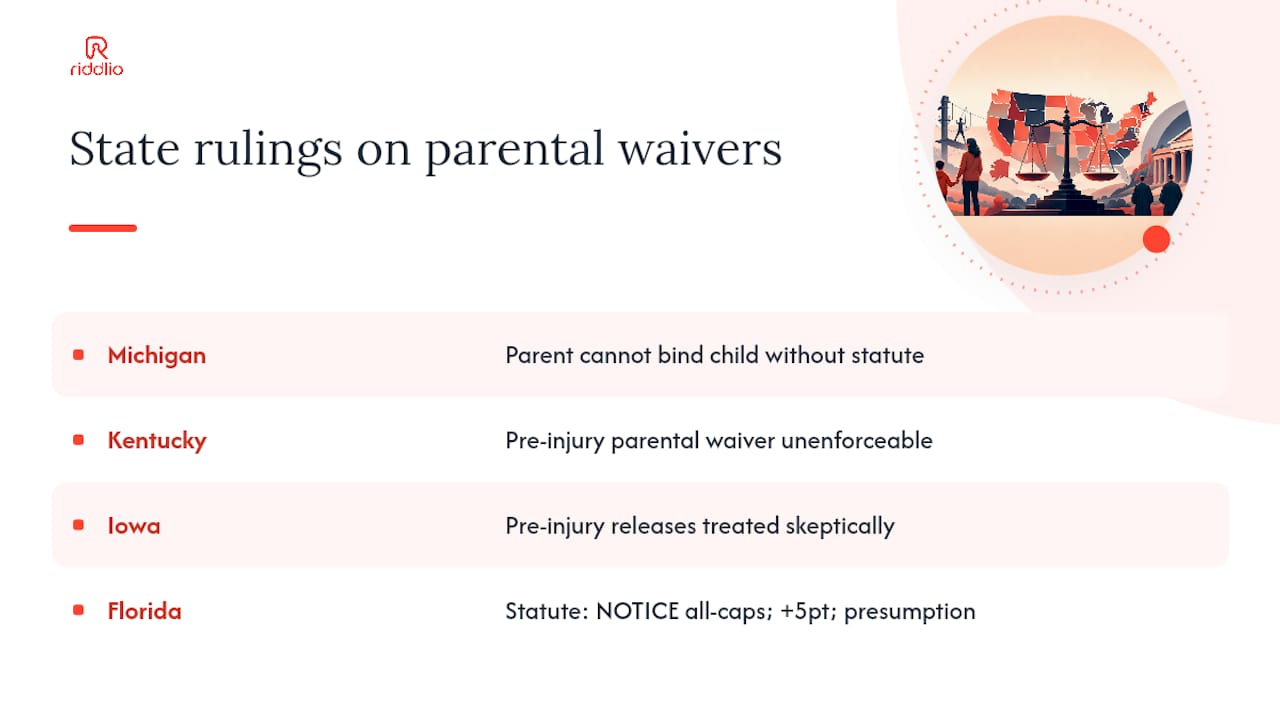
That common-law logic runs deep. The Michigan Supreme Court’s opinion in Woodman v. Kera LLC discusses the long-standing principle that a parent generally cannot bind a child by contract, and that changing this rule requires clear statutory authority, not just a signature on a form. Kentucky reached a similar conclusion on different facts.
In Miller v. House of Boom, the Kentucky Supreme Court found a parent’s preinjury waiver signed on behalf of a child unenforceable, reasoning that Kentucky public policy did not support a parent’s authority to release a minor’s future claims against a commercial recreational venue. The full opinion is a useful read for any operator drafting waivers for a trampoline park, climbing gym, or escape room.
Iowa’s courts have gone further still. The Galloway opinion from the Iowa Supreme Court discusses public-policy limits on a parent’s authority to waive a child’s claims before an injury occurs, treating pre-injury parental releases with real scepticism.
Florida sits at the opposite end. Its legislature built a statutory safe harbour specifically because courts kept striking these waivers down. Florida Statute §744.301(3) lets a natural guardian bind a minor to a pre-injury release for a commercial activity, provided the waiver includes a conspicuous statutory NOTICE in uppercase text, set in a font at least five points larger than the surrounding body copy. Comply exactly, and the statute gives you a rebuttable presumption of enforceability and shifts the burden of proof onto the person contesting the release.
None of this covers gross negligence, recklessness, or intentional acts. Most states won’t let any waiver, parental or otherwise, shield a venue from those. And “parent” isn’t always the right signer, either: a legal guardian consent covers foster or custodial arrangements, while an emancipated minor can typically sign for themselves under most state emancipation statutes.
How does waiver enforceability vary by state?
Three practical categories cover most of the country, and knowing which one your state falls into changes how much weight your paperwork actually carries. Roughly a third of states consistently reject parental waivers for minors outright, according to industry guidance summarised by LegalClarity, while the rest either enforce them conditionally or leave the question genuinely unsettled.
| State category | Typical legal effect | Operator action required |
|---|---|---|
| Statutory safe-harbour states (e.g. Florida) | Waiver enforceable if exact statutory notice and formatting are followed | Match the statute’s wording and font requirements precisely |
| Common-law rejection states | Courts frequently void parental waivers for minors as against public policy | Collect the waiver anyway for evidentiary value; don’t rely on it as a full defence |
| Unsettled or fact-dependent states | Enforceability depends on the specific judge, facts, and activity type | Draft conservatively, log everything, ask counsel before expanding operations |
Before you rely on any waiver, run four quick checks: confirm which category your state falls into, ask whether both parents (or only one) need to sign for a shared-custody child, check your state code for any specific notice or formatting requirement, and log the relevant statute or case citation in your policy file.
When you call your insurer or a local attorney, come with specific questions: does our state enforce parental waivers for recreational injury claims? Is there a statutory format we must follow? Does our current waiver language need a gross-negligence carve-out? A five-minute call answers all three.
What should a parental waiver for an escape room include?
The strongest waivers combine clear risk disclosure with clean, complete signature data, because even in a state that won’t enforce the release outright, a thorough document still does real work. It documents informed consent, discourages weak claims, and gives your insurer something concrete to work with, a point LegalClarity’s operator guidance makes directly.
- A plain-language description of the activity, including physical demands (crawling, confined spaces, flashing lights, loud sound effects).
- A clear statement of risks: minor bumps and falls, claustrophobia triggers, and the general nature of a live puzzle environment.
- A conspicuous statutory notice, where your state requires one, formatted to that state’s exact wording and type-size rule.
- A signature block capturing printed name, relationship to the minor (parent, legal guardian, other), and date.
- An emergency medical authorisation clause covering treatment if a guardian can’t be reached immediately.
- A photo and marketing consent toggle, separate from the liability release itself.
- Indemnity language where your state’s law permits it.
Pro Tip: Florida’s statute requires the NOTICE heading in capital letters, in a font size at least five points larger than the surrounding text. Don’t bury it in a footer, that single formatting slip can cost you the statute’s rebuttable presumption entirely.
A well-drafted emergency medical clause is not decoration. It removes hesitation from your staff at the exact moment they need to act fast, and it belongs in every waiver regardless of which state category you fall into.
When and how should you collect parental consent for minors?
Decide upfront whether you collect at booking or on arrival, because that single choice shapes your entire audit trail. Collecting during online booking gives you a clean digital timestamp and forces the guardian to engage with the waiver before they’ve even left home, but some venues still require a fresh signature at check-in to confirm the actual signer is present and matches the booking record.

Build your policy around a few fixed rules. Link every waiver to a specific booking ID, not a loose form floating in a filing cabinet. Train front-desk staff on what counts as acceptable proof of guardianship, generally a verbal confirmation plus matching last names or a stated relationship, and know exactly when to escalate an ambiguous case to a manager rather than wave someone through.
Group and party bookings need their own workflow. A parent booking six kids for a birthday party should be prompted to either forward individual guardian consent links to other parents or confirm they’re authorised to sign on each child’s behalf, depending on what your state allows. Set a clear refusal policy too: if a guardian won’t sign, the minor doesn’t play, full stop, and that rule needs to be stated at booking, not sprung on a family in your lobby.
Timing reminders reduce last-minute scrambles. A confirmation email with the waiver link, a 48-hour reminder, and a same-day pre-arrival text each catch a different kind of procrastinator, and automated SMS reminders handle this without staff having to chase anyone by phone.
Are digital signatures legally valid for minor waivers?
Yes, a properly executed electronic waiver is widely admissible under the federal ESIGN Act and state-level UETA statutes, but the implementation details determine whether it holds up. You need explicit consent to sign electronically, a clear display of the full waiver text before signing, and a durable audit trail, points echoed in small-business waiver guidance from Waiver World.
Demand these technical features from any waiver software before you commit to it:
- Timestamped signatures with IP address or device metadata captured automatically.
- Captured printed name, relationship to the minor, and contact email tied to each signature.
- Version control, so you can prove exactly what waiver text a guardian actually agreed to.
- Direct linkage between the signed waiver and the specific booking record.
Retention matters as much as capture. Keep signed waivers for the length of your state’s statute of limitations for minors, which often extends well past the injury date because the clock doesn’t start running until the child turns 18 in many states. Encrypt records at rest, log who accesses them, and set a documented destruction schedule once your retention window closes. Medical information you collect for emergency authorisation rarely triggers HIPAA (that law targets healthcare providers, not recreation venues), but treat it with the same care regardless.
| Data element | Why it matters | Retention guidance |
|---|---|---|
| Signature timestamp + IP/device | Proves when and how consent was given | Keep for full retention window |
| Printed name + relationship | Confirms signer authority over the minor | Keep for full retention window |
| Waiver version signed | Shows exact terms the guardian accepted | Keep alongside signature record |
| Booking ID link | Ties consent directly to the specific visit | Keep for full retention window |
An integrated booking platform that automatically links a signed waiver to its booking record removes the manual matching that causes most retrieval headaches when a claim surfaces months later.
Sample parental consent and release language
The block below is a starting structure, not finished legal language. Localise every clause to your state’s requirements and have counsel review it before it goes live.
Send this draft to your insurer and your local attorney before adapting it for live use. A template that works in Florida can be legally worthless in a state that rejects parental waivers outright.
What to do if a minor is injured on-site
Act in this order the moment an incident happens:
- Secure the area and stop any related activity in that room immediately.
- Get the minor appropriate medical attention, calling emergency services if warranted.
- Photograph the scene, equipment, and any relevant condition before anything is moved or reset.
- Collect witness statements from staff and other guests present, in writing, the same day.
- Preserve the executed waiver linked to that specific booking, along with CCTV footage covering the incident window.
- Notify your manager and your insurer within your policy’s required timeframe.
Insurers generally request the same core evidence package: a copy of the signed waiver, the booking record, a written staff incident report, and any available camera footage. Missing even one of these slows a claim significantly.
- Keep all communication about the incident factual and route it through a single authorised spokesperson.
- Don’t speculate publicly about fault, liability, or the strength of your waiver.
- Involve counsel early if the injury is serious or the guardian disputes the waiver’s validity, not after a demand letter arrives.
A working operator’s view on waivers and risk
Running a venue means constantly trading operational friction against legal defensibility, and parental waivers sit right at that intersection. Make the process too heavy and families abandon bookings at checkout; make it too light and you’re left with a flimsy form that won’t survive a claims adjuster’s first read, let alone a courtroom.
What actually reduces risk isn’t a perfect waiver, because no waiver is bulletproof against every state’s courts. It’s a waiver tied cleanly to a specific booking, timestamped, stored with a real audit trail, and backed by staff who know the verification script cold. That combination cuts the time an insurer spends untangling a claim, and it gives your legal counsel something solid to work with instead of a printed form pulled from a filing cabinet three months after the fact.
A practical way to run parental consent waivers without the admin load
Riddlio automates waiver collection so it ties directly to each booking, sends the family a reminder before they arrive, and stores the signed record with a full audit trail, no separate paperwork system to manage on the side.

The features that actually matter for this workflow: digital signature capture built to ESIGN standards, timestamped audit trails with device metadata, waivers linked automatically to the online booking calendar so nothing gets separated from its booking record, automated SMS and email reminders that chase down unsigned waivers before arrival, and secure storage with retention controls you set once and forget.
For a venue running back-to-back bookings on a Saturday, the payoff is concrete: fewer families stuck at the counter filling out paper forms, fewer no-shows caused by last-minute waiver confusion, and a complete evidence trail ready the moment an insurer asks for it. Take a look at how the escape room booking system handles waiver-to-booking linkage, and start a trial to see the reminder workflow running against your own calendar this week.
Sources
Hand this shortlist to your attorney or insurer, or file it directly in your operations policy folder for quick reference.
- Client alert: Businesses—do you have a potentially enforceable waiver for a minor? (Shumaker) — 2026-04-17
- IN THE SUPREME COURT OF IOWA (Galloway opinion)
- Opinion of the Court — Miller v. House of Boom (Kentucky Supreme Court)
- How to fill out an escape room liability waiver: key clauses (LegalClarity)
- How to create a small business liability waiver (2026 Guide) | Waiver World
Do escape rooms need parental consent for minors? Yes. Most venues require a parent or legal guardian to sign a waiver before a minor participates, since courts in many states won’t hold a child bound by any agreement they signed themselves.
Is a parental waiver for a minor always enforceable? No. Enforceability depends on the state; some enforce a parental waiver under specific statutory conditions, others treat it as void against public policy for a minor’s own injury claim.
What is Florida §744.301 and why does it matter to escape rooms? It’s a statute letting a natural guardian bind a minor to a pre-injury release for a commercial activity, provided the waiver includes an exact statutory NOTICE, giving the business a rebuttable presumption in litigation if followed precisely.
Can a digital signature replace a paper parental waiver? Yes, provided it meets ESIGN and UETA standards, including explicit consent to sign electronically, clear display of waiver terms, and a durable audit trail with timestamp and signer details.
How long should a venue keep signed parental waivers on file? Retention periods vary by state statute of limitations for minors, which often doesn’t start running until the child turns 18, so many venues retain records well beyond the visit date. Confirm the exact period with local counsel.
Can an emancipated minor sign their own waiver? In most states, yes, an emancipated minor can generally sign legal documents, including liability waivers, without a parent or guardian’s signature, subject to your state’s emancipation statute.
This article is general information, not a substitute for advice from a qualified lawyer. Consult a qualified legal professional about your own circumstances before acting on anything here.