Offer a modest discount off any session sitting under half-filled at the 24 hour mark, send it by SMS with a one-click booking link, and set the expiry for four hours before the slot starts. That’s the whole playbook in one move. Last minute discounts, in operational terms, are time-limited price cuts you issue on unsold sessions to convert dead inventory into revenue before it disappears entirely.
The trigger matters more than the discount size. Here’s the minimum setup:
- Utilisation threshold: below 50% booked at 24 hours out
- Channel: SMS first, booking widget banner second
- Expiry: hard cutoff, never “until sold out”
- Guardrail: never price below your variable cost per session
Pro Tip: Send the SMS before you touch the widget. A targeted message to people who’ve booked with you before converts faster than a public banner, and it doesn’t train browsers to wait for a deal that never comes.
Key Takeaways
Last minute discounts work when they’re triggered by real utilisation data, priced above variable cost, and delivered through SMS and a private booking link rather than a public coupon code.
| Point | Details |
|---|---|
| Set the trigger | Only discount sessions under 50% filled at 24 to 72 hours out, never busy slots. |
| Protect the floor | Never price below variable cost per session (staff wage, reset labour, consumables). |
| Choose the channel | Lead with SMS and a one-click booking link, use widget banners as backup. |
| Track profit, not just bookings | Watch incremental profit per room and no-show rate, roll back if either turns negative. |
| Automate it with Riddlio | Riddlio’s dynamic pricing and SMS reminders apply these triggers automatically across peak, off-peak, and group slots. |
Table of Contents
- Practical tactics for last minute discounts: SMS, widgets and staff scripts
- How much should you discount, and where’s the floor?
- Which automation features actually protect your margin?
- How do you know if the discount is actually working?
- Staff costs, reset time and capacity limits you can’t ignore
- What actually makes a last-minute offer irresistible
- Is discounting last minute fair to full-price customers, and is it legal?
- What other industries teach about converting unsold inventory
- Why finance-led rules beat pricing theory
- How Riddlio turns unsold slots into booked revenue
- Frequently asked questions
- Sources
Practical tactics for last minute discounts: SMS, widgets and staff scripts
Three channels do almost all the work here: SMS, your booking widget, and your front-desk staff. Get these right and you’ll rarely need anything fancier.
The SMS workflow
- Pull your schedule 24 to 48 hours out and flag any session under 50% capacity.
- Write a message under 160 characters: venue name, time, discount, one link, one deadline.
- Attach a one-click booking link that pre-fills the discounted rate. No coupon code to type, no extra steps.
- Set the expiry in the message itself (“Offer ends 6pm today”) so there’s no ambiguity.
Automated SMS reminders already do heavy lifting on reducing no-shows; pairing that same channel with a same-day discount push is a natural extension rather than a new system to build.
Widget flash deals
A flash banner on your booking widget works when someone’s already on your site comparing times. Show the discounted price only on the specific slots you’re trying to fill, not site-wide. A blanket discount on every time slot just trains people to check your site before ever paying full price.
Walk-ins and phone calls
Give your front-of-house staff a script, not a policy document. Something like: “We’ve actually got a 6pm slot open tonight at $15 off if you can jump in within the hour.” Confident, specific, time-boxed.

Pro Tip: Match the audience to the slot. Weekday afternoon gaps suit students and remote workers. Late weeknight slots suit couples or solo puzzle fans. Don’t waste a family-sized discount on a two-person room.
One rule overrides all of this: never discount a time slot where utilisation is already strong. If your Saturday 7pm consistently books out, a discount there just hands away margin you’d have captured anyway. Save the tactic for the slots that would otherwise sit empty. This approach follows yield-management practice for escape rooms recommendations through capacity reporting and targeted, capped offers.
How much should you discount, and where’s the floor?
Work out your variable cost per session before you set a single discount rate. Add up the game master’s wage for that session, the reset labour between groups, and consumables (props, printed clues, cleaning supplies). For most single-room venues this lands somewhere in the range of typical game master wages, reset labour, and consumables per session, though your own numbers will vary by wage rates and room complexity.
That figure is your floor. Never discount below it, because a booking that doesn’t cover variable cost isn’t really a booking. It’s a cost you’ve paid to look busy.
Beyond that, the discount band should follow the reason for the sale:
- Moderate discounts for routine, recurring fills (a quiet Tuesday afternoon)
- Larger discounts reserved for genuinely dead inventory (last two hours of a slow night)
- Deep discounts generally avoided unless there is an extraordinary reason, as they may signal desperation rather than opportunity
Pricing works best when it balances what a player is willing to pay against what the session actually costs to run, and dynamic pricing tuned to demand does exactly that rather than applying a flat cut everywhere.
Public, evergreen coupon codes are the trap most venues fall into. Once a code lives permanently on a review site or a group chat, you’ve quietly reset the market’s expectation of your normal price. Rule-based, private offers, triggered only by inventory data and sent only to the people you choose, avoid that erosion because there’s no code to hoard or share.
Filling even a handful of extra off-peak sessions a week adds up faster than most operators expect, because staff costs for scheduled hours are largely fixed whether the room is full or empty. That’s the arithmetic that makes a disciplined discount profitable rather than just a nice gesture.
Which automation features actually protect your margin?
Dynamic pricing does the heavy lifting here, but only if it’s configured with guardrails, not left to run wild.
- Trigger condition: fire the discount only when a slot sits under roughly 50% booked at the 24 to 72 hour mark, never earlier
- Price floor: hard code your variable cost as the minimum, so the system can’t undercut itself into a loss
- Learning window: give the system about 30 days before you judge results, since early data is exploratory rather than reliable
Dynamic pricing built for escape rooms adjusts rates across peak, off-peak, and group bookings automatically once those triggers are set, which is a lot more reliable than a staff member manually checking the calendar every morning.
Rule-based, private offers beat public coupon codes for the same reason mentioned above: they’re triggered by real inventory data and disappear once the slot fills or the window closes. Pair the discount message with a reminder in the same SMS, since automated reminders already cut no-shows and a same-day nudge does double duty.
Pro Tip: Before switching any of this on, confirm your booking platform shows real-time inventory, supports one-click checkout at the discounted rate, and actually enforces the expiry instead of honouring a “deal” three days late.
How do you know if the discount is actually working?
Run a simple test before rolling anything out venue-wide.
- Pick two comparable time slots (same day of week, similar historical fill rate).
- Apply the discount trigger to one, leave the other at standard pricing.
- Run it for 2 to 4 weeks, or until you’ve logged 10 to 20 incremental bookings, whichever comes first.
- Compare incremental profit, not just incremental bookings, between the two.
The metric that actually tells you whether this is working is incremental profit, since staff and fixed costs are already committed for scheduled hours, which means most of what a marginal booking brings in flows straight through to your bottom line.
| Metric | What it tells you | Rollback signal |
|---|---|---|
| Incremental revenue per session | Extra dollars from the discounted slot vs. an equivalent undiscounted one | Flat or negative after 3 weeks |
| Profit per room | Whether the discount still clears your variable cost floor | Trending toward zero or below |
| Utilisation change | Whether fill rate genuinely improved on targeted slots | No measurable lift |
| No-show rate | Whether discounted bookings show up | Rises above your normal baseline |
| Repeat-booking rate | Whether discount customers return at full price later | Sharp drop suggests price anchoring |
Roll back the tactic if incremental profit turns negative or your repeat-booking rate falls sharply. Both are signs the discount is either unprofitable or quietly training customers to expect a lower price permanently.
Staff costs, reset time and capacity limits you can’t ignore
A last-minute discount only makes sense if your team can actually run the session without extra cost. If filling a quiet 3pm slot means calling in a game master on overtime, you’ve likely erased the margin the discount was supposed to capture. The tactic works best on slots inside hours you’re already staffing, where the marginal cost of one more group is close to zero.
Reset time is the other constraint operators underestimate. If your reset between groups runs 15 to 20 minutes for prop and clue reset, don’t schedule a discounted slot so tight to the next booking that a late finish causes a domino delay. Build in a buffer, especially for rooms with more physical props or last-act mechanisms that take longer to reset correctly.
Capacity and group size also shape which slots are worth discounting. A six-person room running at two players is a worse economic outcome than a four-person room running full, even at a discount, because you’re paying the same game master wage either way. When corporate or group bookings are involved, cap discounted inventory and block adjacent slots so a promotional booking doesn’t overlap with an event or overcommit your only available game master, a constraint yield-management guidance for escape rooms flags directly around capacity reporting and event blocking.
What actually makes a last-minute offer irresistible
The discount amount matters less than how you frame the urgency. A message that says “10% off tonight, expires 6pm” outperforms a vague “limited time offer” because the deadline is concrete and the reader can act on it immediately rather than filing it away to think about later.
Social proof helps too, though it needs to be true and specific, as explained in how far in advance you should book a vacation rental. If your venue genuinely fills fast on weekends, a line like “our Saturday slots usually book out days ahead” gives a same-day offer more weight than the discount alone. Scarcity language only works when it’s honest. Claiming “almost sold out” for a room that’s actually 30% booked erodes trust the first time a regular customer notices the gap between the message and reality.
Loss framing tends to beat gain framing for same-day offers specifically. “This slot disappears at 6pm” creates more urgency than “save 15% today,” even though they describe the same deal. That’s partly why a hard expiry baked into the SMS itself, rather than a vague “act fast,” tends to convert better.
One more thing operators often skip: give the discount a reason. “Off-peak special” or “we had a cancellation” reads as legitimate and situational. A recurring, unexplained discount reads as your actual price, and operator roundtables on pricing strategy consistently point to framing and intent as the difference between a tactic and a habit customers exploit.
Is discounting last minute fair to full-price customers, and is it legal?
Transparency protects you here more than any legal technicality does. If a customer who paid full price on Tuesday discovers a friend got the same room 20% cheaper on Wednesday because it was a slow night, most people accept that as normal supply-and-demand behaviour, the same logic behind airline seats and hotel rooms. What erodes trust is inconsistency dressed up as randomness, like offering the same customer three different prices for the same slot across three separate visits with no discernible pattern.
Keep your terms genuinely time-limited and say so plainly in the message. “Expires 6pm today” is a fair, verifiable claim. Implying scarcity that doesn’t exist, or advertising a “one-time” deal you actually run every week, drifts into misleading advertising territory in most jurisdictions and is worth avoiding on principle, not just liability.
Fairness also means applying the trigger consistently rather than by whim. If your rule is “any slot under 50% at 24 hours out gets offered a discount,” apply it every time that condition is met, not just when a favourite regular happens to call. A published, consistent rule, even if customers never see the mechanics, protects you from the perception of favouritism and makes your pricing defensible if anyone ever asks why.
What other industries teach about converting unsold inventory
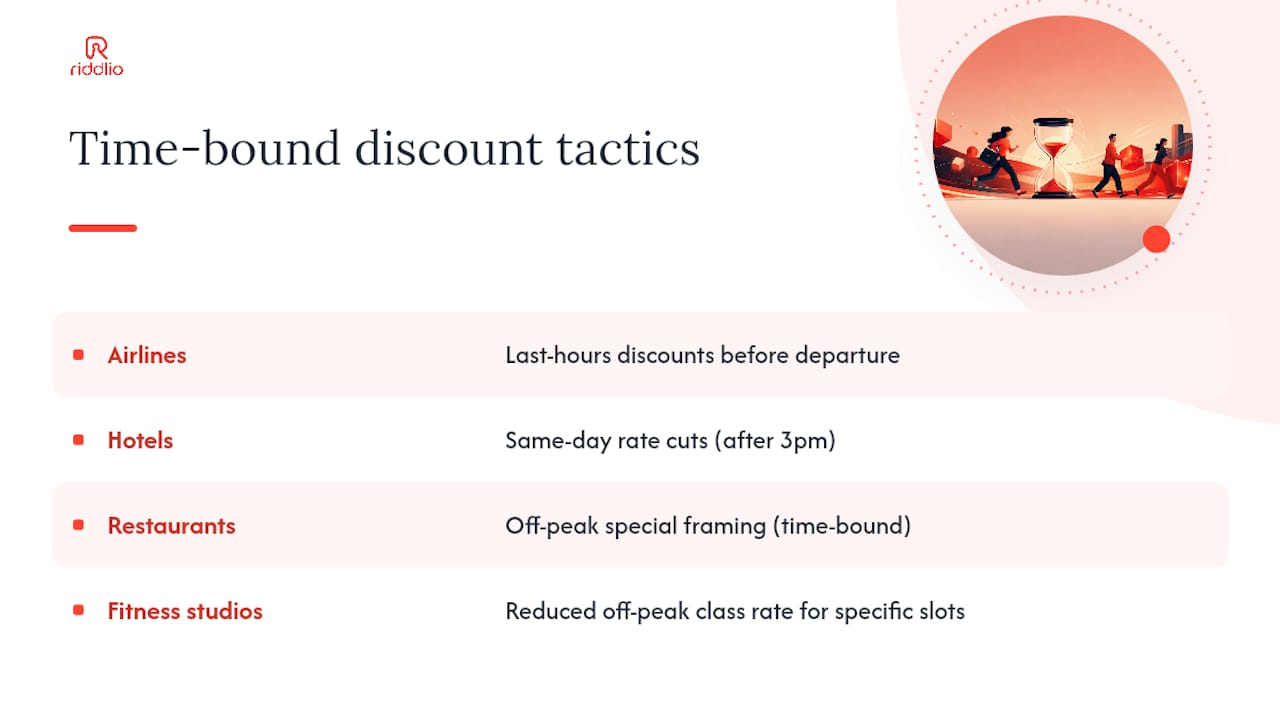
Airlines pioneered this problem long before escape rooms existed: a seat that flies empty earns nothing, so carriers discount aggressively in the final hours before departure rather than let the seat go to waste. Hotels do the same with same-day room rates, often dropping prices sharply after 3pm local time once it’s clear a room won’t sell at rack rate.
Restaurants running quiet Tuesday nights frequently use “off-peak special” framing on set menus rather than a blanket discount, precisely because that framing signals a specific, time-bound reason rather than a permanent price drop. That’s the same principle escape room operators can borrow: name the reason, bound the time, and keep the regular price the anchor customers remember.
Fitness studios with off-peak class discounts show a similar pattern to what a well-run escape room could achieve. A 10am weekday class rarely fills at full price, so studios offer a reduced “off-peak” rate specifically for that slot, which trains members to associate the discount with the time of day, not with the brand’s price being negotiable. The same logic applies directly to a Tuesday 2pm escape room slot versus a Saturday night one.
What all of these share is restraint. None of them run permanent, public, deep discounts. They run targeted, time-boxed offers tied to a specific supply signal, exactly the model that protects an escape room’s regular pricing while still converting the inventory that would otherwise sit empty.
Why finance-led rules beat pricing theory
Most advice on discounting escape room slots stays abstract: know your customer, test and learn, be data-driven. None of that tells an operator what to actually type into a booking system at 9am on a Tuesday. The judgement worth taking from all this is narrower and more useful: set your price floor to variable cost, trigger discounts only off a real utilisation number, and measure profit per room rather than total bookings.
Where conventional advice falls down is treating all discounting as roughly the same activity. The venues that get this right treat the discount as a supply-clearing mechanism, not a marketing personality.
If you’re prioritising one thing first, make it the price floor. Everything else, the channel, the message, the audience targeting, is optimisation. Get the floor wrong and every optimisation downstream just accelerates a loss. Get it right, and even a clumsy SMS campaign will still protect your margin while it fills the room.
How Riddlio turns unsold slots into booked revenue
Every tactic above depends on having the right infrastructure underneath it, and that’s precisely where most venues get stuck running this manually through spreadsheets and group texts. Riddlio is built specifically for escape room operators who need dynamic pricing, SMS automation, and real-time occupancy data working together instead of as three disconnected tools.

Dynamic pricing applies your utilisation triggers and price floor automatically across peak, off-peak, and group bookings, so you’re not manually checking the calendar every morning to spot a quiet slot. Automated SMS reminders cut no-shows on top of that, and the same channel doubles as your last-minute offer delivery system once a discount trigger fires. Real-time analytics show which slots convert and which don’t, and the online booking calendar handles one-click checkout at the discounted rate without you building a separate landing page for every promotion.
If you’re currently running this playbook by hand, start with a trial and review the booking system features to see how the pricing rules and SMS triggers slot into your existing calendar.
Frequently asked questions
What counts as a last minute discount for an escape room? It’s an operator-issued, time-limited price reduction applied to a specific unsold session, usually triggered when utilisation falls below a set threshold within 24 to 72 hours of the slot.
How much should I discount a last-minute slot?
Will last minute discounts train customers to wait for deals? Public, permanent coupon codes tend to do that. Private, rule-based offers tied to real inventory triggers and sent only to targeted customers rarely cause the same price-anchoring effect.
Should I list last-minute discounts on OTA sites? Third-party platforms take a commission that eats directly into an already-reduced margin, so most operators get better results running the offer through their own SMS list and booking widget instead.
How long should I test a new discount tactic before deciding if it works? Run it for 2 to 4 weeks, or until you’ve logged 10 to 20 incremental bookings. Judge success on incremental profit per room, not just the raw booking count.
What’s the single biggest mistake operators make with last-minute pricing? Discounting without knowing the variable cost per session first. Without that floor, a “successful” discount can still lose money on every booking it generates.
Sources
- AI Tools for Escape Rooms: Fill Slots & Win Reviews | SmbAI
- The Economics of Escape Room Pricing - CipherDot