The best holiday pricing strategy publishes locked price blocks two to three months out, protects a floor price beneath any discount, and layers targeted premiums on hero SKUs while using bundles instead of blanket markdowns. That’s the model behind Pricefy’s holiday pricing research and it’s the same logic booking platforms like Riddlio automate for time-slot operators.
TL;DR:
- Lock holiday prices two to three months in advance, focusing on premium SKUs and using bundles instead of uniform discounts to protect margins.
- Utilize multiple tactics such as dynamic pricing with manual overrides, bundling, and scarcity cues to effectively influence customer buying behavior during peak periods.
- Set final prices at least eight to twelve weeks prior, and avoid panic discounts within three weeks of the holiday, instead applying targeted, modest markdowns.
- Benchmark premiums around 30 to 70% for peak windows like Christmas and New Year’s, and implement minimum bundle sizes to prevent inventory from selling out on low-margin units.
- Coordinate pricing with marketing efforts, ensure channel consistency, and plan post-holiday clearance in stages to preserve price integrity and margins.
Table of Contents
- What is holiday pricing and why does it work differently to regular sales?
- Which holiday pricing tactics actually move the needle?
- How should you handle Black Friday and Cyber Monday specifically?
- When should you lock in your holiday prices?
- What markup and markdown bands actually work?
- What should you measure to know if your holiday pricing worked?
- How do booking platforms automate these holiday pricing rules?
- Is it legal to raise prices during the holidays?
- Should you price differently for different customer groups?
- How does holiday pricing connect to your marketing calendar?
- What comes after the holidays: clearance without wrecking your margins
- The final week: what to actually do before the holiday hits
- A simpler way to run peak and off-peak pricing for timed experiences
- Sources
What is holiday pricing and why does it work differently to regular sales?
Holiday pricing means setting different rates for date-locked windows, Thanksgiving week, the Christmas run, New Year’s Eve, rather than running a generic seasonal sale. Regular discounting responds to slow-moving stock. Holiday pricing responds to a spike in demand that customers already expect and have budgeted for.
That distinction changes the maths. Shoppers buying gifts or booking a New Year’s experience have less flexibility to wait for a better price elsewhere, so demand stays firmer even as prices rise. Dynamic pricing, the practice of varying price with real-time demand, exploits exactly that reduced elasticity. Done well, holiday pricing protects margin, controls inventory pace, and shapes when customers buy rather than just how much they pay.
Which holiday pricing tactics actually move the needle?
Retailers who plan holiday pricing well don’t rely on one lever. They stack several, each doing a different job.
- Dynamic pricing with manual overrides. Automated rules handle day-to-day demand shifts, but algorithms routinely underprice compressed holiday weeks if nobody steps in. Set the automated floor, then override the peak dates yourself.
- Bundling over blanket discounts. Grouping a hero item with slower-moving accessories protects the anchor product’s perceived value while lifting average order value through bundle pricing. It consistently beats a flat percentage-off sale on both conversion and spend per order.
- Loss leaders, used sparingly. A doorbuster item priced near cost can pull traffic, but only works if it’s genuinely low-stock and paired with high-margin add-ons at checkout. Running more than one or two loss leaders per event turns the whole sale into a discount event.
- Time fences and scarcity cues. “Ends Sunday” or “40 left at this price” isn’t just marketing copy, it’s what stops shoppers from waiting you out. Real fences (a countdown that actually expires) build more trust than fake ones that quietly reset.
The order matters. Decide your floor first, then decide which SKUs carry premiums, then decide where bundles or loss leaders fill the gaps.
How should you handle Black Friday and Cyber Monday specifically?
Black Friday and Cyber Monday reward preparation, not improvisation. Lock your hero offers and discount depth weeks in advance so nobody is eyeballing margin on the day itself.
Stage your promotions instead of cutting everything at once. Early access for email subscribers, a midday flash offer, a last-hour push. This spreads server load and gives you multiple “moments” to market. Watch competitor pricing in real time during the event window and decide upfront which categories you’ll defend on price and which you’ll let go. Stock depth, fulfilment capacity, and return rates should all cap how deep any discount goes. A 40% cut that triggers more returns than it’s worth isn’t a win, it’s a margin leak with good conversion numbers attached.
When should you lock in your holiday prices?
Timing is where most retailers lose money before the sale even starts. Vacation rental pricing research that applies just as well to retail found that holiday pricing needs finalising at least two to three months ahead, and waiting until three weeks out sharply cuts your ability to capture premium rates.
- Eight to twelve weeks out: publish your holiday price blocks and lock hero-SKU premiums. This is also the point to set manual overrides on any algorithmic dynamic pricing tool, since left alone they tend to underweight holiday demand.
- Four to six weeks out: checkpoint your sell-through rate. If a category is tracking ahead, hold or nudge premiums higher. If it’s lagging, plan a targeted, not blanket, adjustment.
- Inside three weeks: avoid panic discounting. Small, bounded markdowns (think 10 to 15%) on specific slow SKUs are fine. Sitewide cuts this late train customers to wait you out next year.
What markup and markdown bands actually work?
Holiday premiums vary by category and market, but published bands from the vacation rental sector, where date-locked demand is most extreme, give a useful benchmark: Thanksgiving windows commonly support premiums of 30 to 50% above baseline, Christmas week runs 40 to 70% above baseline, and New Year’s Eve windows sit around 35 to 55%. Retail categories with strong gift-giving demand often land in similar territory, though you should test against your own baseline rather than copy these numbers blindly.
Pro Tip: Set a minimum order quantity or minimum bundle size on your highest-demand SKUs during peak weeks, the same logic as a minimum-night stay in accommodation, to stop your best inventory selling out on single low-margin units.
| Window | Typical premium band | Notes |
|---|---|---|
| Thanksgiving week | 30 to 50% above baseline | Shorter demand spike, apply tightly to the week itself |
| Christmas week | 40 to 70% above baseline | Longest and deepest demand window of the year |
| New Year’s Eve | 35 to 55% above baseline | Compressed single-event demand, ideal for hero-SKU premiums |
A bundled example: if a $40 hero item and a $15 accessory would normally sell separately, a $48 bundle (a 12% saving off the combined price) protects the hero item’s price integrity while still moving the slower accessory. A time-limited discount on ageing stock, say 15% off for 48 hours, works best framed as a fence rather than a permanent price cut.
What should you measure to know if your holiday pricing worked?
Track conversion rate, average order value, margin per unit, and inventory turn against your baseline, not just against last year’s raw revenue. Academic research on dynamic pricing recommends starting with conservative price differences and testing over an eight to ten week window before widening any bands.
- Run A/B tests on discount depth (10% vs 20%) on a subset of SKUs before rolling out sitewide.
- Check velocity weekly, not daily, small samples early in a promotion mislead you.
- Set a decision threshold in advance: three weeks out, if a category is under 50% of its sales target, apply a controlled 10 to 15% discount rather than an open-ended one.
How do booking platforms automate these holiday pricing rules?
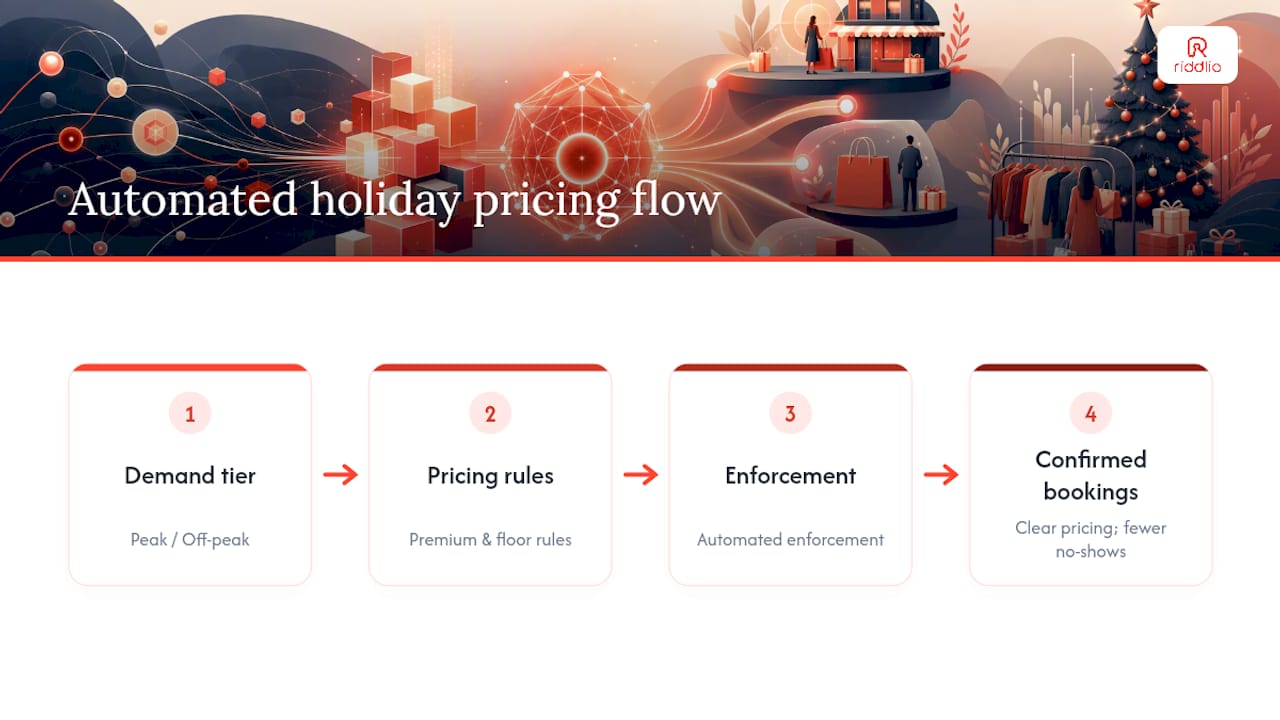
Booking software with built-in dynamic pricing for peak and off-peak tiers enforces the floor and premium logic automatically instead of relying on manual spreadsheet updates. For time-slot venues, that means fewer no-shows, clearer pricing communicated to customers upfront, and minimum-booking rules that hold without staff chasing every exception.
Is it legal to raise prices during the holidays?
Raising prices to match genuine demand is standard commercial practice and legal across most of the United States. Price gouging laws are different: they target steep, opportunistic increases during declared emergencies, not routine seasonal demand pricing, and they vary significantly by state, with some triggering only during a formal state of emergency and others capping increases at a fixed percentage above pre-emergency prices. Holiday pricing built around published, date-locked bands sits well outside that territory because the increase reflects predictable recurring demand rather than a crisis.
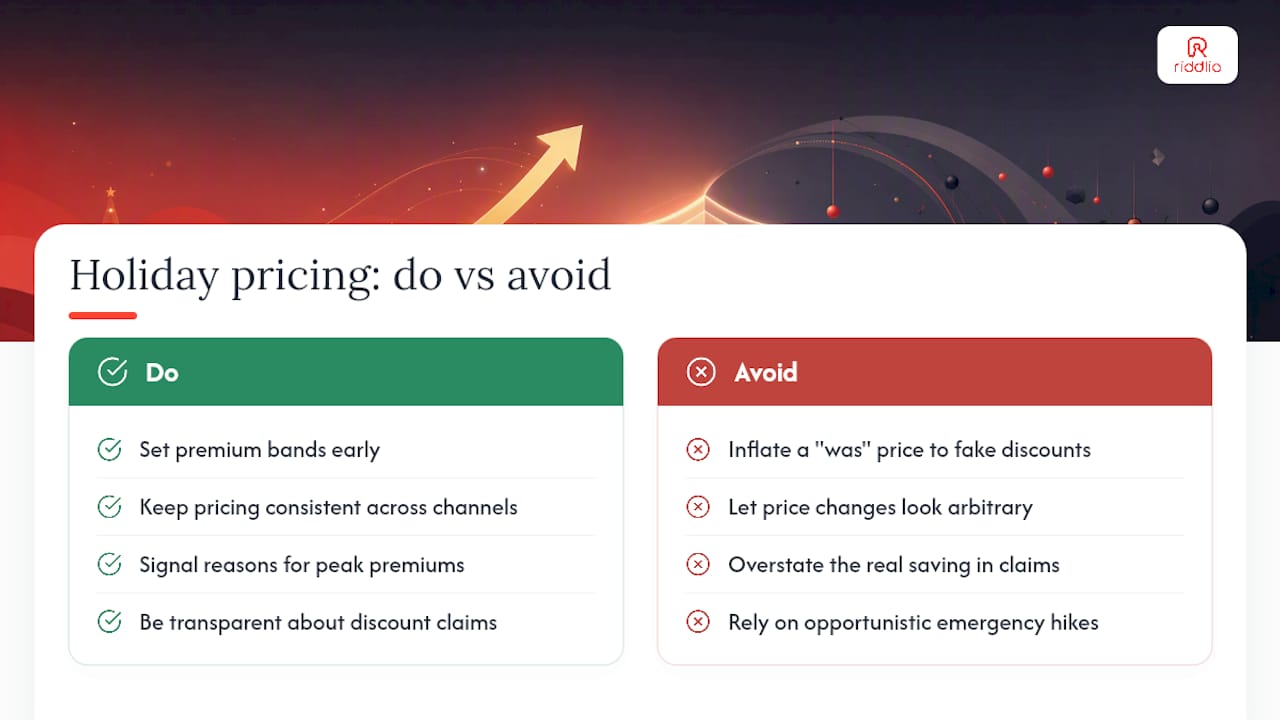
Ethics is a separate question from legality, and it’s the one that affects repeat customers. Transparency matters more during the holidays than any other time of year, because shoppers are actively comparing your price against memory of what you charged last month. Avoid inflating a “was” price only to discount it back to a normal level, a tactic regulators in several markets have specifically targeted and one that erodes trust the moment a customer notices. If you’re running a premium during a peak window, it helps to signal why, limited stock, high demand, extended support hours, rather than let the price change look arbitrary.
The safest approach: set your premium bands early, keep them consistent across your own sales channels, and never let a discount claim overstate the real saving. A customer who feels misled once rarely gives you the benefit of the doubt during the next sale.
Should you price differently for different customer groups?
Segmented holiday pricing recognises that not every buyer values the same thing at the same moment, so a single sitewide price wastes margin on some segments and loses sales on others.
Early shoppers who buy in October or November are typically price-sensitive planners chasing the best possible deal; they respond well to early-bird bundles rather than deep discounts. Last-minute shoppers in the two weeks before Christmas care far more about guaranteed delivery or availability than price, which is exactly where you can hold or even lift your premium rather than discount to compete.
Loyalty segments deserve their own logic entirely. Repeat customers or members respond to exclusive early access and small guaranteed perks more reliably than a bigger discount, and rewarding loyalty this way protects your public price point from erosion. Gift-focused segments, buying for someone else rather than themselves, tend to be less price-sensitive on the item itself but highly sensitive to service factors: gift wrapping, guaranteed delivery dates, easy returns. Price these bundles on the service layer, not just the product.
The mechanics don’t need to be complicated. Tiered email lists, a VIP-only early access window, or a simple “gift ready” bundle at a small premium are all low-effort ways to segment without building a full pricing engine.
How does holiday pricing connect to your marketing calendar?
Holiday pricing only works if your marketing channels carry the same message at the same time, a floor price that email promotes as a discount while your website still shows full price is a fast way to lose trust and sales in the same afternoon.
Map your price changes to your campaign calendar before either goes live. Early-access emails should align with your first premium tier, not your deepest discount, so loyal subscribers feel rewarded rather than baited. Paid social and search campaigns need creative that matches whichever price fence is active that week, an ad promoting “40% off” after the fence has closed is worse than no ad at all.
Cross-channel consistency also protects your floor price. If your website holds a hard minimum but a marketplace listing or a social ad undercuts it, you’ve effectively set a new floor without deciding to. Audit every channel where your prices appear, at minimum weekly during peak weeks, and treat any mismatch as an operational fix, not a minor detail.
What comes after the holidays: clearance without wrecking your margins
Post-holiday pricing is where a lot of the good discipline built up over the season gets undone by rushed clearance decisions. The goal isn’t to move everything at once, it’s to clear genuinely excess stock while protecting the price expectations you just spent two months building.
Segment your remaining inventory before you touch a price. Slow-moving seasonal stock (wrapping paper, holiday-specific items) needs to clear fast and can absorb steep markdowns because it has no value outside the window. Evergreen stock that simply didn’t sell at holiday premiums should step back down to baseline price, not straight to clearance, since a sharp drop trains customers to expect it again next year.
Stagger clearance in visible steps, 20% off, then 40%, then a final clearance tier, rather than jumping straight to the deepest discount. This captures shoppers at every price sensitivity level instead of leaving margin on the table for the first wave of post-holiday buyers. Use the data you gathered during the season, which SKUs held their premium and which needed discounting, to set next year’s initial price blocks rather than starting from scratch.
The final week: what to actually do before the holiday hits
With days left, confirm fulfilment capacity, lock your promo calendar, and set final floor prices, no more adjusting on the fly. Prepare a short list of targeted small discounts for genuinely slow SKUs, and brief your customer service team with clear scripts on delivery cutoffs and stock questions. Whatever you do, don’t torch next year’s price expectations chasing this week’s numbers.
— Iosif Beraru
A simpler way to run peak and off-peak pricing for timed experiences
Everything above works whether you sell physical stock or timed inventory, but slot-based businesses, escape rooms, tours, immersive experiences, face a sharper version of the problem. Every unfilled slot at 7pm on New Year’s Eve is gone forever, unlike a t-shirt that can sit in the warehouse until January.

That’s the gap Riddlio was built to close. Instead of manually editing prices across a spreadsheet and hoping nobody forgets to switch back after the holiday window closes, Riddlio’s dynamic pricing for peak, off-peak and group bookings lets you set the floor once, schedule premium tiers for exact date ranges, and let the booking calendar enforce them automatically, no manual overrides needed on the night itself. It’s built specifically for venues running fixed time slots rather than general retail, so if that’s your business, it’s a more direct fit than adapting e-commerce pricing tools to a booking model. Check your holiday date ranges against Riddlio’s escape room booking system and see what a properly automated peak-pricing calendar looks like before your next big weekend sells out at the wrong price.
Sources
- How to price your vacation rental for holidays 2026
- Seasonal & Holiday Pricing Strategies: Examples & How-To
- Time-of-use pricing — Wikipedia
- Meta-synthesis on dynamic pricing (academic paper)