A gift card redemption rate measures the share of issued cards or vouchers that customers actually use, calculated either by count of cards redeemed or by dollar value redeemed against dollar value sold.
TL;DR:
- Redemption rates are highest for closed-loop, single-venue cards, often surpassing 75% within 12 to 24 months, but lower for open-loop or multi-brand cards.
- Digital delivery methods, omnichannel acceptance, and recognizable brands significantly boost redemption likelihood, while vague expiry rules and poor mobile support hinder it.
- Tracking cohort-based redemption and time-to-first-redemption provides more actionable insights than overall blended rates, enabling quicker response to operational changes.
- Shoppers tend to overspend when redeeming gift cards, making overspend and average order value key metrics alongside redemption percentages for true program success.
- Venue-integrated booking systems with automated reminders and digital wallets create a natural, frictionless redemption experience that accelerates usage and improves revenue prediction.
Table of Contents
- Gift card redemption rate benchmarks: what the numbers actually mean
- How to calculate redemption rate (formulas and quick examples)
- What actually drives whether a gift card gets used
- Tactical checklist to increase redemption rates
- The metrics that actually predict revenue, not just redemption
- Fraud, scams and the accounting traps that erode programme value
- Why activity venues see faster redemption when systems talk to each other
- Stop chasing the redemption percentage and start chasing the profit
- Turn vouchers into booked slots, faster
- Sources
Gift card redemption rate benchmarks: what the numbers actually mean
Redemption benchmarks swing wildly depending on how the card was issued and where it can be spent. A closed-loop card tied to one venue or retailer tends to redeem faster and more completely than an open-loop card usable anywhere, simply because the recipient has fewer decisions to make. Email-delivered promotional vouchers often sit at the low end, with industry benchmarking suggesting many email campaigns deliver low single-digit redemption, while loyalty-programme rewards and targeted offers routinely land far higher because the recipient already has a relationship with the brand.
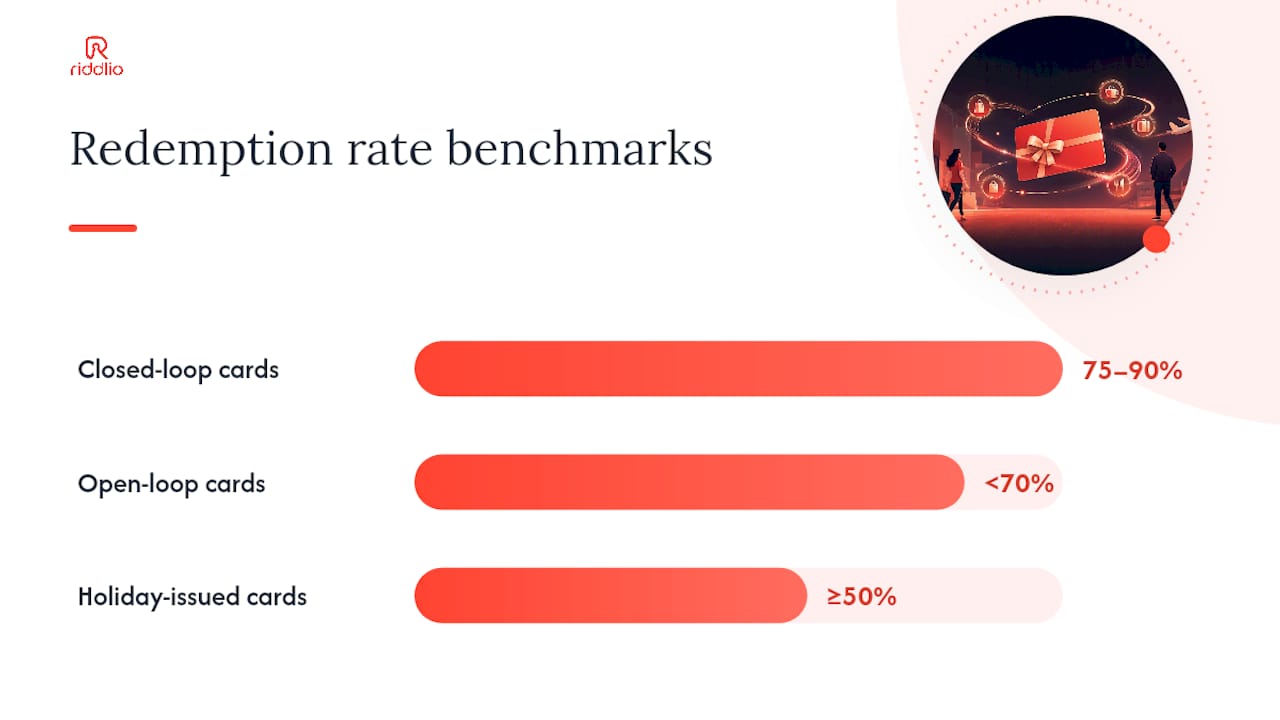
Seasonal timing matters too. Holiday-issued cards move fast once the season ends. A 2026 TSG and Bank of America consumer study found a large share of recipients had used at least half of their holiday gift cards within a short window after Christmas, which tells you redemption isn’t a slow trickle for most cardholders. It’s a burst, followed by a long tail of stragglers.
That long tail is where the accounting gets confusing. A card sitting unused six months after purchase is not the same thing as a card that will never be redeemed. The first is a point-in-time unredeemed balance, still a liability on the books and still a live prospect for redemption. The second is breakage, the portion a business can eventually recognise as revenue because state law and accounting standards allow it once redemption becomes remote. Conflating the two leads plenty of operators to either overstate their loss or understate their actual liability.
A significant share of American adults are currently holding at least one gift card they haven’t used, according to survey data reported by Bankrate/YouGov research, with the average holder sitting on substantial unspent value. That’s a lot of dormant purchasing power, but it also cuts the other way: when people do redeem, they tend to spend more than the card is worth. Many shoppers overspend the face value at checkout, which is the real commercial upside of a gift card programme and the reason redemption rate alone is an incomplete measure of success.
Realistic ranges to work from:
- Closed-loop, single-venue cards: often 75 to 90% redeemed within 12 to 24 months.
- Open-loop or multi-brand cards: frequently lower, sometimes below 70%, because choice paralysis and forgetting both increase.
- Promotional email vouchers: low single digits unless heavily targeted or time-limited.
- Loyalty and post-purchase reward vouchers: meaningfully higher, since the recipient is already an active customer.
How to calculate redemption rate (formulas and quick examples)
Two formulas cover most reporting needs, and both are worth tracking side by side because they tell you different things.
- Count-based redemption rate = (number of cards redeemed ÷ number of cards issued) × 100. If you sold 200 vouchers last quarter and 150 have been used, that’s a 75% count-based rate.
- Value-based redemption rate = (dollar value redeemed ÷ dollar value issued) × 100. Sell $10,000 worth of vouchers and see $7,200 redeemed, and you’re sitting at 72% by value, a slightly different picture than the count-based figure because higher-value cards don’t always redeem at the same pace as smaller ones.
- Cohort-based redemption rate groups cards by the month or week they were issued, then tracks that specific cohort’s redemption curve over time rather than blending everyone together. A blended, lifetime rate looks stable even when your underlying performance is quietly getting worse, because rapid growth in new issuance masks a decline in how fast older cohorts convert. Cohort tracking catches that shift months before a blended number would.
Cohorts are the more actionable of the three because they respond quickly to operational changes. Change your reminder cadence in March, and a March cohort will show you the effect within weeks, not after a full year of blended data has washed it out.
What actually drives whether a gift card gets used
Ease of redemption outweighs almost every other factor, and the data backs this up more starkly than most operators expect. Research from TSG Payments found that 39 to 49% of consumers say they’re less likely to use a gift card at all if their preferred redemption channel isn’t available. If a customer wants to redeem on their phone and the process demands a printed voucher or a phone call to book, a meaningful chunk of them will simply never get around to it.
A handful of factors consistently separate high-redemption programmes from low ones:
- Digital delivery and wallet support. Cards that land in Apple Wallet or Google Wallet get seen repeatedly; a code buried in an old email gets forgotten.
- Omnichannel acceptance. The card needs to work wherever the customer expects to redeem it, whether that’s in person, on a booking page, or through a call centre.
- Denomination framing. Round, generous-feeling amounts (a $50 card) tend to prompt faster action than oddly specific ones, and higher denominations often trigger the overspend behaviour mentioned earlier.
- Distribution timing. A card issued as a spontaneous gift moves differently to one issued as a delayed refund or goodwill gesture, where urgency is lower from the start.
- Brand recognition. Recipients redeem faster when they immediately recognise and trust the issuing brand; an unfamiliar name adds a decision-making step that costs redemption momentum.
- Expiry terms and legibility of conditions. Vague or hidden expiry rules breed distrust and hesitation, even in jurisdictions where cards legally can’t expire for years.
None of these factors work in isolation. A generous denomination on a card that can’t be redeemed on mobile still underperforms, because the friction problem overrides the incentive.
Tactical checklist to increase redemption rates
Improving redemption isn’t about one big lever. It’s a stack of small friction removals that compound. Work through these roughly in order of effort versus payoff:
- Switch to digital-first delivery. Send vouchers as wallet-compatible passes or clean, mobile-friendly links rather than PDFs or printed cards. This is the single highest-leverage change most programmes can make.
- Build an automated reminder cadence. A short sequence, roughly one reminder at 30 days, another at 90 days, and a final nudge as expiry approaches, recovers a real slice of cards that would otherwise sit forgotten. Email and SMS both work, but SMS tends to get read faster for time-sensitive nudges.
- Add on-site redemption prompts. If a customer is already booking or browsing, surface “you have a $30 credit available” at the point of checkout rather than relying on them to remember it separately.
- Test attachment offers at redemption. A small “add $10, get $15 to spend” prompt at the point of use lifts both redemption and overspend simultaneously.
- Rethink your denomination strategy. Offer a small set of clean amounts rather than arbitrary values, and consider a limited-time bonus (redeem within 60 days, get 10% extra) to pull forward the long tail.
- Design every test around time-to-first-redemption, not just final redemption percentage. A tactic that shaves two weeks off the average time to first use will show up in your cohort data long before your annual redemption number moves.
Pro Tip: Run a simple A/B test where one cohort gets an SMS reminder at day 14 and a control cohort gets your existing email-only sequence. Time-to-first-redemption is one of the fastest metrics to move, and you’ll usually see a measurable gap within a month, long before you’d notice anything in a full-year redemption report.
Integrated payment and communication tools remove a lot of this manual work. Platforms that combine payment processing with automated SMS reminders mean the nudge sequence runs itself instead of relying on someone remembering to send it. Digital wallet cards from providers like RESTOBOT show a similar principle at work in hospitality: convenience at the point of redemption is what actually moves the number, more than any messaging tweak on its own.

The metrics that actually predict revenue, not just redemption
Cohort analysis and time-to-first-redemption matter more than a single blended redemption percentage, because they tell you whether your programme is getting faster or slower to convert, not just where it landed after the fact. Practitioner guidance on gift card metrics consistently points to tracking cohorts over lifetime averages precisely because a lifetime number hides deterioration until it’s already baked into a year of data.
Time-to-first-redemption is the leading indicator worth watching weekly.
Overspend and average-order-value uplift deserve just as much attention as redemption itself. If shoppers routinely spend beyond the card’s face value, that incremental dollar amount is the actual commercial return on the programme, separate from the redemption percentage entirely.
Build a simple reporting rhythm around these fields:
- Redemption rate by cohort (weekly issuance groups), tracked at 30, 90, and 180 days.
- Median and average time-to-first-redemption per cohort.
- Overspend rate and average dollar amount spent beyond card value.
- Outstanding liability (unredeemed balance) versus recognised breakage, reported separately.
Fraud, scams and the accounting traps that erode programme value
Gift cards are a favourite target for scammers precisely because they’re hard to trace and easy to liquidate. The Federal Trade Commission’s data on gift-card scams documents recurring patterns: fraudsters pressure victims into buying cards and reading out the codes, then drain the balance before the victim realises anything is wrong.
Reasonable mitigations for a venue or retailer selling vouchers directly:
- Cap the value of any single card purchase and flag unusually large or repeated purchases for review.
- Monitor for rapid, sequential redemption attempts from a single card, a common signature of stolen codes.
- Keep distribution channels secure and avoid publishing redeemable codes anywhere publicly accessible.
On the accounting side, keep unredeemed balances and recognised breakage as separate line items. Treating every unredeemed dollar as “lost revenue” the moment it’s issued overstates your loss; treating it all as guaranteed future revenue understates your actual liability. Neither view holds up under scrutiny, and gift card accounting practices generally require you to track the two separately until redemption becomes genuinely remote.
Why activity venues see faster redemption when systems talk to each other
Escape rooms and other activity venues have a structural advantage most retailers don’t: redemption requires an actual booking, which creates a natural moment to close the loop. When voucher sales are integrated directly with the booking calendar, a customer redeeming a card doesn’t need to call, email, or hunt for a promo code field buried three pages deep. They pick a slot and the value applies automatically.
Seasonal venues should set their cohort window to match their actual booking cycle rather than a generic 12-month default. A card sold in December for a venue that runs mostly weekend group bookings needs a different redemption curve expectation than one sold to a corporate client booking mid-week team events.
Practical points worth building into any venue’s voucher setup:
- Automated SMS reminders tied to voucher expiry dates catch recipients before the card lapses, not after.
- Booking-linked redemption removes the “how do I actually use this” question entirely.
- Cohort windows should follow the venue’s own seasonal booking pattern, not a one-size-fits-all calendar quarter.
Pro Tip: If your venue runs strong seasonal peaks, set a shorter cohort window (60 to 90 days) around your peak season and a longer one for off-peak issuance. You’ll get a much clearer read on whether slow season vouchers genuinely convert worse or just take longer.
Stop chasing the redemption percentage and start chasing the profit
The obsession with a single redemption percentage misses the point entirely. Chasing the highest possible number often means over-engineering reminder sequences for cards that were never going to add meaningful revenue anyway.
The better use of your time is running small, fast experiments that shift time-to-first-redemption. Change one variable, watch the cohort, and let the data tell you what’s actually working before you commit to a bigger rebuild.
— Iosif Beraru
Turn vouchers into booked slots, faster
Riddlio gives venue operators one thing most gift card setups don’t: a direct line from voucher purchase to booked, paid session, with nothing manual sitting in between. Vouchers sell and redeem inside the same online booking calendar customers already use, automated SMS reminders chase down unredeemed balances before they go cold, and integrated payment processing means the value applies at checkout without a separate code lookup.

Operators get clearer revenue reporting too. Analytics break out redeemed value, outstanding liability, and overspend at the point of booking, so you’re not guessing whether your voucher programme is actually pulling its weight. If your escape room or activity venue is still handling gift vouchers as a manual, disconnected process, start by checking how Riddlio’s booking system handles voucher sales and redemption end to end.
Sources
- Gift Card Statistics 2026: Market Size, Redemption & Unused Balances
- Scammers prefer gift cards — Federal Trade Commission