Under federal law, the money loaded onto most gift cards cannot expire for at least five years from the date it’s put on the card, and inactivity fees can only kick in after 12 months of non-use. Several states go further and ban expiries or fees outright. Check your state’s rule before assuming the five-year floor is the whole story, and keep your receipts either way.
TL;DR:
- Many states prohibit gift card expiration dates entirely, with California, Illinois, and Washington leading the way by banning expiry for most store-issued cards.
- Federal law requires funds on gift cards to remain valid for at least five years from last load or activation, with this period resetting upon additional deposits.
- Inactivity fees can only be charged after 12 months of non-use and cannot be more than one per month, with strict disclosure requirements on the card itself.
- Businesses must clearly state expiry policies, fees, and replacement contact details directly on the card and during checkout to meet legal standards.
- Using centralized voucher management software like Riddlio can streamline compliance, tracking, and disclosures, reducing legal risk for entertainment venues.
Table of Contents
- What does federal law actually require for gift cards?
- How do state gift card laws differ from the federal floor?
- When can a business charge a fee, and what has to be disclosed?
- What should you do if a gift card is refused or a fee looks wrong?
- Why do smart venues drop expiry dates altogether?
- Our take: compliance beats cleverness here
- Sell vouchers without the compliance headache
- Where to check the current rules yourself
- Sources
- FAQ
What does federal law actually require for gift cards?
The Credit CARD Act of 2009 set the national baseline, and it’s stricter than most people assume. The underlying funds on a store gift card, gift certificate, or general-use prepaid card can’t expire for at least five years from the date the card was activated or last loaded with money, according to FDIC guidance on gift cards. That five-year clock resets every time someone adds value to the card, so a frequently topped-up card effectively never expires in practice.
The rule sits inside Regulation E, specifically 12 C.F.R. §1005.20, which is the section the Consumer Financial Protection Bureau enforces against issuers. It doesn’t just cover expiry dates. It also governs fees, and this is where a lot of issuers get sloppy.
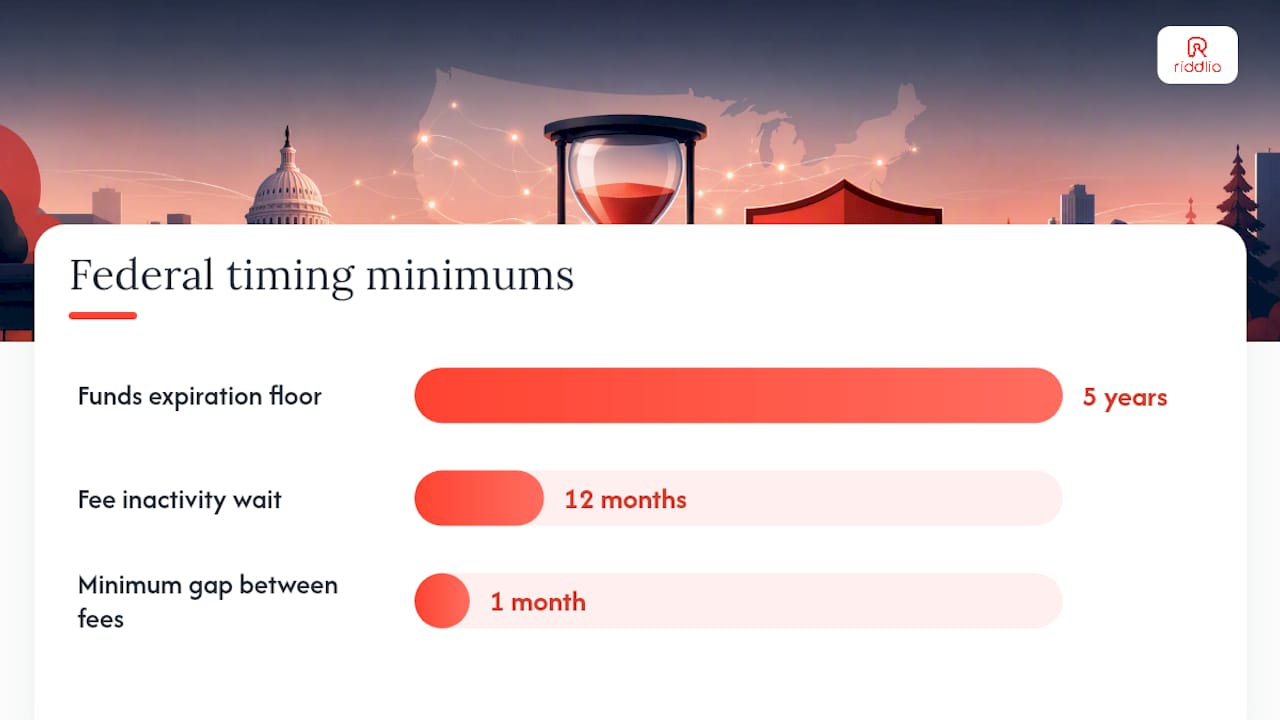
Inactivity, dormancy, or service fees can only be charged after a card has sat unused for at least 12 consecutive months, and even then the issuer can charge no more than one fee per month. A card can’t rack up multiple fees in a single billing cycle just because the fine print allows it.
Disclosure obligations go further than most retailers realise:
- The card or certificate must clearly state whether an expiry date applies and, if so, what it is.
- Any fee, its amount, and the circumstances that trigger it must be disclosed on the card itself, not buried in a separate terms page.
- Issuers must print a toll-free number and website (if one exists) so a cardholder can request a replacement once a physical card has technically expired but the underlying funds are still valid, according to CFPB’s Regulation E requirements.
- Charging a replacement fee in that situation is prohibited outright.
The federal floor in numbers: funds can’t expire for at least 5 years from activation or last load; fees require at least 12 months of inactivity first; and issuers can charge no more than one fee per month after that.
There’s a scope question worth answering plainly: what counts as a “gift card” under this law? General merchandise cards, store-specific cards, and general-use prepaid cards bought by a consumer all qualify. Cards issued as part of a loyalty, rewards, or promotional program are treated differently and can lawfully carry different expiry terms, because no money changed hands to buy them. Employer-issued cards and cards distributed for market research or promotional purposes fall under similar carve-outs. If you’re a merchant relying on one of these exemptions, the safest move is to disclose the exemption in plain language rather than assume shoppers will read it into the fine print.
One practical wrinkle: the federal rule applies whether the card is physical plastic or a digital, online-only code. A retailer can’t dodge the five-year floor just by issuing the card electronically instead of printing it.
How do state gift card laws differ from the federal floor?
Federal law is a floor, not a ceiling, and a growing number of states have built well above it. The pattern that matters most for anyone asking whether gift cards are allowed to expire is this: several states simply say no, full stop, for most store-issued cards, while others allow expiry but tighten the fee rules or add a cash-redemption right for small balances.
The National Conference of State Legislatures maintains a 50-state tracker summarising exactly which states ban expiries, which restrict fees, and which require cash-out at low balances. It’s the single most useful bookmark for anyone trying to answer “how long are gift cards valid” for a specific state, because the answer genuinely isn’t uniform.
Three states illustrate the range well.
California. Under Cal. Civil Code §1749.5, most gift certificates and store gift cards sold to consumers cannot expire at all. There are exceptions for cards issued as part of a promotional, loyalty, or awards program, and for cards sold below face value at a discount to a nonprofit or employer. California also has a cash-redemption rule: once a card’s remaining balance drops below a set dollar threshold, the holder can demand the balance in cash instead of continuing to use the card for purchases. That threshold has shifted over time, so check the current figure on the state’s own consumer affairs pages rather than relying on an older guide.
Illinois. State law and consumer guidance describe a similarly strict regime for store-issued gift cards: no expiry dates and no dormancy or service fees on the vast majority of retail gift cards, according to Illinois Legal Aid. This is one reason so many national retailers simply print “no expiration date” on every card they issue nationwide rather than run two sets of card stock for different states. It’s cheaper to comply with the strictest state everywhere than to manage 50 different rule sets.
Washington. RCW 19.240 prohibits expiration dates and most fees on gift certificates, with defined exceptions for cards distributed for promotional purposes, cards usable at multiple unaffiliated merchants, and a handful of other narrow categories. Washington also has its own cash-redemption provision for small remaining balances, structured similarly to California’s.
The common threads worth remembering as you check your own state:
- Total expiry bans apply in a meaningful number of states for standard store-issued cards, regardless of what the federal five-year floor would otherwise allow.
- Fee restrictions are often tighter than federal law, with some states banning dormancy fees entirely rather than just capping them at one per month.
- Cash-out thresholds exist in several states, giving consumers the right to demand cash once a card balance falls under a set dollar amount.
- Promotional and loyalty exemptions show up in nearly every state’s statute, so a “free $10 gift card with purchase” promo card usually isn’t governed by the same rules as a card someone paid cash for.
- Multi-state retailers almost always default to the strictest applicable rule across their footprint rather than segment compliance by store location, which is why “no expiration, ever” has become the norm on most receipts nationwide.
There’s a business-side consequence that doesn’t get enough attention: unclaimed property and escheat law. When a gift card sits unredeemed for years, many states require the issuer to eventually report and remit the unused balance to the state as unclaimed property, rather than keeping it as revenue. The reporting triggers, dormancy periods, and exemptions for gift cards vary by state, and getting this wrong exposes a merchant to audit liability that has nothing to do with the CARD Act at all. This is a separate compliance track from expiry and fee rules, and small retailers frequently miss it entirely until an audit letter arrives. Reading through how gift card liabilities should be recorded is a reasonable starting point if your bookkeeping hasn’t caught up with your voucher sales volume.
If your business operates in more than one state, or sells gift cards online to customers nationwide, the practical answer to “which state law applies” usually comes down to where the consumer purchased or will redeem the card, not where your business is headquartered. When in doubt, apply the strictest rule among the states you serve.
When can a business charge a fee, and what has to be disclosed?
A dormancy fee is only lawful under federal law once a card has gone a full 12 months without use, and even then the issuer can charge no more than one fee in any given month, per FDIC’s consumer guidance. A fee charged in month six, or three fees stacked into one billing cycle, breaches the federal rule regardless of what a merchant’s terms and conditions claim.
Several states remove this permission entirely. If a business operates in a state that bans dormancy fees outright, the federal 12-month allowance is irrelevant there. It’s overridden by the stronger state protection.
Disclosure is where a lot of otherwise well-intentioned businesses slip up, because “disclosed” has a specific legal meaning: clear and conspicuous, not merely present somewhere in a document. A footnote on page four of a terms-of-service page a customer never opens doesn’t meet the bar. Neither does six-point font on the back of a physical card, printed in a colour that barely contrasts with the background.
What “clear and conspicuous” tends to look like in practice:
- The expiry date (or a clear statement that there is none) printed directly on the card face or the certificate itself.
- Any fee, its dollar amount, and the exact circumstance that triggers it, stated in the same location, not cross-referenced to a separate policy.
- A toll-free number and website printed on the card for replacement requests, as required by Regulation E.
- The same information repeated at online checkout if the card is sold digitally, since a digital purchase flow has no physical card face to print terms on.
One enforcement pattern worth knowing: regulators and state attorneys general treat buried or contradictory disclosure as a red flag independent of whether a fee was technically lawful. A card that says “no fees” on the front and lists a $2.95 monthly dormancy fee in the online terms is the kind of mismatch that draws complaints, because the disclosure itself violates the “clear and conspicuous” standard even if the fee amount would otherwise pass muster.
Pro Tip: Print your expiry and fee disclosure in the same font size as your logo, not smaller. If you wouldn’t want a customer squinting to find it, a regulator will treat that as intentional obscurity.
A quick compliance checklist for merchants selling gift cards or vouchers:
- Confirm whether your card is a standard retail card, a promotional card, or a loyalty reward, since the rules differ.
- State the expiry policy on the card, receipt, and checkout confirmation, not just in a linked policy document.
- If you charge any fee, state the trigger condition and dollar amount in the same place as the expiry disclosure.
- Print a toll-free number and website for replacement requests.
- Cross-check your state’s rule against the federal floor and apply whichever is stricter.
What should you do if a gift card is refused or a fee looks wrong?
Start by pulling together whatever proof you have that the card carried value. If a merchant refuses a card claiming it expired, or you spot a dormancy fee you didn’t expect, a methodical approach gets results faster than an angry phone call.
- Locate your documentation first. Find the original receipt, activation confirmation, order confirmation email, or a photo of the card itself showing the balance and any printed terms.
- Contact the issuer directly. Call the toll-free number printed on the card, or email the retailer’s customer service, and ask specifically whether the underlying funds are still valid under the five-year federal minimum, even if the physical card looks expired.
- Document every interaction. Note the date, the name of the representative, and what was said. If the response is by email, keep it.
- Request a written explanation if refused. A merchant that won’t put its refusal in writing is a merchant that knows the refusal probably doesn’t hold up.
- Escalate to the right agency. Your state attorney general’s consumer protection office typically handles state-law violations like fees charged before month 12 or expiries banned outright in your state. The Consumer Financial Protection Bureau handles federal Regulation E violations. The Federal Trade Commission takes complaints about broader deceptive practices. State consumer protection divisions, similar to New York’s Division of Consumer Protection, are especially active around the holiday shopping season when gift card complaints spike.
- Consider small claims court for larger balances. If a merchant refuses a documented balance and won’t resolve it through the usual channels, small claims court is available for amounts within your state’s filing limit, and you generally don’t need a lawyer.
For merchants on the other side of that phone call, the fix is usually simpler than the dispute makes it feel: honour a documented balance, correct the fee, and note what went wrong internally so the same disclosure gap doesn’t generate the next five complaints.
Why do smart venues drop expiry dates altogether?
Plenty of businesses look at the patchwork of state rules and decide the simplest path is a blanket no-expiry, no-fee policy on every gift voucher they sell, regardless of which state the buyer is in. It isn’t just goodwill. There are real operational reasons behind it.
Unclaimed property reporting is the big one. When a card sits dormant, many states eventually require the issuer to report and remit the balance as unclaimed property, and tracking which states exempt gift cards from that requirement (some do, some don’t) is its own administrative project, according to Illinois Legal Aid’s practitioner guidance. Removing expiries doesn’t eliminate escheat exposure entirely, but it does simplify the accounting, because there’s no expiry event forcing a reclassification of the liability.
There’s also a customer-goodwill angle that shows up directly in redemption behaviour. A voucher that a customer feels anxious about losing is a voucher they’re less likely to gift, less likely to recommend, and more likely to complain about if they do lose it. A clear, generous policy removes that friction, and it tends to show up in redemption rates rather than sitting as an abstract brand benefit.
If you’re running an escape room or similar experience venue and sell gift vouchers, here’s a practical checklist for staying compliant without overhauling your entire booking system:
- State your voucher policy (expiry, if any, and any conditions) directly on the voucher and at checkout, not buried in a separate FAQ page.
- Give customers a way to check their remaining balance online rather than making them call or email to find out.
- Keep a clear, exportable record of voucher sales, redemptions, and outstanding balances for however long your state’s escheat rules require.
- Provide a toll-free number or support email for replacement requests, printed on both the physical and digital voucher.
- Automate the reminder and confirmation emails so customers know exactly what they bought and how to redeem it, reducing “I forgot I had this” disputes months later.
Voucher and payment tools that were built for a specific venue type, rather than adapted from generic e-commerce, tend to handle this better because balance tracking, redemption records, and payment reconciliation live in one system instead of three disconnected ones.
Pro Tip: Put your redemption instructions and contact number on the confirmation email, not just the voucher itself. Customers lose physical cards; they rarely delete every email.
Our take: compliance beats cleverness here
Most gift card advice online treats this as a legal trivia question: what’s the federal minimum, which states are strictest, cite the statute, move on. That misses what actually generates complaints and enforcement action, which is disclosure quality, not the underlying rule itself.
A card that discloses its terms clearly and follows a stricter-than-required policy almost never draws a regulator’s attention, even in a state with looser rules than California or Illinois. A card that technically complies with the federal five-year floor but buries a dormancy fee in six-point type is exactly the kind of thing that turns into a state attorney general complaint, regardless of whether the fee amount itself was lawful.
The practical priority for a small business isn’t memorising every state’s cash-out threshold. It’s building one habit: print your terms where the customer will actually see them, keep records long enough to answer a dispute or an escheat audit, and default to the strictest rule you touch. Everything else in this area is detail work around that one decision.
— Iosif Beraru
Sell vouchers without the compliance headache
There is software that combines voucher sales, redemption tracking, and payment processing into one dashboard specifically designed for certain entertainment venues.

When a customer buys a voucher through your booking page, Riddlio tracks the remaining balance automatically and syncs it with your payment integrations, so there’s no manual reconciliation when a customer redeems part of a balance and wants the rest applied to a future booking. Automated confirmation and reminder emails carry your redemption terms every time, which solves the disclosure problem this article just walked through: the terms travel with the customer instead of sitting in a policy page nobody opens. That matters more for compliance than any single feature, because the biggest risk in this whole area isn’t the rule itself, it’s a customer who never saw it.
If you’re running a venue and currently managing vouchers by hand, take a look at Riddlio’s gift voucher features and the pricing page, which lists the Starter plan at $29 per month, Pro at $79 per month, and Unlimited at $199 per month, with Enterprise pricing available on request.
Where to check the current rules yourself
Statutes get amended, thresholds shift, and guidance pages get updated more often than most retail policies do. These are the primary sources worth bookmarking rather than relying on a summary article, however current:
- CFPB’s Regulation E, §1005.20 for the exact federal text on expiry, fees, and disclosure.
- FDIC’s consumer guidance on gift cards for a plain-language federal summary.
- NCSL’s 50-state gift card statute tracker to check your specific state’s current rule.
- Washington’s RCW 19.240 and Illinois Legal Aid’s gift card guidance as examples of state statutory text.
- Your state attorney general’s consumer protection division for filing a complaint, and the Consumer Financial Protection Bureau for federal violations.
- Industry resources like The Ticket Blog’s promo code guidance if you’re layering discount codes on top of gift voucher sales and want to keep the two systems from conflicting.
Sources
- What You Should Know About Gift Cards — FDIC
- Gift Cards and Gift Certificates Statutes and Legislation — NCSL
- § 1005.20 Requirements for gift cards and gift certificates — CFPB / Regulation E
- Chapter 19.240 RCW — Gift certificates (Washington state)
FAQ
Are gift cards legally allowed to expire?
Yes, but only within limits. Federal law says the underlying funds can’t expire for at least five years from activation or the last load, and a number of states, including California, Illinois, and Washington, ban expiry entirely for most store-issued cards.
Will a gift card from 10 years ago still work?
It depends on your state and what kind of card it is. If it was issued in a no-expiry state like Illinois, the balance is likely still valid; if it carried a lawful five-year federal expiry and no stronger state protection applied, the underlying funds may have technically expired, though the issuer must still provide a replacement mechanism under Regulation E rather than simply refusing to honour it.
Is it illegal to have an expiry date on a gift card?
Not under federal law by itself, since the CARD Act permits expiry after a five-year minimum. It becomes illegal in states such as California, Illinois, and Washington, which prohibit expiry dates on most standard retail gift cards regardless of the federal floor.
Do all gift cards expire after 5 years?
No. Five years is the federal minimum before funds can expire, not a fixed expiry point every card must follow. Many states override that floor entirely by banning expiry, and plenty of retailers voluntarily adopt a no-expiry policy nationwide to simplify compliance and reduce unclaimed property reporting obligations.
How can a small business check which gift card rules apply to it?
Start with the NCSL’s 50-state tracker to find your state’s specific statute, then compare it against the federal floor in Regulation E and apply whichever rule is stricter. Venues using a platform like Riddlio can also centralise voucher terms and balance tracking in one system, which makes it easier to keep disclosures consistent across every sale.