A gift card is a contract liability the moment it’s sold, not revenue. Under ASC 606, you recognise the cash as a liability on the balance sheet and only book it as revenue when the card is redeemed or when you can legitimately recognise breakage.
There are two accepted paths for unredeemed balances:
- Proportionate recognition — release expected breakage into revenue in line with the pattern of actual redemptions, provided you have the data to support it.
- Remote method — hold the liability until the chance of redemption is remote, then recognise it.
One more thing to flag before you touch the ledger: sales tax generally kicks in on redemption, not at the point of sale, and state unclaimed property laws can override your breakage assumptions entirely if a card sits dormant long enough.
Key Takeaways
Gift card sales are contract liabilities under ASC 606, and breakage can only be recognised proportionately with reliable redemption data or once redemption becomes remote.
| Point | Details |
|---|---|
| Sales create a liability | Debit cash, credit contract liability at issuance; revenue only posts on redemption or recognised breakage. |
| Two breakage methods | Use proportionate recognition with solid redemption data, or wait until redemption is remote. |
| Sales tax follows redemption | Tax generally triggers at redemption, though some states tax single-purpose vouchers at issuance. |
| Escheatment overrides breakage | State dormancy rules can require remitting unredeemed balances instead of recognising them as revenue. |
| Data capture is the real bottleneck | Unique card IDs and timestamped redemptions, the kind Riddlio’s voucher tracking provides, make breakage estimates auditable. |
Table of Contents
- Which accounting rules govern gift card accounting
- Journal entries for gift card sales and redemptions
- How do you estimate gift card breakage?
- Sales tax and unclaimed property rules for gift cards
- What controls do you need to support breakage estimates
- A worked example of gift card breakage recognition
- How a voucher platform reduces bookkeeping friction
- The gap between textbook GAAP and how venues actually operate
- Get the gift card data your accountant actually needs
- Frequently asked questions about gift card accounting
- Sources
Which accounting rules govern gift card accounting
ASC 606 is the governing U.S. GAAP standard for any prepaid product, gift cards included. It treats the sale as a contract liability rather than revenue, because the performance obligation, delivering goods or services, hasn’t been satisfied yet. The standard’s guidance on customers’ unexercised rights is what lets you recognise breakage at all.
For the ASU background, ASU 2014-09 introduced the five-step revenue model that ASC 606 now codifies, and FASB’s own revenue recognition summaries are the reference point auditors expect to see cited in your accounting policy notes.
If you’re building or defending a breakage estimate, the paragraphs that matter most are ASC 606-10-55-46 through 55-49, covering unexercised rights specifically. Auditors will also want to see disclosure of your contract liability balances, the significant judgements behind your breakage rate, and a roll-forward showing how that liability moved during the period.
Journal entries for gift card sales and redemptions
The entry at the point of sale is simple: debit cash, credit a contract liability account (often labelled “unearned gift card revenue” or similar). No revenue touches the income statement yet.
At redemption, you reverse part of that liability into revenue:
- Full redemption: debit contract liability for the full face value, credit revenue for the same amount, plus the usual cost of goods sold entry if inventory is involved.
- Partial redemption: debit contract liability only for the amount used, credit revenue for that portion, and leave the remaining balance sitting as a liability.
- Sales tax at redemption: credit a sales tax payable account alongside the revenue entry, since most jurisdictions trigger the tax obligation here rather than at issuance.
Promotional and bulk or B2B sales need their own treatment. If a customer gets a $100 card for $80, that $20 discount should sit in a separate contra account rather than being folded into the standard liability balance, because it changes your transaction price allocation. Bulk sales to corporate buyers often carry different redemption behaviour entirely, so keep them in a separate cohort from the outset.
The most common mistake accountants make here is booking gift card sales straight to revenue at the point of sale. It inflates current-period revenue and misstates the liability, and it’s exactly the kind of error practitioner guidance keeps flagging as a recurring issue.
How do you estimate gift card breakage?
Breakage under ASC 606-10-55-48 works one of two ways. If you can reliably estimate the amount customers won’t redeem, you recognise that breakage proportionately, in step with actual redemption activity. If you can’t support a reliable estimate, you wait until redemption is remote before recognising anything.
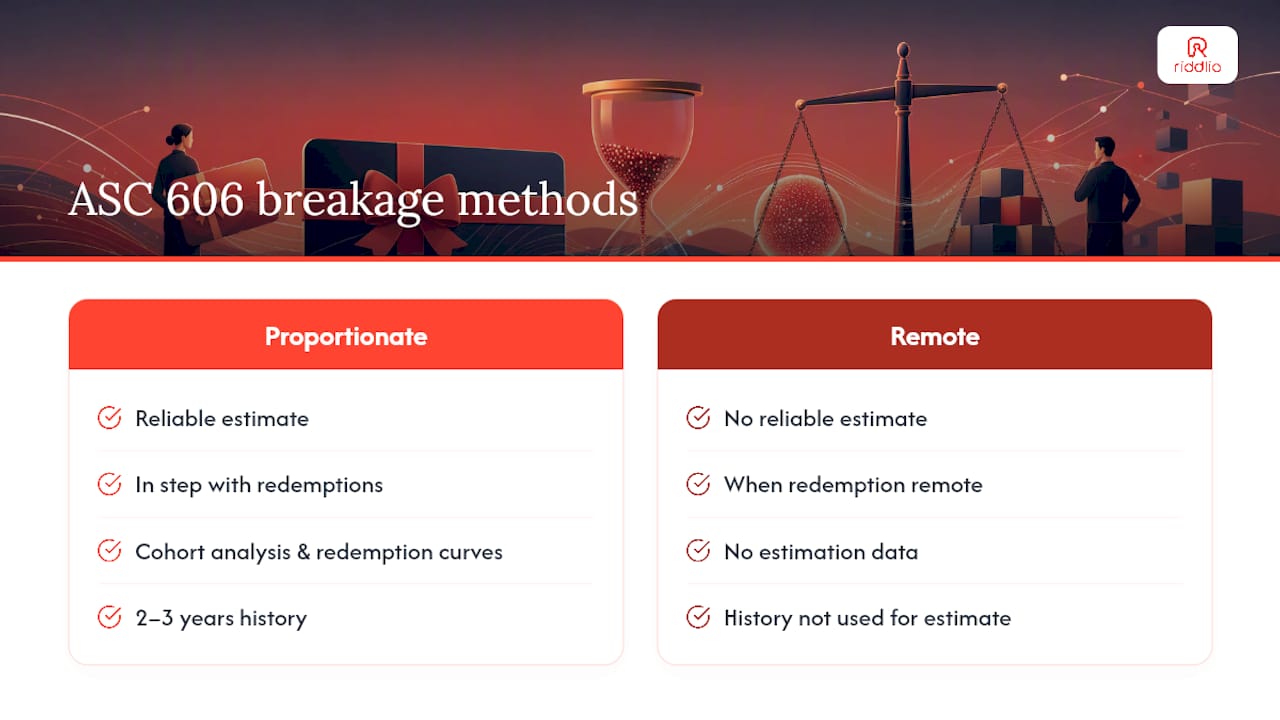
Building a defensible proportionate estimate takes real data: cohort analysis by issuance month, historical redemption curves showing how quickly each cohort typically gets used, and enough history (most businesses use two to three years minimum) to smooth out seasonal noise. The estimate changes when you recognise revenue, not the total amount, since the full liability eventually clears one way or another.
The Deloitte roadmap on customers’ unexercised rights is explicit that this estimate must be constrained. You can’t front-load an aggressive breakage rate that later needs reversing once actual redemption data comes in lower than expected. Auditors treat a reversal as a red flag on the quality of your estimation process, not just a rounding error.
Pro Tip: Tag every gift card with a unique identifier at issuance and keep that tag through redemption or expiry. Without it, you can’t build a redemption curve by cohort, and without a cohort curve, your breakage rate is a guess dressed up as an estimate.

Sales tax and unclaimed property rules for gift cards
Sales tax generally follows redemption, not the initial sale, because you’re taxing the goods or services eventually delivered rather than the card itself. That said, some states carve out exceptions for single-purpose vouchers, so check your state’s specific rule before assuming issuance is always tax-free.
Escheatment is a completely separate legal question from GAAP, and it can override your accounting plans. Many states require issuers to remit unredeemed balances to the state after a dormancy period, typically three to five years, which means that portion of the liability was never yours to recognise as breakage revenue in the first place.
A few things to build into your close process:
- Capture cardholder domicile data where you can, since escheatment rules generally apply based on the holder’s last known address.
- Split your outstanding liability between balances likely subject to escheatment and balances genuinely eligible for breakage recognition.
- Check state-specific rules through a resource like Unclaimed rather than assuming one dormancy period applies everywhere.
What controls do you need to support breakage estimates
Auditors don’t take your breakage rate on faith. They want to trace it back to real transaction data, which means your systems need to capture more than just a total dollar figure.
At minimum, track for every card: a unique identifier, issuance date, issuing location, purchaser details where available, face value, any promotional discount applied, and every redemption event against it. GBQ’s practitioner guidance is blunt about what happens without this: period-end breakage becomes a forensic exercise instead of a routine reconciliation.
Routine reconciliations should include the gift card ledger against cash and AR reports, sales cohorts against redemption activity, and a monthly ageing of outstanding balances. Keep promotional cards tagged separately from standard-price cards, since mixing them muddies your transaction price allocation.
Pro Tip: Assign a distinct sequence range to promotional card batches at issuance. It turns “build me a redemption cohort for this campaign” into a five-minute query instead of a manual reconstruction.
A worked example of gift card breakage recognition
Say a venue sells gift cards at a certain face value and generates cash accordingly. Historical data may provide an estimate of expected breakage across the cohort. As customers redeem cards, the company records contract liability debits and revenue credits corresponding to redemptions, while proportionately releasing expected breakage in line with actual redemptions.
If the venue instead used the remote method, because it lacked sufficient redemption history, none of that $4,000 would hit revenue in March. It would sit as a liability until redemption became remote, likely tied to a state’s escheatment dormancy trigger rather than an internal estimate.
How a voucher platform reduces bookkeeping friction
Most of the friction in gift card accounting comes down to data quality, not the accounting rules themselves. A voucher platform that assigns a unique ID to every card, timestamps every sale and redemption, and keeps promotional and bulk sequences separate gives you exactly the raw material a proportionate breakage estimate needs.

When evaluating any booking or voucher system for this purpose, check for payment reconciliation against your accounting ledger, exportable cohort reports by issuance date, automated ageing of outstanding balances, and an audit log you can hand to an external reviewer without reconstructing it manually.
Riddlio’s gift voucher features were built around this exact problem for escape room venues, tracking each card through issuance and redemption so the cohort data is already sitting there when your accountant needs it.
The gap between textbook GAAP and how venues actually operate
Most guidance on gift card accounting reads like it was written for a national retail chain with a dedicated revenue accounting team. That’s not who’s actually running a gift card program day to day. It’s a bookkeeper at a small entertainment venue trying to figure out whether last month’s card sales inflated revenue, and an owner who has no idea their unredeemed balances might be subject to escheatment in three states they’ve sold cards into.
The conventional advice, “just follow ASC 606”, undersells how much of this comes down to data you either captured at the point of sale or didn’t. You can’t retrofit a redemption cohort onto six months of gift card sales that were never tagged with issuance dates. That’s not an accounting failure, it’s an operational one that shows up as an accounting problem months later.
If there’s one thing worth prioritising over everything else in this article, it’s this: fix your data capture before you worry about which breakage method to apply. A perfectly reasoned proportionate estimate built on incomplete redemption data is worse than a conservative remote-method approach, because it looks defensible right up until an auditor asks you to trace it back to source records you don’t have.
Get the gift card data your accountant actually needs
Escape room operators running gift voucher programs usually hit the same wall: the accounting standard is clear enough, but the point-of-sale system wasn’t built to capture what a breakage estimate requires. Riddlio was built specifically for venues like yours, with gift voucher sales and redemptions tracked against unique identifiers from the moment a card is issued.

That means your bookkeeper isn’t reconstructing redemption cohorts from scratch at year end. Every voucher sale, redemption, and promotional batch sits in one exportable record, alongside integrated payment processing that reconciles cash received against what’s been redeemed. If you’re currently tracking gift cards on a spreadsheet separate from your booking system, that gap is exactly where breakage estimates fall apart under audit scrutiny.
Check out Riddlio’s online booking and voucher features to see how the data lines up with what your accountant needs at close.
Frequently asked questions about gift card accounting
Is a gift card sale recorded as revenue? No. It’s recorded as a contract liability under ASC 606 because you haven’t yet delivered the goods or services the customer paid for.
When can you recognise gift card breakage as revenue? Either proportionately, as redemptions occur and you have reliable historical data to support an estimate, or once the likelihood of redemption becomes remote.
Does sales tax apply when a gift card is sold? Generally no. Most states trigger sales tax on redemption of the underlying goods or services, though a handful of exceptions exist for single-purpose vouchers.
How does escheatment affect gift card revenue recognition? State unclaimed property laws can require you to remit unredeemed balances after a dormancy period, which prevents you from recognising that portion as breakage revenue.
What data do auditors expect for a breakage estimate? Unique card identifiers, issuance and redemption timestamps, and enough historical cohorts to build a defensible redemption curve.
This article is general information, not a substitute for advice from a qualified financial advisor. Consult a qualified financial professional about your own circumstances before acting on anything here.
Sources
- Accounting for gift cards (AccountingTools)
- Deloitte roadmap on ASC 606 breakage
- Gift vouchers accounting guide for U.S. travel & hospitality (Antravia)
- FASB revenue recognition summary