For most Australian event organisers, the best starting point is a combination of Eventbrite for ticketed public events, Facebook Events for social reach, and Humanitix or TryBooking for community-focused or charity events. Add a local tourism board listing (like Experience Adelaide or Events) for targeted local audiences. If you run a timed or ticketed experience like an escape room or tour, Riddlio handles the booking and operations side that listing sites simply don’t cover.
Quick picks at a glance:
- Eventbrite — Best for public events needing wide discovery and integrated ticketing. Free to list; ticketing fees apply on paid tickets.
- Facebook Events — Best for social sharing and local audience targeting. Free.
- Humanitix — Best for charitable and community events. Booking fees donated to charity.
- TryBooking — Best for smaller Australian community events. Low fees, local payment options.
- Meetup — Best for recurring interest-based groups. Organiser subscription required.
- Eventfinda — Best for Australian regional discovery. Free basic listing available.
- Local tourism boards — Best for city-specific reach. Often free or low cost.
- Riddlio — Best for timed, ticketed experiences (escape rooms, tours) needing end-to-end booking, payments, and automated communications.
Many platforms will list your event for free, though most require organiser registration before you can submit.
Key takeaways
The most effective approach to event listing in Australia is to combine two or three high-reach public platforms with a local tourism board submission, then add a dedicated booking system if your event is timed or slot-based.
| Point | Details |
|---|---|
| Start with two or three platforms | Eventbrite, Facebook Events, and one local board cover most Australian audiences without spreading effort too thin. |
| Submit to local boards early | City tourism and council calendars can take one to two weeks to approve; submit six to eight weeks before your event. |
| Check fees before publishing | “Free to list” often means per-ticket fees on paid events; calculate total cost per ticket sold across each platform. |
| Use calendar feeds where available | Platforms like Explorio World support RSS/ICS sync, keeping listings current without manual updates across every site. |
| Riddlio for timed experiences | Escape rooms, tours, and slot-based venues benefit from Riddlio’s booking calendar, SMS reminders, and operational analytics alongside public listings. |
Table of Contents
- Which event listing sites suit your event best?
- How do you choose the right platform for your event?
- How to publish and optimise your event listing
- Australian local boards and niche calendars worth adding
- When does a booking platform matter more than a listing site?
- Riddlio for timed and ticketed experiences
- Sources
- Product Listings
Which event listing sites suit your event best?
Two to three platforms is the right number for most organisers. Spreading across ten dilutes your effort without proportional return.
| Platform | Best for | Free vs paid | Ticketing & payments | Australia reach | Promotion features | Setup / approval | Analytics |
|---|---|---|---|---|---|---|---|
| Riddlio | Timed experiences: escape rooms, tours, workshops | Subscription SaaS | Full payment processing, deposits, gift vouchers | Direct booking via venue site | White-label widget, calendar sync, SMS/email reminders | Immediate (self-managed) | Real-time operational analytics |
| Eventbrite | Public events, broad discovery | Free to list; % fee on paid tickets | Yes, integrated | Strong | SEO listing, email tools, social sharing | Fast (minutes) | Attendee and sales reports |
| Facebook Events | Social-reach events, local audiences | Free | No native ticketing; links to external | Very strong (social) | Organic sharing, targeted ads | Immediate | Basic reach metrics |
| Humanitix | Charity and community events | Booking fees go to charity | Yes, integrated | Growing in Australia | Social sharing, email | Fast | Standard reports |
| TryBooking | Community groups, small paid events | Low flat fees | Yes, local payment options | Good (Australia-focused) | Basic | Fast | Basic |
| Meetup | Recurring interest groups | Organiser subscription | Limited | Moderate | Community discovery | Fast | Basic attendance |
| Eventfinda | Australian regional events | Free basic listing | Optional | Good (AU/NZ) | Category search, SEO | Fast | Limited |
| AllEvents.in | International or broad discovery | Free basic | Limited | Global, moderate AU | Category search | Fast | Limited |
| Events.org | General listing + registration | Free basic | Registration flows | Moderate | Category listing | Fast | Basic |
| Eventful | Broad public event discovery | Free | No native ticketing | Moderate | Directory listing | Fast | Minimal |
| Local tourism boards | City-specific residents and visitors | Free or low cost | No (links out) | Highly targeted local | Local SEO, tourism promotion | Days to weeks | Minimal |
A few notes worth calling out:
- Riddlio sits in a different category from the others. It is not a public marketplace where strangers discover your event; it is the operational layer that converts a listing into a confirmed, paid booking. For escape rooms, tours, and any slot-based experience, that distinction matters more than extra marketplace reach.
- Eventbrite charges a percentage fee on paid tickets (the exact rate depends on your plan and ticket price), so factor that into your pricing before you publish.
- Local tourism boards take longer to approve (sometimes one to two weeks), but the audience is genuinely targeted. A visitor searching “things to do in Adelaide this weekend” on an official tourism site is far more purchase-ready than a casual social media scroller.
How do you choose the right platform for your event?
Start with three questions: Who is your audience? Do you need ticketing? What is your budget for fees?
Event type and audience are the primary filter. A community fundraiser suits Humanitix or TryBooking. A recurring networking group suits Meetup. A large public festival suits Eventbrite. A timed escape room experience suits Riddlio, with a public listing on Eventbrite or Eventfinda pointing traffic back to your direct booking page.
Fees deserve more scrutiny than most organisers give them. “Free to list” rarely means free to sell tickets. Eventbrite’s percentage fee on paid tickets can add up quickly on a high-volume event. TryBooking’s flat-fee model is often cheaper for community events with lower ticket prices. Always calculate your total cost per ticket sold, not just the listing cost.
Discovery features vary significantly. Platforms with strong SEO (Eventbrite, Eventfinda) help people find your event through Google. Facebook Events relies on social sharing and algorithmic reach. Local tourism boards deliver targeted local intent but limited volume.
Approval time matters if you are listing close to the event date. Most commercial platforms approve listings within minutes. City tourism boards and council calendars can take days or weeks, so submit early.
Red flags to watch for:
- Hidden booking or processing fees not shown upfront
- Unclear refund and cancellation policies (check who bears the cost of refunds)
- No data export or attendee data access after the event
- Approval processes with no stated timeline or confirmation
How to publish and optimise your event listing
Preparation checklist (have these ready before you open any platform):
- High-resolution event image (most platforms recommend at least 1920 × 1080 px)
- Event title, short description (under 160 characters for SEO snippets), and full description
- Accurate venue address or online event link
- Ticket types and pricing, including any early-bird or group rates
- Accessibility information
- Contact details and refund policy
Suggested timeline:
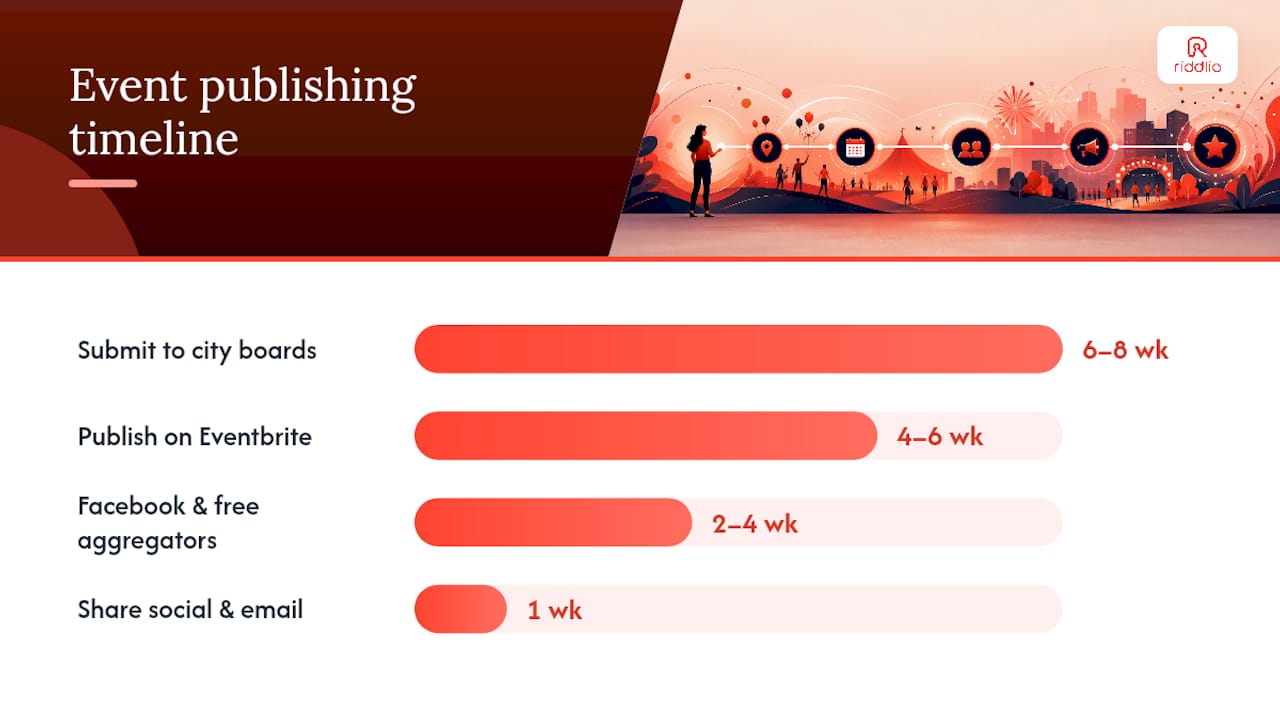
- 6–8 weeks out: submit to city tourism boards and council calendars (long approval windows)
- 4–6 weeks out: publish on Eventbrite, Eventfinda, and other commercial platforms
- 2–4 weeks out: create Facebook Event and begin sharing; submit to free aggregators like HappeningNowNext (24–48 hour review) and Explorio World (free, supports calendar feed sync)
- 1 week out: share across social channels, send email reminders, update listings with any changes
Optimisation tips:
- Use your primary keyword in the event title and first paragraph of the description
- Choose the most specific category available on each platform (not just “entertainment”)
- Add a direct link to your ticketing or booking page in every listing
- Use the same hero image across all platforms for brand consistency
- On platforms that support it, connect a calendar feed (RSS/ICS) so updates sync automatically rather than requiring manual edits across every site
Pro Tip: On Eventbrite, the first 140 characters of your event description appear in Google search results as the meta description. Write that opening sentence as if it is a search ad: specific, benefit-led, and with the event date included.
Australian local boards and niche calendars worth adding
City tourism and council boards are underused by most organisers, which is exactly why they work. The audience is smaller but far more intentional.
State and city tourism boards:
- Experience Adelaide accepts event submissions from promoters and surfaces them to visitors actively planning a trip to Adelaide. Submission requires basic event details, images, and lead time for review.
- events.canberra.com.au requires organisers to register for access before submitting. The process is straightforward, but allow at least one to two weeks for approval.
- Most state tourism sites (Visit Victoria, Destination NSW, Tourism Queensland) have similar submission portals. Search “[state] tourism events submission” to find the current intake page.
Free aggregators suited to Australian events:
- HappeningNowNext lists events for free, reviews submissions within 24–48 hours, and reaches city-level audiences across multiple Australian cities.
- Explorio World offers free listings and supports calendar feed integration (RSS/ICS/Google Calendar), so your event details stay current without repeated manual updates.
- YourEventFREE accepts listings across many categories and provides SEO guidance to help organisers improve discoverability on search engines.
- Australian Regional Events maintains a guide to free listing sites specifically for Australian events, worth checking for niche directories relevant to your event type.
For curated local experiences targeting tourists, Experience by Locals is worth exploring as a partner channel for guided or immersive events.
Most local boards require: event name, date and time, venue address, a short description, one or two images, and a contact or ticketing link. Submission is usually free. The main cost is lead time.
When does a booking platform matter more than a listing site?
Listing sites get people to your event page. A booking platform converts them into confirmed, paid attendees and keeps your operations running smoothly.
For most one-off public events, a listing plus Eventbrite’s built-in ticketing is enough. The gap shows up with timed or slot-based experiences: escape rooms, guided tours, cooking classes, axe throwing. These venues need more than a ticket sale. They need slot management, automated reminders to reduce no-shows, payment processing with deposits, and post-event analytics to understand which time slots fill fastest.

Gartner’s review of event marketing and management platforms catalogues dozens of tools in this space, from enterprise conference platforms (Cvent, Bizzabo) down to venue-specific booking systems. The right scope depends on your event’s operational complexity, not just its size.
For escape rooms and similar timed experiences, the practical benefits of a dedicated booking platform include:
- Automated SMS and email reminders that reduce no-shows without any manual follow-up
- Real-time slot analytics showing which sessions fill, which don’t, and where pricing adjustments make sense
- Integrated payment processing with support for deposits, gift vouchers, and group bookings
- Calendar sync so your availability is always accurate across booking channels
The workflow that works well in practice: list on Eventbrite or a local tourism board for discovery, then direct traffic to your own booking calendar for the actual reservation. That way you get marketplace reach without paying per-ticket fees on every booking.
The case for combining listings with a booking system
Most organisers treat listings and booking software as separate decisions. They are not. A listing without a clean booking flow loses attendees at the last step. A booking system without any listing presence limits your discovery to people who already know you exist.
The organisers who get this right use public platforms for reach and a dedicated system for conversion. For escape rooms specifically, that split is almost always worth it: the listing drives traffic, the booking system handles everything from payment to the reminder SMS sent two hours before the session. Attendees who receive a reminder are far less likely to forget or no-show, which matters more for a timed experience than for a general admission event where a late arrival is just a late arrival.
The broader point applies to any experience with fixed capacity and a clock running: workshops, tours, tastings. The listing gets you found. The operations platform gets you paid and keeps the session full.
Riddlio for timed and ticketed experiences
Listing sites put your event in front of people. Riddlio handles what happens next.
For escape room operators and timed experience venues, the gap between “someone clicked your Eventbrite listing” and “someone showed up, paid, and had a great time” is where most revenue is lost. Riddlio’s online booking calendar closes that gap with real-time slot management, automated SMS reminders, integrated payment processing, and operational analytics, all in one place.

Where a public listing site ends at the ticket sale, Riddlio continues through waiver collection, staff scheduling, dynamic pricing for peak and off-peak slots, and gift voucher management. It sits alongside your listings, not instead of them: use Eventbrite or a local tourism board for discovery, then route confirmed bookings through Riddlio for the full operational flow.
If you run an immersive experience or any slot-based venue, start a free trial at Riddlio and see how the booking calendar fits your current setup.
Sources
- [vFairs … vFairs … vFairs …
Product Listings
… Products 1 - 20 of 27 …
vFairs
…
Zoom Events
…
Webex Suite
…
Cvent Event Marketing and Management
…
Bizzabo Event Experience OS
…
RingCentral Events
…
KonfHub
…
SpotMe
…
RainFocus
…
Eventify
…
JioEvents
…
EventMobi
…
Stova
…
Accelevents
…
6Connex Event Management Platform
…
Eventleaf
…
inwink
…
Angage Platform
…
EVA Event Tech Hub
…
Let’s Get Digital](https://www.gartner.com/reviews/market/event-marketing-and-management-platforms)
- Are there websites that will list my event for free?
- Events
- Experienceadelaide
- List Your Events for Free | HappeningNowNext
- List Your Event for Free | Explorio World