Electronic signatures are legally valid and generally enforceable across the United States. The E-SIGN Act (15 U.S.C. §7001 et seq.) establishes the federal baseline: a signature or contract cannot be denied legal effect solely because it exists in electronic form. The Uniform Electronic Transactions Act (UETA), adopted by 49 states, covers intrastate transactions where federal law does not directly apply. Agency guidance from the FDIC, Federal Reserve, NCUA, and OMB reinforces that framework for regulated industries.
Three conditions most often determine whether an electronic signature will hold up:
- Consent: the parties must have agreed to conduct the transaction electronically, and consumers must give affirmative, informed consent before receiving electronic disclosures.
- Intent and attribution: the signature must reflect a deliberate act by an identifiable person logically associated with the record being signed.
- Record retention and reproducibility: the signed record must be stored in a format that accurately reflects the original and remains accessible for as long as the law requires.
Exceptions exist. Wills, certain family-law instruments, and some court filings are excluded from E-SIGN coverage. Specific industries carry their own overlay rules. But for the vast majority of commercial and consumer transactions, the answer to “is electronic signature legal?” is a straightforward yes, provided those three conditions are met.
Key takeaways
Electronic signatures are legally valid in the U.S. under the E-SIGN Act and UETA, but enforceability depends on affirmative consent, proper attribution, and reproducible record retention.
| Point | Details |
|---|---|
| Confirm document eligibility | Check whether the transaction is excluded by 15 U.S.C. §7003 before proceeding electronically. |
| Implement affirmative consent | Provide E-SIGN disclosures and a demonstration step before recording consumer consent. |
| Maintain audit trails | Capture authentication method, IP data, timestamps, and document hashes at the time of signing. |
| Retain reproducible records | Store signed records in an open format (PDF/A) with exportable audit trails for the legally required period. |
| Review vendor contracts | Require tamper-evident seals, exportable archives, and a documented migration plan in writing. |
Table of Contents
- How does U.S. law treat electronic signature legality?
- What are the key E-SIGN Act provisions professionals must know?
- Why does state law still matter under UETA?
- Which documents are excluded from electronic signature coverage?
- What makes an electronic signature legally enforceable?
- Practical compliance checklist for businesses using electronic signatures
- Industry and transaction special rules
- How do you defend an electronic signature if its validity is challenged?
- What platform features support legal enforceability?
- Common mistakes lawyers and compliance teams see
- How do international agreements affect cross-border electronic signatures?
- Recent court cases clarifying electronic signature enforceability
- Limitations on electronic signature validity beyond common exceptions
- An editorial perspective on practical compliance posture
- Riddlio and electronic waivers for escape room venues
- Sources
How does U.S. law treat electronic signature legality?
The E-SIGN Act and UETA divide the legal landscape between federal and state jurisdiction, but they share the same foundational principle.
The E-SIGN Act applies to interstate commerce and federal agency transactions. Its core rule is blunt: an electronic record or signature may not be denied legal effect, validity, or enforceability solely because it is in electronic form. OMB guidance issued at enactment emphasised that the Act’s purpose was to remove paper barriers while preserving consumer protections, not to override substantive legal requirements that happen to require a writing.
UETA fills the intrastate gap. Where the E-SIGN Act governs interstate commerce, UETA governs transactions between parties in the same state. The two statutes are deliberately harmonised: UETA’s rule mirrors E-SIGN’s non-discrimination principle. In practice, most commercial transactions are covered by one or the other.
Federal preemption under E-SIGN is real but limited. E-SIGN does not preempt state laws that are consistent with its provisions, and states may modify or limit UETA’s application provided they do not discriminate against electronic signatures or impose requirements that effectively require paper. That nuance matters when a state has added its own consumer-protection rules on top of the federal floor.
What are the key E-SIGN Act provisions professionals must know?
The E-SIGN Act’s practical requirements go beyond the headline non-discrimination rule. Three provisions come up repeatedly in compliance reviews and regulatory examinations.
Non-discrimination of electronic form. The statute’s core rule applies to signatures, contracts, and records alike. A document is not unenforceable simply because it was signed with a click, a typed name, or a cryptographic certificate rather than a pen.
Consumer consent. Before delivering disclosures electronically to a consumer, a business must obtain affirmative consent. That consent must follow a specific sequence: the consumer receives a clear and conspicuous statement of the right to receive paper, the right to withdraw consent and the consequences of doing so, and the hardware and software requirements needed to access the electronic records. The consumer then consents electronically in a manner that reasonably demonstrates they can access the information in the form to be delivered.
The Federal Reserve Bank of Minneapolis describes compliant demonstration techniques as including a retrieval step within the electronic document itself, such as requiring the consumer to open and confirm access to a sample disclosure before consent is recorded.
Record retention and reproducibility. Under E-SIGN, electronic records must be retained in a form that accurately reflects the original information and remains accessible to all persons entitled to access for the period required by law. The FDIC’s compliance examination manual makes clear that examiners will test both accuracy and ongoing accessibility, not just the existence of a stored file.
A practical E-SIGN compliance checklist for most businesses runs to six steps:
- Confirm the transaction is within E-SIGN’s scope and not a statutory exception.
- Provide a clear, conspicuous notice of the right to receive paper and the right to withdraw consent.
- Obtain affirmative electronic consent after a reasonable demonstration that the consumer can access the records.
- Retain a record of the consent itself, including the hardware/software disclosure provided.
- Store signed records in a reproducible format accessible for the legally required retention period.
- Maintain audit logs that capture who signed, when, and by what method.
The NCUA’s examination guidance applies the same checklist logic to credit unions, and the FDIC applies it to banks. Both agencies flag consent-flow gaps and inaccessible archives as the most common examination findings.
Why does state law still matter under UETA?
UETA was drafted by the Uniform Law Commission and adopted, with variations, by 49 states. New York is the notable holdout: it operates under its own Electronic Signatures and Records Act (ESRA), which covers a narrower set of transactions and carries different procedural requirements. Illinois and Washington have also made modifications that practitioners need to check.
The LII’s statutory chapter reference for the E-SIGN Act notes that state adoptions of UETA mean intrastate transactions are governed primarily by state law, and where states have diverged from the model act, those differences are binding.
Four things to check in your state’s version of UETA:
- Adoption status and amendments: confirm whether your state adopted the 1999 model act, a modified version, or a separate statute entirely (New York, Illinois).
- Consumer-protection carve-outs: some states added consumer-protection provisions that require additional disclosures or impose stricter consent standards than the federal floor.
- Notarisation and real-property rules: many states have enacted remote online notarisation (RON) statutes, but the rules vary significantly on what technology is acceptable and which instruments require in-person notarisation.
- Agency and regulatory rules: state agencies (insurance commissioners, banking regulators, DMVs) sometimes impose their own electronic-record requirements that sit on top of UETA.
Some states have also amended their UETA adoptions to address blockchain-based records and smart contracts. Arizona and Wyoming, for example, have passed legislation recognising blockchain signatures in certain contexts. These amendments do not override E-SIGN but can affect how courts in those states treat novel signature technologies.
Which documents are excluded from electronic signature coverage?
Not every document can be signed electronically. The statutory exceptions under 15 U.S.C. §7003 carve out several categories from E-SIGN’s coverage entirely.
The most commonly encountered exclusions are:
- Wills, codicils, and testamentary trusts: these remain paper-only under E-SIGN, and most state UETA adoptions follow the same exclusion.
- Family-law documents: adoption papers, divorce decrees, and certain domestic-relations orders are excluded or subject to court-specific rules.
- Court orders and official court documents: filings in federal and state courts are governed by court rules, not E-SIGN, and many courts still require wet-ink signatures or specific e-filing formats.
- Notices of default, foreclosure, eviction, and utility disconnection: E-SIGN specifically excludes certain consumer notices where the stakes of non-receipt are high.
- Product recalls and safety notices: similarly excluded to protect consumers who may not have reliable electronic access.
Beyond the statutory list, industry-specific rules add further complexity. FDA 21 CFR Part 11 governs electronic records and signatures in pharmaceutical and medical-device contexts and imposes its own validation, audit-trail, and access-control requirements that go well beyond E-SIGN. I-9 employment eligibility verification has its own DHS rules about remote completion and electronic storage. When federal or agency rules govern a specific transaction type, those rules control, and E-SIGN’s general provisions step back.
The practical pointer: before executing any document electronically, identify the controlling statute or agency rule for that instrument. E-SIGN’s general validity rule is not a safe harbour for excluded categories.
What makes an electronic signature legally enforceable?
Courts and statutes apply three core elements when assessing whether an electronic signature is valid, as Mayer Brown’s analysis of enforceability factors explains: intent to sign, logical association with the record, and attribution to a specific person.
Intent to sign is the most litigated element. A signature is only valid if the signer performed an act with the purpose of authenticating the record. Clicking “I agree” after reading a contract satisfies this. Accidentally checking a pre-ticked box generally does not. The flow design matters enormously.
Logical association means the signature must be attached to or embedded in the record it authenticates. A signature stored separately from the document it purports to cover creates an evidentiary gap that opposing counsel will exploit.
Attribution connects the signature to a specific person. This is where authentication methods earn their keep. An IP address and timestamp alone are weak attribution evidence. Multi-factor authentication, email verification, or a knowledge-based authentication step creates a much stronger chain.
The technology used to create the signature is legally irrelevant, provided those three elements are present. A typed name at the bottom of an email, a click on a “sign here” button, a scanned wet-ink signature, or a cryptographic digital certificate can all satisfy the definition. As ArentFox Schiff’s implementation guidance notes, courts look at the surrounding evidence more than the specific technology. A typed name backed by a detailed audit trail is often more defensible than a cryptographic signature with no supporting process documentation.
Pro Tip: Design your signature flow so that the signer must take an affirmative, unambiguous step to sign, separate from any step to read or scroll through the document. That separation is what courts point to when finding intent.
Practical compliance checklist for businesses using electronic signatures
Reducing enforceability risk is mostly a process problem, not a technology problem. The following steps reflect the requirements under E-SIGN and the examination focus areas identified by the FDIC and NCUA.
- Confirm document eligibility. Check whether the transaction falls within E-SIGN/UETA scope or is excluded by statute, agency rule, or court requirement.
- Provide clear notice. Before obtaining consent, give the consumer a plain-language statement of their right to paper, the right to withdraw consent, and the hardware/software needed to access electronic records.
- Obtain affirmative consent with a demonstration step. The consumer must consent electronically in a way that reasonably demonstrates they can access the records. A common compliant method is requiring the consumer to open and confirm receipt of a sample document before the consent is recorded.
- Retain the consent record. Store the consent itself, including the disclosure provided, the date, and the method of consent, as a separate record alongside the signed document.
- Store records in a reproducible format. Files must accurately reflect the original and remain accessible for the legally required retention period. PDF/A is a common archival format; proprietary formats that depend on a single vendor’s software create long-term accessibility risk.
- Maintain robust audit logs. Capture signer identity, authentication method, IP address, device information, timestamps, and document version hashes at the time of signing.
- Conduct vendor due diligence. Review vendor contracts for tamper-evidence commitments, exportable archive formats, data migration obligations, and indemnities for record integrity failures.
- Involve compliance or legal counsel for regulated industries. Healthcare, finance, immigration, and pharmaceutical contexts carry overlay rules that require specialist review.
Pro Tip: When negotiating vendor contracts, require three specific commitments in writing: tamper-evident seals on stored records, exportable archives in an open format (PDF/A or equivalent), and a documented migration plan if the vendor changes its platform or is acquired. Regulatory examiners will ask for all three.
Industry and transaction special rules
Several sectors impose requirements that sit on top of E-SIGN and UETA. Getting the general rule right is not enough in these contexts.
- I-9 employment eligibility verification: the Department of Homeland Security permits electronic I-9 completion and storage under specific conditions, including audit trails, quality assurance programmes, and the ability to reproduce the form for inspection. Remote completion rules changed in 2023 and employers should verify current DHS guidance.
- Real estate: state law governs deeds, mortgages, and property transfers. Most states permit electronic recording through UETA, but some instruments still require wet-ink signatures or notarisation. Remote online notarisation is available in most states but the technology and process requirements vary.
- Notarisation: traditional notarisation requires the notary and signer to be physically present in most states. RON statutes allow audio-visual notarisation, but each state’s RON law specifies approved platforms and identity-proofing standards. A RON performed on a platform not approved in the relevant state may be invalid.
- Healthcare: HIPAA does not prohibit electronic signatures, but it requires that electronic records containing protected health information meet the Security Rule’s access-control and integrity standards. FDA 21 CFR Part 11 applies to electronic records used in clinical trials and drug manufacturing, imposing validation, audit-trail, and closed-system requirements that go well beyond E-SIGN.
- Finance and consumer lending: Regulation Z (Truth in Lending) disclosures and Regulation E (Electronic Fund Transfer) notices must comply with both E-SIGN’s consent requirements and the specific timing and format rules in those regulations. The FDIC and NCUA examination manuals treat E-SIGN compliance as a component of broader consumer-protection examinations.
- Court filings: federal courts operate under the CM/ECF system with its own e-filing rules. State courts vary widely. Neither system is governed by E-SIGN, and practitioners must follow the specific court’s local rules.
For any high-risk or regulated transaction, the safest approach is to identify the controlling agency rule first and treat E-SIGN as a floor, not a ceiling.
How do you defend an electronic signature if its validity is challenged?
A challenge to an electronic signature typically takes one of three forms: a claim that the signer lacked intent, a claim that the record was tampered with after signing, or a claim that the signature cannot be attributed to the named person. Each has a documentary answer.
The most useful evidence bundle, as ArentFox Schiff’s guidance describes, includes:
- Complete audit trail: every action taken on the document from creation to signing, including opens, scrolls, and the signing event itself, with timestamps.
- Document version hashes: a cryptographic hash of the document at the time of signing proves the content has not changed since execution.
- Signer authentication records: the method used to verify identity (email link, SMS code, knowledge-based authentication, multi-factor), the IP address, geolocation data, and device fingerprint.
- Consent screen records: a screenshot or stored record of the consent disclosure the signer accepted, including the date and version of the terms.
- Certificate details: for cryptographic signatures, the certificate chain, issuing authority, and validity period at the time of signing.
- Vendor attestation: a signed statement from the platform provider confirming the integrity of the records and the audit trail methodology.
Preserving this evidence requires more than keeping the signed PDF. Export the full audit trail as a separate document, store it alongside the signed record in a format that cannot be edited, and document the chain of custody from signing to storage. Courts have accepted vendor-generated audit trail reports as business records, but only when the vendor’s methodology is documented and the export is contemporaneous with the signing event.
When responding to a challenge, address the specific objection directly. A tampering claim is answered with the document hash. An intent claim is answered with the consent screen record and the affirmative signing step. An attribution claim is answered with the authentication records and IP/device data.
What platform features support legal enforceability?
The legal requirements map directly to platform features. When evaluating an e-signature solution, the following capabilities are the ones that actually affect enforceability and court readiness.
- Detailed audit logs that capture every document event with timestamps, not just the signing event.
- Tamper-evident seals applied to the document at the time of signing, typically via cryptographic hashing, so any post-signing modification is detectable.
- Multi-factor authentication options including email verification, SMS one-time passwords, and knowledge-based authentication for higher-risk transactions.
- Document hashing and version control so the signed version can be distinguished from any draft.
- Exportable archives in open formats (PDF/A, XML) that do not depend on the vendor’s platform to be readable.
- Long-term archival controls including configurable retention periods and access-control logs.
- Consent flow management that records the disclosure provided, the consumer’s affirmative response, and the hardware/software notice.
| Platform feature | Legal purpose | What to require in the vendor contract |
|---|---|---|
| Detailed audit log | Proves attribution and intent | Exportable in PDF/A or CSV; retained for the contract’s required period |
| Tamper-evident hash | Rebuts tampering claims | Hash algorithm documented; hash stored separately from the document |
| Multi-factor authentication | Strengthens attribution evidence | Authentication method logged per signing event |
| Exportable archive | Satisfies reproduction and retention requirements | Open format; migration plan on vendor change |
| Consent flow records | Demonstrates E-SIGN consumer consent | Stored as a separate record alongside the signed document |
DocuSign and Adobe Sign both offer these features at the enterprise tier, and both publish legal compliance documentation describing how their audit trails and tamper-evident seals are constructed. When evaluating either platform, request the specific technical documentation rather than relying on marketing summaries.
Common mistakes lawyers and compliance teams see
The errors that most often surface in litigation and regulatory examinations are not exotic. They are process failures that were predictable and preventable.
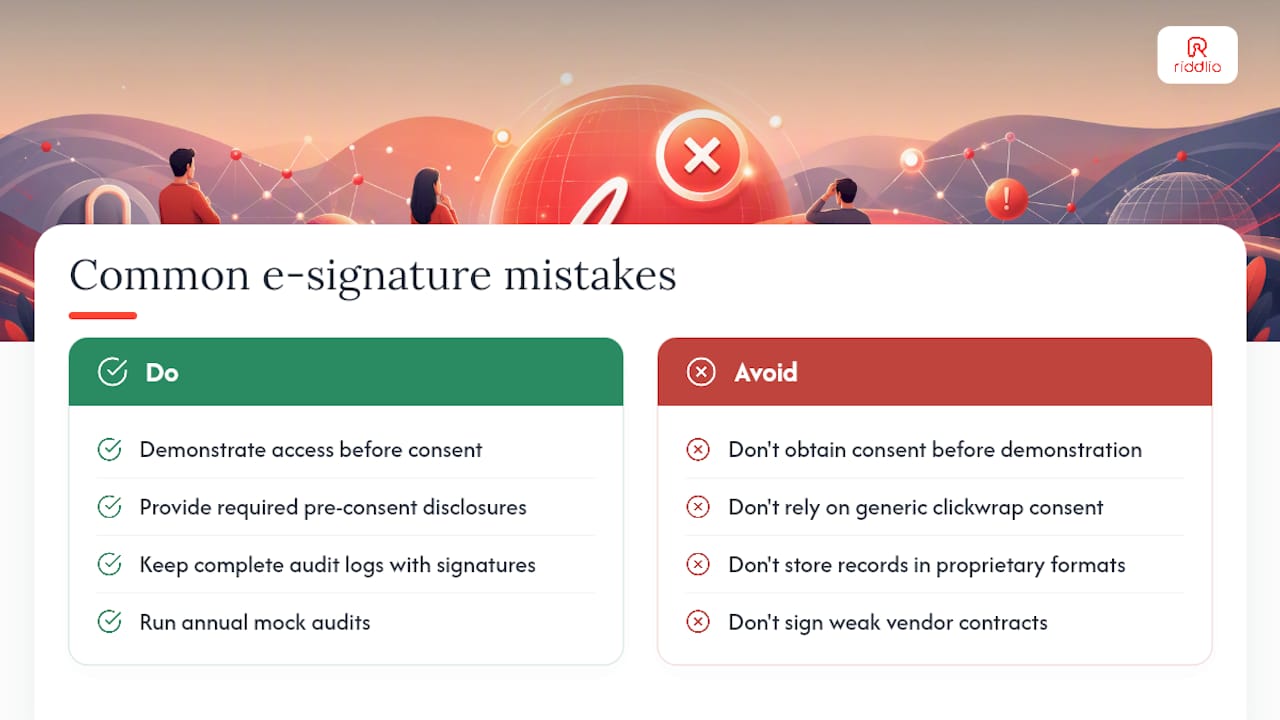
Skipping the consent demonstration step. Businesses frequently obtain a consumer’s agreement to receive electronic disclosures without first demonstrating that the consumer can actually access them. The Federal Reserve Bank of Minneapolis is explicit: the demonstration must precede consent, not follow it. A consent obtained without a prior demonstration step is defective under E-SIGN.
Treating clickwrap as informed consent. A checkbox labelled “I agree to receive electronic documents” is not sufficient on its own. E-SIGN requires that the consumer receive specific disclosures about their rights before consenting. Many businesses embed the consent in a general terms-of-service acceptance without providing those disclosures separately. Courts have found such consents inadequate.
Poor record retention. Purdue Global Law School’s practice note identifies inadequate retention as one of the two most common implementation failures. Files stored in proprietary formats, on vendor platforms with no export capability, or without documented retention periods create gaps that are impossible to close after the fact.
Inadequate audit logs. Storing the signed PDF without the accompanying audit trail is the single most common evidentiary problem. The PDF proves a document exists; the audit trail proves who signed it, when, and how. Without the trail, attribution challenges are very difficult to answer.
Weak vendor contracts. Businesses often sign vendor agreements that contain no commitments about record integrity, no migration obligations, and no indemnities for data loss. When a vendor changes its platform or is acquired, records stored in proprietary formats can become inaccessible. The FDIC’s examination guidance specifically flags vendor software upgrades as a compliance risk.
Pro Tip: Run a mock audit annually: pull a random sample of signed records, attempt to reproduce them in their original form, verify the audit trail exports correctly, and confirm the consent records are stored alongside the signed documents. Gaps found in a mock audit are fixable; gaps found by an examiner are not.
The Mayer Brown analysis puts the intent-demonstration failure at the top of the list: e-signature flows must include an affirmative, opt-in act and a clear option to decline or request paper. Flows that make declining difficult or that bury the paper-option disclosure in fine print are the ones most likely to be challenged successfully.
How do international agreements affect cross-border electronic signatures?
When a contract involves parties in different countries, U.S. electronic signature law does not automatically govern. The enforceability of the signature depends on the law of the jurisdiction where enforcement is sought, and that jurisdiction’s rules may differ significantly from E-SIGN and UETA.
The European Union’s eIDAS Regulation (EU No 910/2014) creates a tiered signature framework: simple electronic signatures, advanced electronic signatures, and qualified electronic signatures (QES). A QES issued under eIDAS carries a legal presumption of validity across EU member states that a U.S. E-SIGN-compliant signature does not automatically receive. If a contract is likely to be enforced in an EU court, the signature method matters more than it would in a purely domestic U.S. transaction.
The United Nations Commission on International Trade Law (UNCITRAL) Model Law on Electronic Signatures provides a reference framework that many non-EU countries have adopted in some form, but adoption is uneven and the specific rules vary by country.
For cross-border contracts, the practical steps are straightforward. Identify the governing law clause in the contract and confirm it is enforceable in the relevant jurisdiction. Check whether the counterparty’s jurisdiction recognises the signature method being used. For high-value or high-risk cross-border transactions, consider using a cryptographic digital certificate issued by a trust service provider recognised in the counterparty’s jurisdiction. And involve local counsel in any jurisdiction where enforcement is a realistic possibility.
The U.S. has not ratified a bilateral or multilateral treaty that creates automatic mutual recognition of electronic signatures with other countries. Each cross-border transaction requires a jurisdiction-specific analysis.
Recent court cases clarifying electronic signature enforceability
U.S. courts have consistently upheld electronic signatures in commercial disputes, but the case law also illustrates exactly where weak processes fail.
In Sgouros v. TransUnion Corp. (7th Cir. 2016), the court found that a clickwrap agreement was unenforceable because the website design did not make clear to the user that clicking a button constituted agreement to the terms. The button’s label did not reference the terms, and the terms were not displayed in a way that a reasonable user would notice. The case is widely cited for the proposition that the visual and procedural design of a consent flow is legally material, not just the existence of a checkbox.
In Meyer v. Uber Technologies, Inc. (2d Cir. 2017), the Second Circuit upheld an arbitration clause in a mobile app because the sign-up screen displayed a notice that the user’s action constituted agreement to the terms, and a hyperlink to the terms was visible on the same screen. The contrast with Sgouros is instructive: conspicuous notice and a clear visual link to the terms are what distinguish an enforceable clickwrap from an unenforceable one.
Courts have also addressed authentication challenges. Where a party denies signing, courts look to the audit trail and authentication records. In several district court decisions involving DocuSign and Adobe Sign records, courts have admitted vendor-generated audit trail reports as business records under Federal Rule of Evidence 803(6), provided the offering party could establish the records were made in the ordinary course of business and the methodology was documented.
The consistent thread across recent decisions is that the process surrounding the signature matters as much as the signature itself. A well-documented consent flow and a complete audit trail have repeatedly been the deciding factors.
Limitations on electronic signature validity beyond common exceptions
Beyond the statutory exclusions, several contract types present practical enforceability challenges that practitioners encounter regularly.
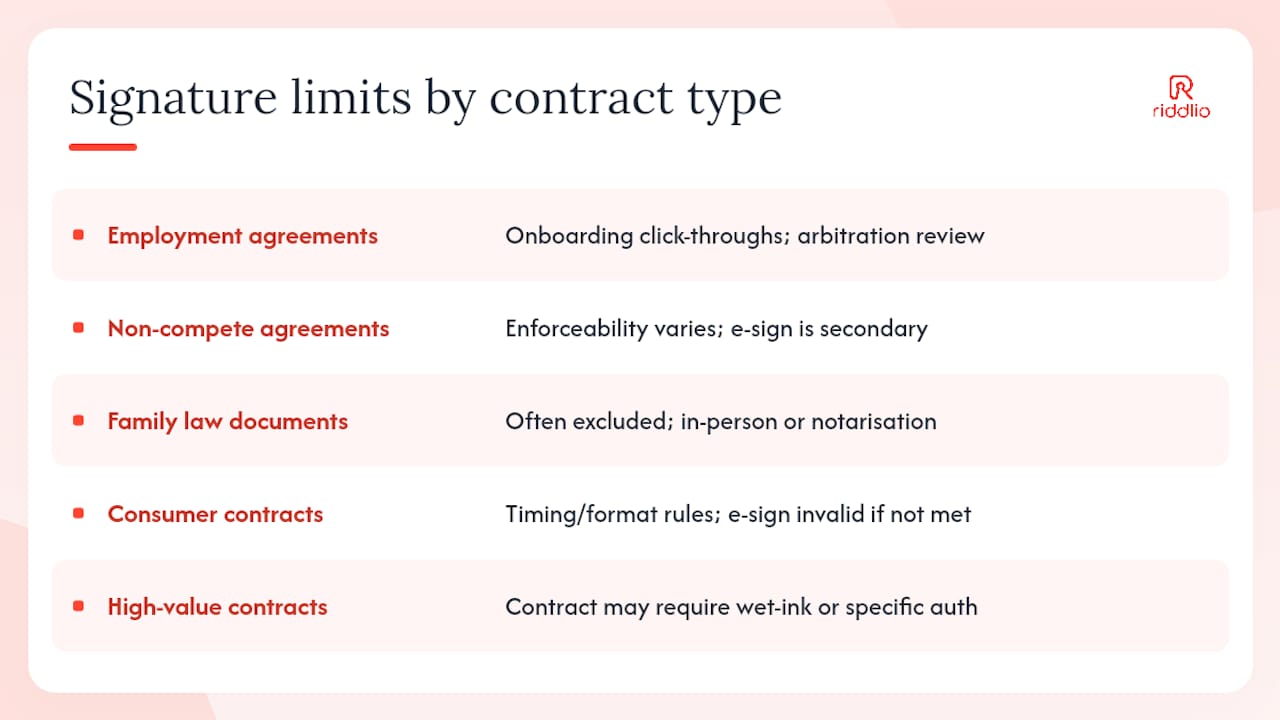
Employment agreements. E-SIGN and UETA apply to employment contracts, and courts have generally enforced electronically signed arbitration agreements and offer letters. The risk area is onboarding flows where multiple documents are presented in sequence and the employee clicks through without reading. Courts in some jurisdictions have scrutinised whether the employee had a meaningful opportunity to review the arbitration clause specifically, separate from the general employment terms. California courts have been particularly willing to find procedural unconscionability in onboarding flows that bury arbitration clauses.
Non-compete agreements. Enforceability of non-competes varies dramatically by state, and the electronic signature question is secondary to the substantive enforceability question. In states where non-competes are disfavoured (California, Minnesota, Oklahoma), a perfectly executed electronic signature does not save an otherwise unenforceable agreement.
Family law documents. Separation agreements, prenuptial agreements, and parenting plans are often excluded from E-SIGN coverage or subject to court-specific rules. Even where electronic signatures are technically permitted, family courts frequently require in-person execution or notarisation to protect parties from coercion claims.
Consumer contracts with mandatory disclosures. Contracts governed by the Truth in Lending Act, the Real Estate Settlement Procedures Act, or state consumer-protection statutes carry specific timing and format requirements for disclosures. An electronically signed contract that does not meet those timing requirements is defective regardless of the signature’s technical validity.
High-value commercial contracts. Sophisticated parties sometimes include provisions requiring wet-ink signatures or specific authentication methods. Where a contract specifies the form of signature required, that specification controls over E-SIGN’s general permissiveness.
The common thread is that electronic signature legality is a necessary but not sufficient condition for enforceability. The underlying substantive law of the contract type, the jurisdiction, and the specific consent and disclosure requirements all layer on top.
An editorial perspective on practical compliance posture
The legal framework for electronic signatures in the U.S. is genuinely well-constructed. E-SIGN and UETA together cover the vast majority of commercial transactions, the non-discrimination principle is clear, and courts have been consistent in upholding properly executed electronic signatures for over two decades.
What the framework does not do is protect businesses from their own process failures. The cases where electronic signatures fail are almost never about the technology. They are about consent flows that did not clearly communicate the right to paper, audit trails that were never exported before a vendor migration, and vendor contracts that contained no commitments about record integrity.
For venue operators and small businesses using digital waivers and booking agreements, the compliance posture should be conservative: treat every signed record as if it will be challenged in court, because occasionally it will be. Learn how to sell digital tickets and manage digital records easily to streamline your workflows. That means designing consent flows with the signer’s experience in mind, not just the legal minimum, and choosing platforms that give you ownership of your records rather than custody of them.
The practical advice is simple: involve counsel before deploying a new electronic signature workflow in a regulated context, document every vendor promise in writing, and run a records reproduction test before you need to rely on those records in a dispute.
Riddlio and electronic waivers for escape room venues

Escape room venues collect signed waivers from every player, and those waivers are electronic records subject to the same enforceability principles covered in this guide. Riddlio’s digital waiver management captures clear intent and consent at the point of booking, stores records in a reproducible format, and gives venue operators the audit trail they need if a waiver is ever challenged.
The escape room waiver software includes consent flow design that meets E-SIGN’s affirmative-consent standard, record retention controls, and exportable archives. For venues that want their booking and waiver workflows integrated into a single system, Riddlio’s online booking calendar connects the consent process directly to the booking record, creating a complete chain of evidence from reservation to signed waiver.
Sources
- Is Your Electronic Signature Valid? Validity and Other Key Considerations | Mayer Brown
- E-signatures: When they’re legal and best practices for implementation | ArentFox Schiff
- Congress
- X-3 The Electronic Signatures in Global and National Commerce Act (E‑Sign Act) | FDIC
- 15 U.S.C. § 7003 — Specific exceptions | US Code
- E‑Sign Act requirements | Federal Reserve Bank of Minneapolis
- 2000 OMB Guidance on Implementing the Electronic Signatures in Global and National Commerce Act | The White House
- 15 U.S. Code Chapter 96 — Electronic Signatures in Global and National Commerce | LII / Legal Information Institute
This article is general information, not a substitute for advice from a qualified lawyer. Consult a qualified legal professional about your own circumstances before acting on anything here.