Dynamic pricing rules are the automated logic that adjusts prices in real time based on demand, inventory levels, competitor moves and other market signals. The main payoff is better revenue per unit of inventory, whether that’s a hotel room, a retail SKU or an escape room time slot. A working system needs three things: clean data feeds, a rule engine to evaluate conditions, and guardrails that stop the automation from making a bad call at 2am.
TL;DR:
- Dynamic pricing systems should prioritize margin enforcement, with margin rules set above discount and competitor-matching rules to prevent margin erosion.
- Accurate, real-time cost data and a clear rule hierarchy are essential to avoid unintended price swings and maintain profitability during automation.
- Business-specific rule sets for escape rooms include peak premiums, off-peak discounts, group pricing, and last-minute offers, all requiring live occupancy data for effectiveness.
- Regular monitoring, testing, and reviews of rule performance are necessary to prevent overfitting, underpricing, and to ensure pricing strategies adapt to demand shifts.
- Transparent communication and legal compliance are critical, especially when using competitor or customer data, to avoid misuse and regulatory scrutiny.
Table of Contents
- Common methods and types of dynamic pricing
- How rule-based dynamic pricing works: inputs, evaluation flow and automation
- Concrete rule types: a practitioner’s catalogue
- Step-by-step implementation checklist for rule-based pricing
- Guardrails, ethics and legal considerations
- Measuring success: KPIs, experiments and observability
- Common pitfalls and best practices
- Applied example: dynamic pricing rules for escape rooms
- Executive recommendation and quick adoption checklist
- Why rule discipline beats clever algorithms
- Run your escape room’s pricing rules without the spreadsheet chaos
- Sources
Common methods and types of dynamic pricing
Every pricing engine, no matter the industry, runs on some combination of five approaches. Knowing which one fits your business is the first real decision you’ll make, and it usually determines everything downstream.
Demand and time-based pricing reacts to how full your calendar or warehouse is getting. An airline raises fares as a flight fills up. An escape room raises the price of a Saturday 7pm slot as bookings climb, then drops the Tuesday 2pm slot to fill it. This is the most common entry point for businesses new to dynamic pricing because the trigger (occupancy percentage, time to event) is easy to measure and easy to explain internally.
Competitor-based pricing tracks what similar businesses charge and adjusts to stay within a defined band, rather than matching exactly. Retailers do this constantly on marketplaces. It’s powerful, but it’s also where legal risk creeps in, which we’ll cover properly in the guardrails section.
Value and elasticity-based pricing segments customers by what they’re actually willing to pay, rather than treating every buyer the same. A business customer booking a corporate team-building session tolerates a different price point than a group of teenagers celebrating a birthday. Elasticity modelling estimates how sensitive each segment is to a price change, and demand forecasting techniques like the ones outlined in Harvard Business Review’s classic four-step framework still underpin most of this work today.
Bundle and group pricing rewards volume or combination purchases. Buy four movie tickets, get a discount. Book a group of eight for an escape room, unlock a lower per-head rate. This method works because it shifts the unit of analysis from “one booking” to “one transaction,” which changes the margin maths in your favour.
Special-event and surge pricing applies a temporary multiplier tied to a calendar event, whether that’s New Year’s Eve, a public holiday, or a local festival driving foot traffic. It’s the most visible form of dynamic pricing to the public, and the one most likely to generate a customer complaint if it’s not communicated well.
Applied by vertical, the differences show up fast:
- Travel and hospitality: heavy use of time-to-departure and occupancy triggers, refreshed multiple times a day.
- Retail and ecommerce: competitor-matching combined with inventory clearance rules, often refreshed hourly.
- Entertainment and experience venues: a blend of time-based, group, and event pricing, usually refreshed daily or weekly rather than by the minute, because the booking window is longer and the inventory (a room, a slot, a seat) is fixed.
The vertical you’re in dictates refresh frequency more than anything else. Airlines can reprice every few minutes because inventory turns over constantly. An escape room with eight time slots a day doesn’t need that cadence, and building it anyway just adds noise.
How rule-based dynamic pricing works: inputs, evaluation flow and automation
A pricing engine is only as good as what feeds it. Before you write a single rule, you need five categories of input flowing in reliably: your cost base (so you never price below what a unit costs to deliver), current inventory or slot availability, competitor price feeds where relevant, demand signals like booking velocity or search volume, and customer segment data for targeted offers.
Once the data’s flowing, the engine has to decide what to do when more than one rule applies to the same product or slot at the same time, and this is where most implementations get sloppy.
- Rules are evaluated by priority. Each rule you write gets a rank. A margin floor rule, for instance, typically outranks a promotional discount rule, because you never want a discount to push a price below cost.
- Each rule narrows a feasible price corridor. Rather than one rule simply overwriting the last, well-built engines treat every applicable rule as a constraint that shrinks the acceptable price range, from both the top and the bottom.
- The engine selects a final price inside that corridor, typically the value closest to the current price, to avoid unnecessary sticker shock between refresh cycles. This corridor-intersection logic is described clearly in documentation on rule engine mechanics, and it’s the single most useful mental model for anyone building or buying a pricing system.
- Fallback behaviour kicks in when rules conflict outright, for example, when a fixed-price rule and a percentage-discount rule both target the same product. The system needs an explicit tiebreaker, usually “most specific rule wins” or “highest priority wins,” configured in advance rather than discovered in production.
- Rounding and price presentation happen last, after the corridor logic has settled on a number. This matters more than it sounds. If rounding runs before margin checks, you can end up a few cents under your floor purely from a cosmetic adjustment.
- The final price integrates back into the booking or commerce system, which then displays it to the customer, applies it at checkout, and logs it for reporting.
Most rule engines let you group conditions using AND/OR logic, targeting by product, category, location, date range or even device type, a pattern common enough that it’s become close to a standard across dynamic pricing plugins and platforms. If you’re evaluating vendors or building in house, ask specifically how conflicting rules resolve. Vague answers here are a warning sign, because conflict resolution is exactly where pricing engines quietly cost businesses money.
The integration point with your booking or commerce system deserves its own line of scrutiny too. A pricing rule that lives beautifully in a spreadsheet but doesn’t sync in real time with what the customer sees at checkout is worse than no rule at all, because now your public price and your intended price disagree.
Concrete rule types: a practitioner’s catalogue
Here’s the working vocabulary you’ll need when configuring an actual engine, whether that’s an enterprise repricing platform or a booking system’s built-in pricing module.
- Fixed price rule: locks a price regardless of other signals, useful for loss leaders or contractually agreed rates.
- Price change limit: caps how much a price can move in a single cycle, expressed as a percentage or dollar amount, protecting customers from shock jumps.
- Price change rule: the core adjustment logic, a percentage or fixed amount applied when a trigger condition is met (occupancy above 70%, for example).
- Price match rule: automatically aligns your price with a named competitor or channel, within defined bounds.
- Sync prices rule: keeps prices consistent across multiple channels or listings, so your website and a third-party booking platform never disagree.
- Margin rule: enforces a minimum profit margin above cost, the single most important guardrail in the whole system.
- Price rounding rule: standardises the final displayed number, rounding to the nearest $5 or ending in $9, for psychological pricing.
- Price relations rule: maintains a fixed relationship between related products, so a premium slot always costs a defined amount more than a standard one.
Each of these needs specific parameters configured before it works. A margin rule needs an accurate cost column mapped for every product, which sounds obvious until you discover half your catalogue has never had true cost data attached to it. A price relations rule needs a clearly defined “anchor” product that others reference. A sync rule needs API access to every channel it’s meant to keep aligned, and if one channel’s feed lags, you’ll get a mismatch that customers notice before you do.
The order of execution matters as much as the rules themselves. Configuration guidance for margin and rounding rules consistently places rounding dead last in the sequence, after every other adjustment has been calculated, because rounding is a presentation step, not a pricing decision. Run it earlier and you risk a rounded price slipping under your margin floor by the exact amount you rounded down.
Price change limits and price match rules are the two most commonly misconfigured in practice. A limit set too tight makes your pricing feel sluggish and unresponsive to genuine demand spikes. A price match rule with no floor exception can walk your price straight through your margin, particularly if a competitor is running a loss-leading promotion you don’t know about.
Pro Tip: Set your margin rule’s priority above every other rule in the system, including promotions and price matching. If a discount or a competitor match would breach your floor, the margin rule should win every time, with no exceptions baked into the config.
Step-by-step implementation checklist for rule-based pricing
Rolling out dynamic pricing rules without a sequence is how businesses end up with angry customers and a spreadsheet full of unexplained price swings. Here’s the order that actually holds up.
- Audit your data readiness first. Confirm you have accurate, current cost data mapped to every product or slot, real-time inventory visibility, and a competitor feed if you’re planning any market-based rules. If cost data is patchy, fix that before writing a single rule.
- Define your KPIs and business goals before you touch the rule engine. Are you optimising for revenue per available slot, margin percentage, or occupancy? These goals sometimes pull in opposite directions, and deciding the priority order up front avoids arguments later.
- Author your rules in order of consequence, not convenience. Write margin floors and price change limits first, then layer demand-based and promotional rules on top, so the protective rules are already in place before anything customer-facing goes live.
- Set explicit priorities for every rule, so the corridor-intersection logic described earlier has a clear hierarchy to follow when two rules touch the same product at the same time.
- Test on a scoped grid before going live everywhere. Pick one product category, one location, or one time window, and run the full rule set against historical data to check for unexpected outputs.
- Run a canary experiment with real traffic on a small slice of inventory. Watching real customer behaviour against a small, contained test group catches problems that historical simulation misses, and structured pilot testing before a full rollout is standard practice for exactly this reason.
- Put operational guardrails and a change-control process in place before scaling up. Every rule change should be logged, timestamped and attributable to a person, not just pushed live from a dashboard on a whim.
Pro Tip: Run your canary test for at least one full booking cycle, not just a few days. A three-day test on a weekly booking pattern will catch weekday behaviour and completely miss what happens on the one day that actually drives your revenue.
Data mapping is the step most teams underestimate. If your cost basis is wrong for even 10% of your catalogue, every margin rule built on top of it inherits that error silently, and you won’t notice until finance asks why gross margin dropped despite prices going up.
Guardrails, ethics and legal considerations
Dynamic pricing has a perception problem before it has a technical one. Customers who discover they paid more than someone else for an identical product, minutes apart, tend to feel cheated even when the pricing logic was entirely reasonable. Transparency about why prices move, whether that’s through a simple “prices vary by demand” note or clearer messaging at checkout, goes a long way toward defusing that reaction.
The legal boundary matters more than most pricing teams realise. Any rule that reacts directly to competitor prices needs a clean line between “monitoring the public market and setting your own price independently” and “coordinating with a competitor,” because the second one is illegal. The Department of Justice’s antitrust guidance is unambiguous on this point: price-fixing and collusion carry serious legal consequences, and pricing algorithms that end up synchronised with a competitor’s, even unintentionally, have drawn regulatory scrutiny in other markets. Independent decision-making has to stay independent, and legal review of any competitor-reactive rule is worth the time it takes.
There’s a second, quieter risk around personal data. Pricing rules that segment by browsing history, device type or inferred willingness to pay can drift into discriminatory outcomes if you’re not deliberate about what data feeds the engine and why.
Practical controls worth building in from day one:
- Price floors on every product, tied to true cost, with no rule permitted to override them.
- Explicit exclusions for products or customer segments where dynamic pricing shouldn’t apply at all, such as accessibility bookings or contractually fixed rates.
- Audit logs on every price change, capturing which rule fired, when, and what the price was before and after.
- Regular reviews of pricing outcomes by customer segment, to catch unintended patterns before they become a complaint or a legal problem.
Measuring success: KPIs, experiments and observability
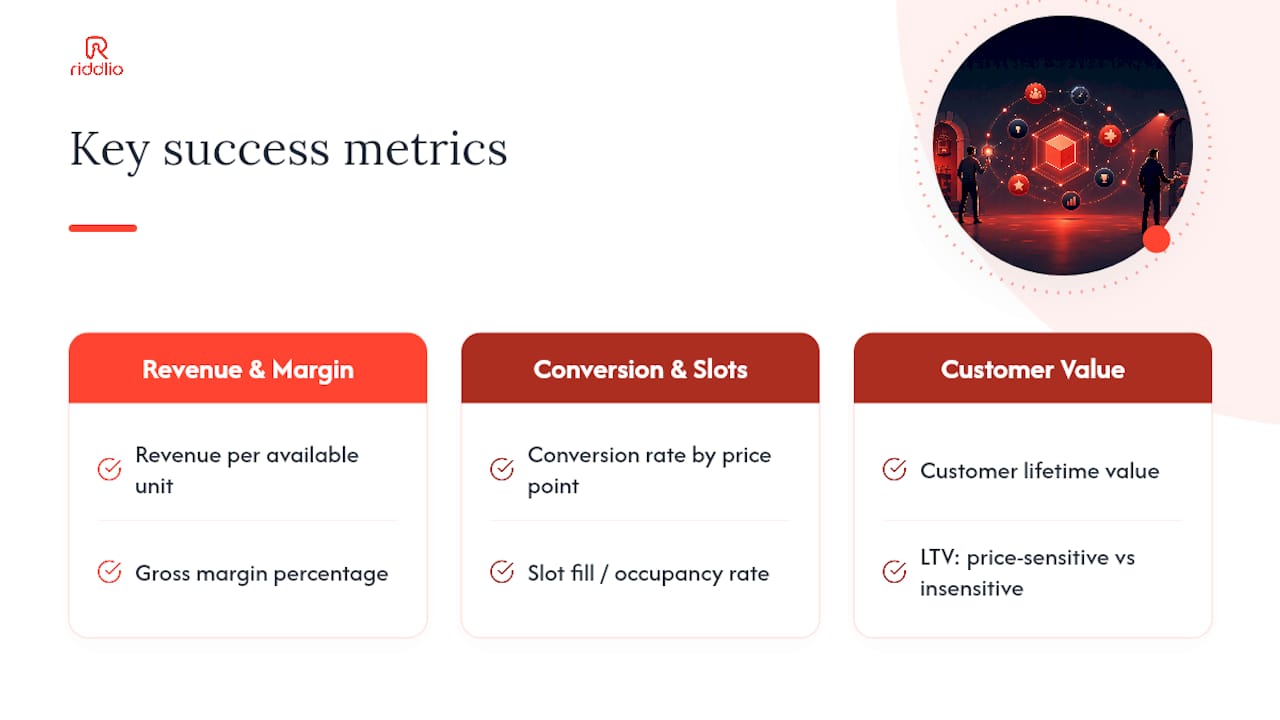
Five metrics tell you whether your rules are actually working: revenue per available unit, gross margin percentage, conversion rate at each price point, slot fill or occupancy rate, and customer lifetime value across price-sensitive versus price-insensitive segments. Watching revenue alone and ignoring margin is a common mistake. It’s entirely possible to grow revenue while quietly destroying margin if a discount rule fires too often.
Good experiment design borrows directly from established demand-forecasting practice. Classic forecasting methodology still holds up: define the market you’re forecasting for, estimate current demand accurately, build a model for how price affects that demand, and only then test a change against it. Skipping straight to “let’s just try a 10% increase and see” without a proper control group makes it impossible to know whether a revenue shift came from your price change or from something else entirely, like a seasonal spike.
Monitoring matters just as much as the initial test. Set alerts for anomalous price swings, sudden drops in conversion at a given price point, or a rule firing far more often than expected, with a clear rollback trigger defined in advance so nobody’s improvising a fix during a live incident.
Businesses that treat every price rejection as pure price sensitivity, rather than checking for genuinely high natural demand at that moment, tend to leave real revenue on the table during their busiest periods.
Elasticity estimates, once you have enough experiment data to trust them, should feed back into refining your rules rather than sitting in a report nobody reads. If a 5% price increase on your busiest slot barely moves conversion, that’s a strong signal you can push further next cycle.
Common pitfalls and best practices
The single most expensive mistake in dynamic pricing isn’t overpricing, it’s underpricing peak demand out of caution. A team nervous about customer backlash will often cap their busiest slot’s price well below what the market would actually bear, quietly leaving revenue on the table every single week that slot fills without complaint.
The second most common failure is overfitting rules to noisy short-term signals. A single unusually quiet Tuesday shouldn’t trigger a permanent discount rule, and a one-off demand spike shouldn’t lock in a permanent premium. Rules built on a week or two of data tend to chase noise rather than genuine patterns, and they need regular review against a longer baseline.
Failing to log and communicate price changes rounds out the top three. If a customer service team can’t explain why a price moved, that conversation goes badly, and if there’s no audit trail, diagnosing a pricing bug after the fact becomes guesswork.
A short best-practice checklist worth pinning above your desk:
- Start with one or two rules, not a fully loaded rule set, and expand once you trust the outputs.
- Keep a hard margin floor on every single rule, no exceptions.
- Require human review of any rule change above a defined price movement threshold.
- Revisit segmentation regularly, so pricing logic reflects who’s actually booking, not who booked six months ago.
Pro Tip: Review your highest-demand time slots specifically for underpricing at least once a quarter. If a slot has sold out every week for a month straight, that’s a pricing signal, not a scheduling coincidence.
Applied example: dynamic pricing rules for escape rooms
Escape room venues are a genuinely good test case for rule-based pricing, because inventory is fixed (a limited number of rooms, a limited number of daily slots), booking windows are relatively short, and demand swings hard between a quiet Tuesday afternoon and a fully booked Saturday night. Balancing perceived value against real operating cost matters more in experience-driven businesses than most retail categories, because a customer paying a premium for a Saturday slot expects the experience itself to feel worth it, not just the timing.
A practical rule set for a typical venue looks something like this:
- Peak premium rule: adds a percentage markup to Friday and Saturday evening slots once bookings cross a defined occupancy threshold.
- Off-peak discount rule: reduces weekday afternoon pricing to pull demand into slots that would otherwise sit empty.
- Group pricing rule: applies a per-head discount once a booking crosses six or eight players, encouraging larger bookings without discounting every transaction.
- Last-minute fill rule: drops the price on a slot still unbooked within 24 to 48 hours of the session, trading margin for occupancy rather than losing the revenue entirely.
None of these rules work well in isolation from real-time visibility into how full each room actually is. This is where an operational dashboard for dynamic pricing earns its place, giving venue operators a live view of occupancy against every active rule, so a peak premium rule can be tightened when a room is filling faster than expected, and a last-minute fill rule can trigger earlier when a quiet week starts showing a pattern.
Venues that get the most out of rule-based pricing tend to treat their rule set as a living document, reviewed monthly against actual booking data rather than set once and forgotten. Some operators also pair pricing changes with on-site promotional signage to reinforce group offers and last-minute deals, a tactic covered well in guidance on digital signage for venue promotions.

Executive recommendation and quick adoption checklist
Adopt dynamic pricing rules once you have reliable cost data, consistent booking or transaction volume to analyse, and enough margin sensitivity that a poorly timed discount would actually hurt. If any of those three are missing, fix the gap before automating anything.
Three moves to make this month: map your true cost data against every product or slot, scope a pilot to one category or time window, and write your margin floor and price change limit rules before any promotional logic goes live.
Delay adoption if your booking volume is too low to generate meaningful data, or if your team can’t commit to reviewing rule performance at least monthly. A pricing engine left unattended for months is a liability, not an asset.
Why rule discipline beats clever algorithms
The businesses that get dynamic pricing wrong aren’t usually the ones with bad rules. They’re the ones with no discipline around who can change a rule, when, and why. A margin floor is only useful if nothing can override it under pressure from a slow week, and that requires a human willing to say no to a tempting short-term discount.
Riddlio’s approach to this reflects a broader truth about pricing automation: the technology should narrow the decision space, not remove the decision-maker. Good rule engines make the obvious calls automatically and flag the judgment calls for a person, which is exactly the balance venues need when a room’s demand pattern shifts and nobody’s watching the dashboard that week.
— Iosif Beraru
Run your escape room’s pricing rules without the spreadsheet chaos
Building the rule set described above, peak premiums, off-peak discounts, group pricing, last-minute fill logic, is only half the job. The other half is keeping that logic in sync with your actual bookings, payments and calendar without juggling three disconnected tools.

Riddlio brings booking management, payment processing and real-time occupancy analytics into one operational view, so a peak premium rule and your live room availability are always looking at the same numbers. Operators can use such dashboards to spot quiet times early enough to trigger fill rules, or to adjust pricing as demand increases before slots sell out at previous rates. If you’re running an escape room and want to see how dynamic pricing works inside a system built specifically for activity venues, have a look at Riddlio’s dynamic pricing feature and book a walkthrough of how it fits your current booking flow.
Sources
- Dynamic pricing
- Dynamic Pricing
- Smart Dynamic Pricing
- Antitrust laws and you
- Four steps to forecast total market demand