What is a data retention policy and why does your venue need one?
A data retention policy is a formal, documented framework that specifies what data your venue collects, how long you keep it, and how you destroy it once it is no longer needed. For Australian escape room operators, this is not optional housekeeping. It sits at the intersection of obligations under the Australian Privacy Principles (APP), Australian Taxation Office record-keeping rules, and the Fair Work Act.
The data categories that matter most for your venue:
- Customer bookings and contact details — names, emails, phone numbers, booking history
- Payment records — transaction data, refunds, gift voucher redemptions
- Signed waivers — liability documents collected at check-in
- Staff payroll and employment records — pay slips, leave, superannuation, contracts
- Operational and GST records — invoices, receipts, financial summaries
The governing bodies you answer to are the Office of the Australian Information Commissioner (OAIC), the Australian Taxation Office (ATO), and the Fair Work Ombudsman. Each imposes different minimum periods and different triggers for when the clock starts.
Table of Contents
Australian legal requirements and best practices for data storage policies
Statutory retention periods
| Record type | Minimum period | Retention trigger |
|---|---|---|
| Business and GST records | 5 years | Date transaction completed |
| Employee records and pay slips | 7 years | Date record was created |
| Contracts (standard) | a variable retention period depending on contract terms | Date contract ends |
| Personal customer data (APP) | No fixed period | Destroy once no longer needed |
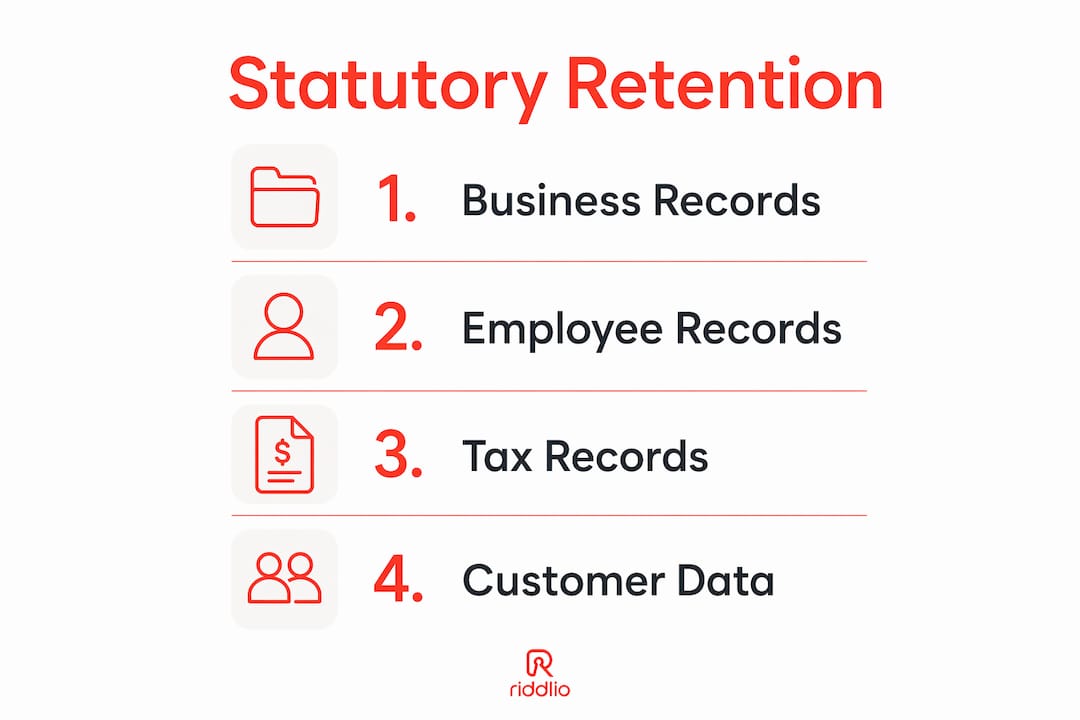
One common mistake: treating the ATO’s five-year rule as a blanket policy for everything. Employee records run to seven years from creation, and certain contracts can extend further. Misreading those different retention triggers risks either premature destruction or unnecessary over-retention.
Structuring your policy
The OAIC recommends a structured retention schedule that categorises data by type and assigns a specific retention period to each. Build yours around three columns: data category, retention period, and the legal or business justification for holding it. That justification column matters. APP 11.2 legally requires you to destroy or de-identify personal information once it no longer serves its original collection purpose, so documenting why you still hold data protects you during any regulatory review.
Over-retaining customer data is a genuine liability. Holding booking records or waiver details indefinitely because they might be useful for marketing does not satisfy APP 11.2. The legal mandate is data minimisation once the original purpose is spent.

Destruction and de-identification
Deleting a record from your active booking system is not enough. Total destruction means the data is unrecoverable across every storage point: cloud backups, third-party integrations, and archived files. Where you instruct a third-party provider to delete data, your policy must include a step to verify that deletion has actually occurred.
De-identification is a legitimate alternative where aggregate data still has operational value, such as booking trend analysis, provided re-identification risk is actively managed.
Auditing, access requests, and communicating the policy
Review your retention schedule at least annually, or whenever you add a new data category. Under the APP, customers can request access to their personal data or ask for it to be deleted. Your policy should specify a response process and a realistic timeframe, typically 30 days.
Communicate the policy to all staff who handle booking or payment data. Brief training at onboarding and a short annual refresh is enough for most venues.
Integrating your policy with your booking platform
A booking system like Riddlio centralises customer data, payment records, and waivers in one place, making it far easier to apply and audit retention rules consistently. Rather than chasing records across spreadsheets and email inboxes, you can manage data categories, flag records approaching their retention end date, and maintain a clear audit trail. Riddlio’s payment processing and booking tools also support the kind of structured data management that underpins a defensible, compliant retention policy.
Pro Tip: Treat your data retention policy as a living document. Review it whenever Australian privacy law changes or your venue adds a new data collection point, such as a self check-in kiosk or SMS reminder programme.
Non-compliance carries real consequences: the OAIC can investigate complaints, issue determinations, and refer serious breaches for civil penalty proceedings under the Privacy Act 1988.
Key takeaways
A compliant data retention policy for an Australian escape room venue combines statutory minimums from the ATO, Fair Work, and APP with documented business justifications and verified destruction procedures.
| Point | Details |
|---|---|
| ATO records: — | Business and GST records must be kept for 5 years from transaction completion. |
| Employee records: — | Fair Work requires payroll, leave, and employment records for 7 years from creation. |
| APP 11.2 destruction obligation | Personal customer data must be destroyed or de-identified once it no longer serves its collection purpose. |
| Destruction means all copies | Deletion from active systems is insufficient; backups and third-party storage must also be cleared and verified. |
| Centralise with booking software | Platforms like Riddlio make it easier to track, audit, and apply retention rules across all data categories. |