
Call tracking for an escape room means giving each marketing source its own phone number, so every call is logged with where it came from, then matching that call to the booking it produced. The tracking number only tells you who rang. The booking system tells you who paid. You need both halves joined, and the less of your revenue that depends on the phone, the less you have to track at all. That is the case for a booking platform that takes the reservation, the payment and the reminder online, with the phone as a backup channel.
This guide covers what call tracking does, how to connect calls to completed bookings, which numbers to buy first, how to handle missed calls, and what to check on call recording rules in the US.
TL;DR
- Call tracking assigns a unique phone number to each marketing source. Calls still ring your real line, but each one is logged with its source, time and duration.
- A call is only a lead until it becomes a booking. The value comes from matching the caller’s phone number to the booking record and sending that revenue back to your ad platform.
- Start with three numbers: your website, your Google Business Profile and your biggest offline channel.
- Every booking made online, paid up front and confirmed by SMS is a call you never have to answer, track or chase.
- Recording is legal under federal law with one party’s consent, but several states require everyone’s consent, so disclose at the start of every call.
Table of Contents
- What call tracking means for an escape room
- Why a call is not a booking
- How to connect calls to completed bookings, step by step
- Fewer calls to track: let the booking page do the work
- Handling missed calls
- Metrics worth watching
- Recording calls in the US: check the rules first
- Perspective
- Put the booking side in order with Riddlio
- FAQ
- Sources
What call tracking means for an escape room
Call tracking works by assigning unique phone numbers to marketing sources, so each inbound call is attributed to the campaign, keyword or channel that produced it. The call rings through to your team as normal. In the background the platform logs the source, the caller, the time and the duration, and it can record the conversation.
Two terms come up in every setup:
- Tracking number (service number): the number the customer dials. You print it on a flyer, show it on a Google ad or place it on your website.
- Answer number: the real phone that rings at your venue or on the manager’s mobile.
There are two kinds of tracking number. A static number is assigned to one source, such as your Google Business Profile. A pooled number rotates across website visitors, so each visitor session can be tied to a source. Dynamic number insertion works through a small script on your site that swaps the visible number depending on whether the visitor arrived from a paid ad, an organic search or a social post.
One limit matters for a small venue. Call tracking only records calls that come in on a tracking number. A guest who copies the number printed on your door, or a number saved in their phone from last year, bypasses it. Treat the data as a sample of your call sources, not a full census.
Why a call is not a booking
Most call tracking pages stop at the call. They show you that a paid search campaign produced 40 calls last month. For an escape room that is only half the answer, because:
- Some callers ask about opening hours and never book.
- Some book a six-person group at $40 a head, others a two-person slot.
- Some call, hang up, then book online an hour later.
The number that matters is revenue per source. One agency case study describes a closed loop: calls were tracked with channel, campaign and region, a live import matched each CRM booking to its original call using the customer’s phone number, and booking values went into Google Ads as offline conversions. The advertiser reported 22% growth in PPC quality leads and 61% higher return on ad spend in the first half of 2024 compared with the first half of 2023. That result belongs to that business, not a forecast for yours, but the mechanism is the useful part: the phone number is the key that links a call to a sale.
For that to work, your booking records need to carry the customer’s phone number, the booking value and a clean status (created, confirmed, cancelled). If bookings live in a spreadsheet, a paper diary or an inbox, there is nothing to match against.
How to connect calls to completed bookings, step by step
1. Decide what counts as the win
The primary conversion should be a completed booking with its value, not a visit to the booking page or a click on a “Book now” button. Phone calls from ads and from your website are secondary actions. Where it goes wrong: counting every click as a conversion makes a campaign look profitable when it is only generating curiosity.
2. Buy a small set of tracking numbers
One provider suggests most businesses start with three numbers: a website pool, one for the Google Business Profile and one for the biggest offline channel. For an escape room that usually means:
- A pool for the website, so paid and organic visitors are separated.
- A single number on your Google Business Profile, where many last-minute callers find you.
- A number for your biggest offline source: a corporate brochure, a hotel concierge card or a school flyer.
Pool size matters. Dynamic numbers need a paid pool sized to your traffic, and too few numbers can muddy attribution. Static numbers usually carry a per-number cost plus per-minute charges. Typical call tracking subscriptions are listed at anywhere from about $15 to over $425 per user per month, depending on provider and features, so check the current price list before you commit.
3. Install the snippet and set routing
Place the tracking script on the pages where people decide to call: the home page, the booking page, the contact page and any group or corporate landing page. Then build routing rules by business hours, source or location, so after-hours calls go to voicemail with a link to book online instead of ringing out.
4. Capture the click ID before the booking hand-off
If your booking widget lives on a different domain from your website, the ad click ID can be lost at the hand-off. One case study on an attraction booking flow found exactly this: the Google click ID was dropped when users were redirected to the booking page, which broke the link between ad click and sale. Capturing it on landing, carrying it into the booking URL and sending verified bookings back through the offline conversion route led to a 207% ROAS improvement for that business. For the web side of this, our guides on conversion tracking for bookings and server-side tracking for bookings walk through the setup, and UTM tracking covers the campaign tags.
5. Avoid double counting
Use one primary booking conversion. If you import the GA4 purchase event into Google Ads and also fire a Google Ads tag for the same booking, one sale is counted twice. The same guide recommends enhanced conversions, which send a hashed customer email to help match bookings to ad clicks when cookies are missing.
6. Match calls to bookings weekly
Export the call log, match each caller’s number to the booking list and note the revenue against the source. Do this weekly at first. After a month you will see which numbers produce paying groups and which produce only questions.
Fewer calls to track: let the booking page do the work
Call tracking is a way of measuring a channel that costs you staff time. Every call has to be answered, while the host is often mid-game, and every booking taken by phone has to be typed into a system, charged and confirmed by hand. The more you can move to online booking with payment at the time of reservation, the more of your revenue is attributed automatically, because the booking carries its own source, value and phone number.
That is how we see the job at Riddlio. Our platform brings bookings, availability, payments and customer communications into one place for escape room venues, so the booking record that your ad data needs already exists, complete, the moment a guest pays. The phone becomes the channel for questions and complex group enquiries, not the only way to get a slot.
If you want to improve the online path first, the 30 day audit for booking conversion rate is a good place to find the friction points, and the 90 day SEO sprint covers how guests find you in the first place.

Handling missed calls
A tracked call that goes unanswered is a lost lead you can at least see. Peak demand is evenings and weekends, which is exactly when your staff are running games. A sound missed-call routine has two parts:
- Instant text-back. When a call goes unanswered, send an SMS within moments with a link to your online booking calendar. The caller wanted a slot; give them the slot list.
- A task for a human. Route a notification to the manager so a group or corporate enquiry gets a personal call back, not just a link.
Treat the link as the main event. A caller who lands on a live calendar showing real availability can pick a time and pay in a couple of minutes, with no phone tag. Our online booking calendar shows availability for each room and group size, so the link answers the question the caller rang with.
Metrics worth watching
With calls and bookings in one view, a short list of numbers tells you most of what you need.
| Metric | What it tells you | What to do with it |
|---|---|---|
| Calls by source | Which channels make people pick up the phone | Move ad spend towards sources whose callers book |
| Call-to-booking rate | How many calls become paid bookings | If low, check your phone script and your online calendar |
| Missed calls by hour | When your team cannot answer | Add text-back, or extend online booking prompts at those hours |
| Booking value by source | Revenue, not just volume | Prioritise sources that bring larger groups |
| Repeat callers | Guests who call twice before booking | Look for unanswered questions on your booking page |
| No-show rate | Revenue lost after a booking is made | Tighten reminders and payment terms |
On no-shows, the fix sits in the booking system rather than the phone. Automated SMS reminders send the guest a message before their slot, and paying at booking changes how seriously people treat the time. Riddlio includes email and SMS reminders, payment management and reporting, so the same platform that takes the booking also shows how each source performs. See our page on SMS reminders for escape rooms for how reminders fit into the guest journey.
Recording calls in the US: check the rules first
Most call tracking tools can record calls, and recordings are useful for training your team and settling disputes. They also bring legal duties.
Under the federal Wiretap Act, one party’s consent is enough to record a call. That guide counts 38 states plus Washington, D.C. as following that standard and 12 states as requiring consent from every party, with state law governing any call where a participant is physically in that state. One state-by-state table lists California, Connecticut (phone calls), Florida, Illinois, Maryland, Massachusetts, Montana, New Hampshire, Pennsylvania and Washington as all-party states, and notes that Delaware and Nevada are disputed. Where the two parties sit in different states, the stricter rule is the safe one to follow.
California deserves special attention, because tourists and corporate groups ring from there. The California Invasion of Privacy Act can apply to communications involving California residents even when the other party is outside the state. A practical reading is that a venue in any state can pick up California rules when it records a California caller.
The working routine:
- Play a clear recording notice at the very start of every tracked call, before any conversation begins.
- Say what is recorded and why, for example for training and quality.
- Do not rely on a notice buried in your website terms.
- Keep recordings only as long as you need them.
Because rules differ by state and change, ask a lawyer licensed in your state to approve your notice wording and retention policy before you switch recording on.
Perspective
We built Riddlio around a simple observation: escape room revenue is decided in a few minutes, when a guest looks at a calendar and picks a slot. Whether that happens on a phone call or on a booking page, the venue needs to know where the guest came from and what they spent.
Call tracking is a good way to see the phone half of that picture. But a venue that runs bookings, payments, reminders and reporting from one platform sees the other half without extra tools or exports. Availability, group sizes and player numbers are already in the system, so there is less to reconcile and less to keep up with on a busy Saturday.
Our advice to operators is to make online booking the easiest route for a guest, keep the phone for the questions that need a person, and read the results in one place. That is what our platform is designed to do for escape rooms.
Iosif Beraru
Put the booking side in order with Riddlio
If your bookings sit in several places, start there: tracking numbers cannot attribute revenue that is recorded inconsistently. Riddlio is an online booking and business management platform for escape room venues, with online bookings, payments, email and SMS reminders, waivers, dynamic pricing, gift vouchers, analytics and integrations with payment providers and marketing tools. Plans are published on the pricing page: Starter is $29 per month, Pro is $79 per month and Unlimited is $199 per month, and Enterprise is priced on request.
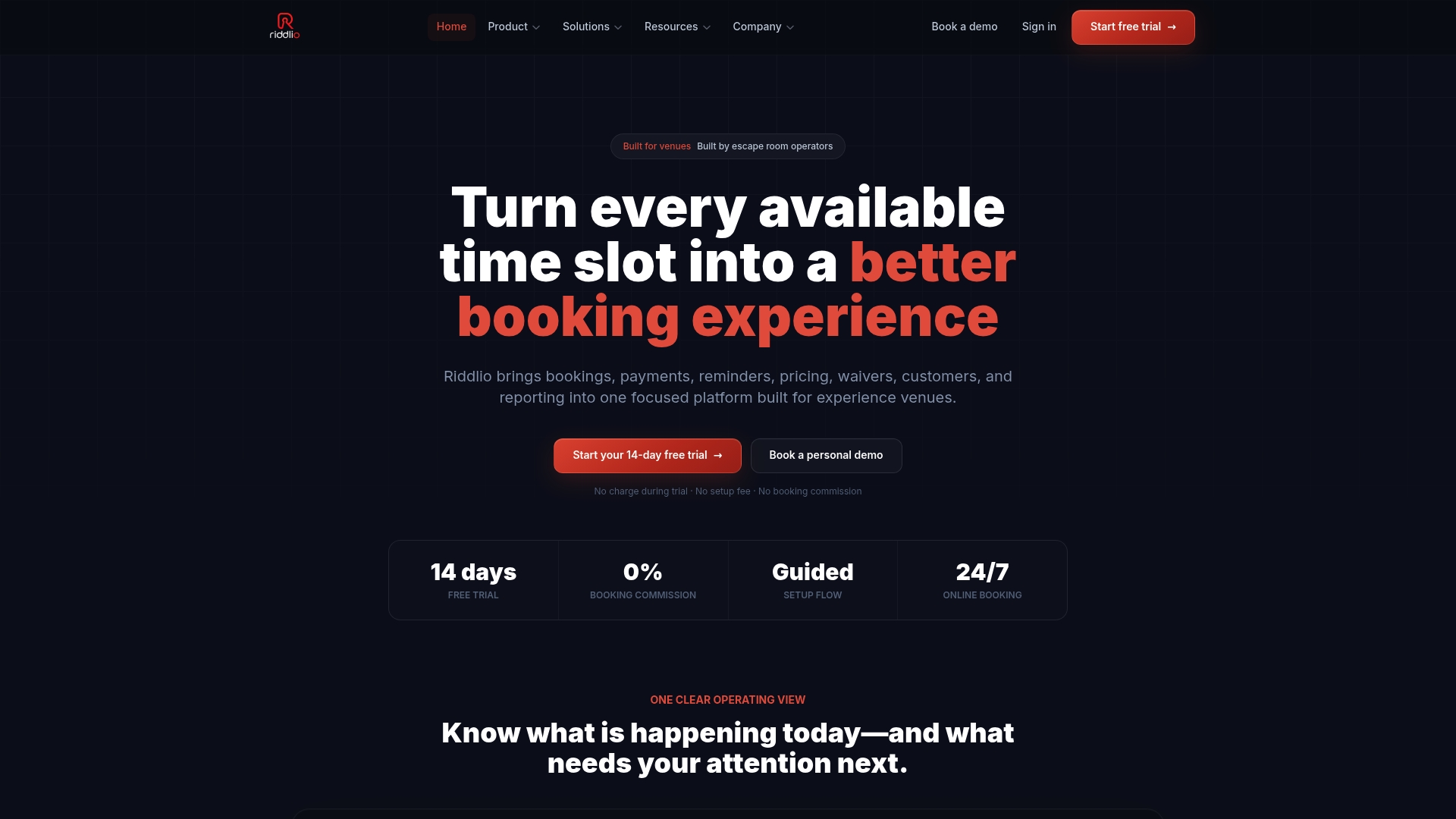
To see how it fits your rooms, look at our escape room booking software and escape room management software pages.
FAQ
What is a call tracking number?
It is a phone number assigned to one marketing source, such as a Google ad or your Business Profile. Calls to it are routed to your real business line, while the system logs the source, time and duration in the background. Numbers come in local and toll-free formats.
Do I need call tracking if most guests book online?
It is worth it if you pay for ads or local listings that show a phone number, because callers from those sources are otherwise invisible in your reports. If almost everything is booked online, your booking data already carries the source and value, and a small set of tracking numbers is enough to cover the remaining calls.
How many tracking numbers should an escape room start with?
Three is a sensible start: one pool for the website, one for your Google Business Profile and one for your largest offline channel. Add more only when you need to separate a specific campaign, and make sure the pool is large enough for your site traffic.
Can I record tracked calls?
Federal law needs one party’s consent, but a number of states require everyone on the call to agree. Play a disclosure at the start of each call and have a lawyer in your state review the wording. California rules can reach calls from California residents wherever you are based.
How do I link a phone call to a booking?
Match the caller’s phone number in your call log to the phone number on the booking record, then attribute the booking value to the call’s source. Ad platforms accept these matched bookings as offline conversions, so campaigns can be judged on revenue instead of call volume.
Sources
- What Is Call Tracking? How It Works, Explained
- What call tracking is, and what it needs to work
- CallRail Review 2026: The Ultimate Guide to Smarter Call Tracking
- Using Call Intelligence to Boost Leads and Maximize ROI
- Call Tracking Numbers: What They Are, How Many You Need
- Call tracking: What it is and how it works
- Call tracking setup and optimization guide
- How CausalFunnel Got A 207% ROAS Improvement
- Escape Room Conversion Tracking Guide (GA4, Google Ads)
- US Call Recording Laws: One-Party and Two-Party Consent
- Employee Monitoring Laws by State 2026
- Understanding the California Invasion of Privacy Act