
For Australian escape-room operators, Riddlio’s built-in dynamic pricing is the practical first choice: it combines governed pricing rules with native booking and payment integration in a single platform purpose-built for venue management.
Three things make it worth shortlisting immediately. First, it enforces floor prices and maximum caps so automated recommendations never violate your margins. Second, pricing changes live inside the same system handling your bookings, payments, and SMS reminders, so there is no data lag between a price update and what a customer sees at checkout. Third, it is available to Australian venues with local payment support and onboarding assistance.
Any viable pricing solution for an escape room should cover:
- Peak and off-peak scheduling — different price bands by day, time, and session
- Group pricing rules — automatic adjustments for larger party sizes
- Floor and cap controls — hard limits the system cannot breach
- Calendar overrides — manual rules for school holidays, local events, and promotional blackouts
- Booking integration — prices update in the live booking calendar, not a separate tool
Dynamic pricing in the entertainment sector can shift revenue meaningfully. Research from Beyond Pricing shows that platforms combining demand forecasts with real-time signals move pricing from reactive manual updates to a proactive revenue-management function, capturing demand and protecting margins simultaneously.
Table of Contents
- What dynamic pricing features does Riddlio give escape-room operators?
- Why dynamic pricing is revenue management, not just raising prices
- What should you require from any dynamic-pricing vendor?
- How to roll out dynamic pricing safely at your venue
- Pricing models, costs, and ROI for Australian escape rooms
- Key takeaways
- The case for pricing that knows your venue
- Riddlio gives you pricing that works from day one
What dynamic pricing features does Riddlio give escape-room operators?
Riddlio’s escape room booking system treats pricing as part of operations, not a separate module bolted on afterwards. That distinction matters when you are managing multiple game rooms, variable group sizes, and a booking calendar that changes daily.

| Feature | What it does for your venue | Outcome to expect |
|---|---|---|
| Peak/off-peak schedules | Sets higher rates for Friday nights and weekends, lower rates for Tuesday afternoons | Fills slow sessions without discounting peak demand |
| Group pricing rules | Adjusts per-person price automatically based on party size | Captures group bookings without manual negotiation |
| Floor and cap controls | Hard minimum and maximum prices the system cannot breach | Protects margins and brand perception at all times |
| Calendar-level overrides | Manual rules for school holidays, local events, and promotional periods | Keeps pricing correct during local context the algorithm cannot predict |
| Booking and payment integration | Price changes reflect instantly in the live calendar and at checkout | No lag between a pricing decision and what customers see |
| Automated reminders | SMS and email reminders tied to confirmed bookings | Reduces no-shows, which directly affects effective revenue per slot |
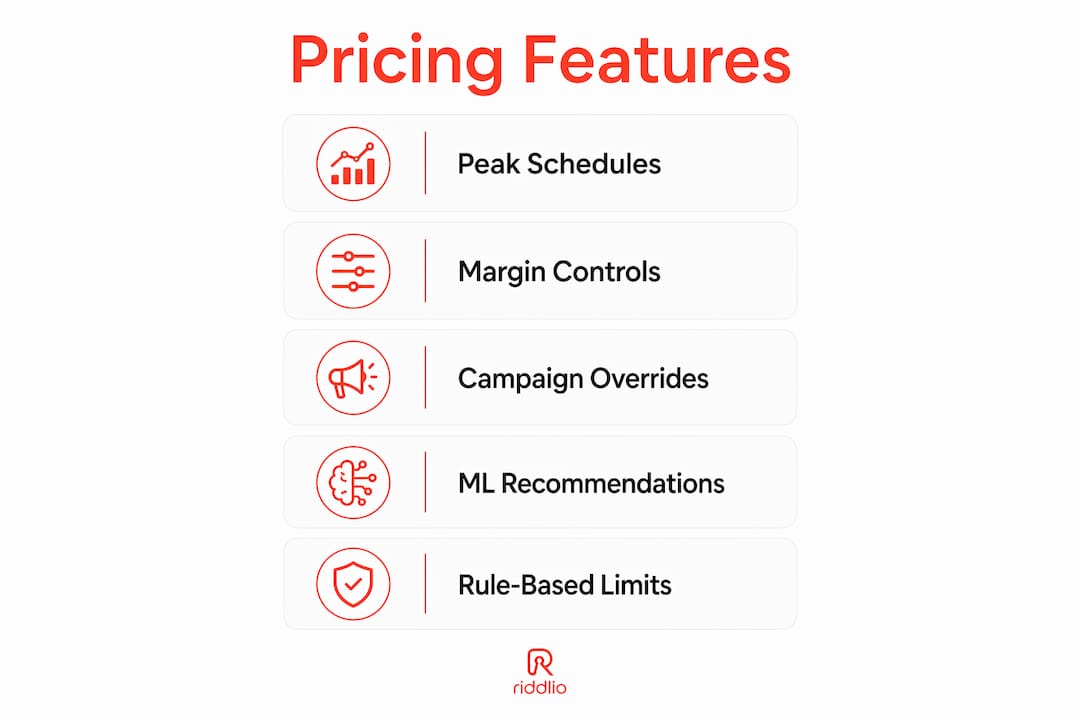
The governed pricing architecture matters here. Modern pricing platforms let operators set margin thresholds and competitive boundaries that automated recommendations cannot violate. Riddlio applies this same principle: the system surfaces recommendations, but your floor and cap rules always win.
Pro Tip: During local events like a city festival or school holiday period, layer a manual campaign override on top of your automated schedule. Automated rules handle the baseline; the override captures the spike without you needing to touch the system daily.
Hybrid architectures that mix rules-based constraints with machine learning recommendations produce explainable, fast pricing that operations teams can actually audit. That explainability is what lets you confidently show a price change to a customer who asks why Friday costs more than Tuesday.
Why dynamic pricing is revenue management, not just raising prices
The framing matters. Dynamic pricing is not about charging the maximum possible rate. It is about capturing the right price at the right time, filling sessions that otherwise have plenty of open spots, and protecting your margins when demand is genuinely high.
Platforms that combine demand forecasts, search behaviour, and inventory signals shift pricing from a monthly spreadsheet exercise into something that responds to what is actually happening in your booking calendar. For a small Australian venue running four game rooms, that responsiveness is the difference between a Tuesday night with many empty seats and one that sees noticeably higher booking because the off-peak rate was attractive enough to pull forward demand.
A simple illustration: if your standard Friday rate is set and you add a small peak evening increment across multiple bookings per month, that is an incremental revenue gain from one rule. Add a discount on Tuesday sessions that lifts occupancy meaningfully, and you recover the lost margin through volume. Neither change requires a pricing analyst. It requires a system with the right controls.
Customer perception is the other side of this. Transparency in the booking flow, showing customers why a price varies, keeps trust intact. Dynamic ticket pricing for live events has demonstrated this across the entertainment sector: clear communication about demand-based pricing reduces friction far more than hiding the variation.
What should you require from any dynamic-pricing vendor?
The non-negotiables are governed pricing rules, native booking integration, compatible payment processing, and local support. Everything else is secondary.
Checklist for vendor demos:
- Can you set a hard floor price and a hard cap that the algorithm cannot override?
- What data does the system use to generate recommendations — booking history, session fill rates, time-to-event?
- How do you apply a manual override for a specific date or event without disabling the automated rules?
- Does the reporting show revenue per slot, occupancy rate, and average booking value separately?
- Can you simulate outcomes before publishing a pricing change live?
- What is the onboarding timeline, and is there local support available in Australia?
- Can you export pricing history and booking data in a standard format?
Red flags to watch for:
- No floor or cap controls — the system can price below cost or above brand tolerance
- Per-booking fees that scale with volume, making costs unpredictable as you grow
- No support for Australian payment processors (Stripe, Square, or equivalent)
- Black-box recommendations with no explanation of why a price was suggested
- No trial period or simulation mode before going live
AI-generated price guidance needs business-defined policies to produce consistent, margin-protecting outcomes. Any vendor that cannot show you where those policies live in their system is a risk.
How to roll out dynamic pricing safely at your venue
A safe rollout follows four phases: data preparation, pilot, scale, and review.
Phase 1: Data preparation (weeks 1–2)
Clean your booking history before enabling any automated optimisation. Normalise booking records, flag outliers such as staff test bookings or complimentary entries, and confirm that ticket types are named consistently across your calendar. Poor data produces poor recommendations.
Sync your booking calendar, confirm your payment processing integration is active, and set your promotional blackout dates so the system does not discount during periods you have already priced manually.
Phase 2: Pilot on one or two game rooms (weeks 3–8)
Start with a single game room or a low-risk session type. Set your floor and cap, enable peak/off-peak rules, and let the system run. Monitor occupancy rate, average booking value, and no-show rate weekly. Do not expand until these metrics stabilise.
Phase 3: Scale to full venue (weeks 9–12)
Once the pilot shows consistent uplift and no customer complaints about pricing transparency, apply the same rule set to remaining rooms. Add group pricing rules at this stage.
Phase 4: Ongoing review (monthly)
Review pricing rules monthly against your booking data. Adjust floors and caps seasonally, and update calendar overrides for upcoming local events.
| Phase | Timeline | Key action |
|---|---|---|
| Data preparation | Weeks 1–2 | Clean records, sync calendar, set blackout dates |
| Pilot | Weeks 3–8 | One room, floor/cap rules, weekly KPI review |
| Scale | Weeks 9–12 | Full venue, add group pricing |
| Review | Monthly | Seasonal rule updates, event overrides |
Pro Tip: Run your pilot for at least 4–8 weeks before drawing conclusions. Shorter windows pick up seasonal noise rather than genuine pricing signal, and you will make the wrong call on whether the rules are working.
Pricing models, costs, and ROI for Australian escape rooms
Pricing software comes in three shapes: flat monthly subscription, per-booking fee, and revenue share. For escape-room venues, a flat monthly model is almost always simpler to budget and more predictable as booking volume grows.
| Pricing model | Cost driver | Risk for venues |
|---|---|---|
| Flat monthly subscription | Fixed fee regardless of bookings | Predictable; cost does not scale with revenue |
| Per-booking fee | Scales with volume | Costs rise as you succeed; erodes uplift gains |
| Revenue share | Percentage of incremental revenue | Vendor incentive aligned, but hard to audit |
Riddlio uses a flat monthly subscription model with no per-booking fees, which means the cost of dynamic pricing does not increase as your booking volume grows.
A worked example for a small Australian venue with a typical number of bookings and average price shows that modest uplifts from better pricing can add meaningful incremental revenue, often covering software costs quickly after a successful pilot.
Australian venues should confirm that their chosen platform supports GST-inclusive pricing display and integrates with local processors. Riddlio supports Stripe, Square, and PayPal natively, which covers the most common payment setups for Australian entertainment venues.
Key takeaways
For Australian escape-room operators, governed dynamic pricing integrated with your booking system is the fastest path to measurable revenue uplift without operational risk.
| Point | Details |
|---|---|
| Governed rules are non-negotiable | Any platform you choose must support hard floor and cap controls the algorithm cannot override. |
| Integration beats standalone tools | Pricing that lives inside your booking system updates in real time at checkout, removing data lag. |
| Clean data before you launch | Normalise booking records and remove outliers before enabling automated recommendations. |
| Pilot for 4–8 weeks minimum | Short pilots pick up seasonal noise; a longer window gives you reliable signal on what is working. |
| Riddlio is built for this | Riddlio bundles governed dynamic pricing, booking, payments, and reminders in one escape-room-specific platform. |
The case for pricing that knows your venue
Most operators who come to dynamic pricing are already leaving money on the table, not because they are pricing badly, but because they are pricing statically. A flat rate for every Friday night treats a sold-out Halloween session the same as a quiet Friday in February. That is not a pricing strategy; it is a default.
What I find operators underestimate is how much of the gain comes from the off-peak side, not the peak side. Raising Friday night rates by $3 feels good. But filling a Tuesday session that was running at 40% capacity, at a $5 discount, often generates more total revenue because the room was going to sit empty anyway. The math on an empty room is always zero.
The other thing worth saying plainly: AI pricing tools do not replace your judgment. They supply objective, data-backed recommendations that remove spreadsheet errors and subjective bias. You still set the floor, the cap, and the override rules. The system works within the boundaries you define. That is not a limitation; it is the design.
Venues that treat dynamic pricing as a set-and-forget feature tend to get mediocre results. Venues that review their rules monthly, update overrides for local events, and run proper pilots get the uplift the technology actually promises.
Riddlio gives you pricing that works from day one
Escape-room operators who want booking, payments, reminders, and governed dynamic pricing in one place, without per-booking fees eating into their gains, have a clear option in Riddlio.

Riddlio is purpose-built for venues like yours: timed sessions, group bookings, variable demand, and the need to protect margins without a revenue analyst on staff. The platform handles peak and off-peak scheduling, group pricing rules, floor and cap controls, and automated SMS reminders that cut no-shows, all from a single dashboard.
Key reasons Australian operators choose Riddlio:
- Native integration with Stripe, Square, and PayPal for GST-compliant payment processing
- Governed pricing rules with hard floor and cap controls
- Flat monthly pricing with no per-booking fees
- Onboarding support and local availability for Australian venues
- All-in-one view: bookings, payments, analytics, and pricing in one system
Start a trial or book a demo to see how Riddlio’s dynamic pricing fits your venue’s booking calendar. If you want the full feature picture first, the escape room management software overview covers everything in one place.